You are waiting at a mainland Italian port with your suitcase—or your car loaded for a Sardinian holiday—when the ferry operator announces a delay. Strong winds and rough seas have disrupted the crossing. Will you lose your ticket? Can you board a later ship? And who pays if you have to stay overnight?
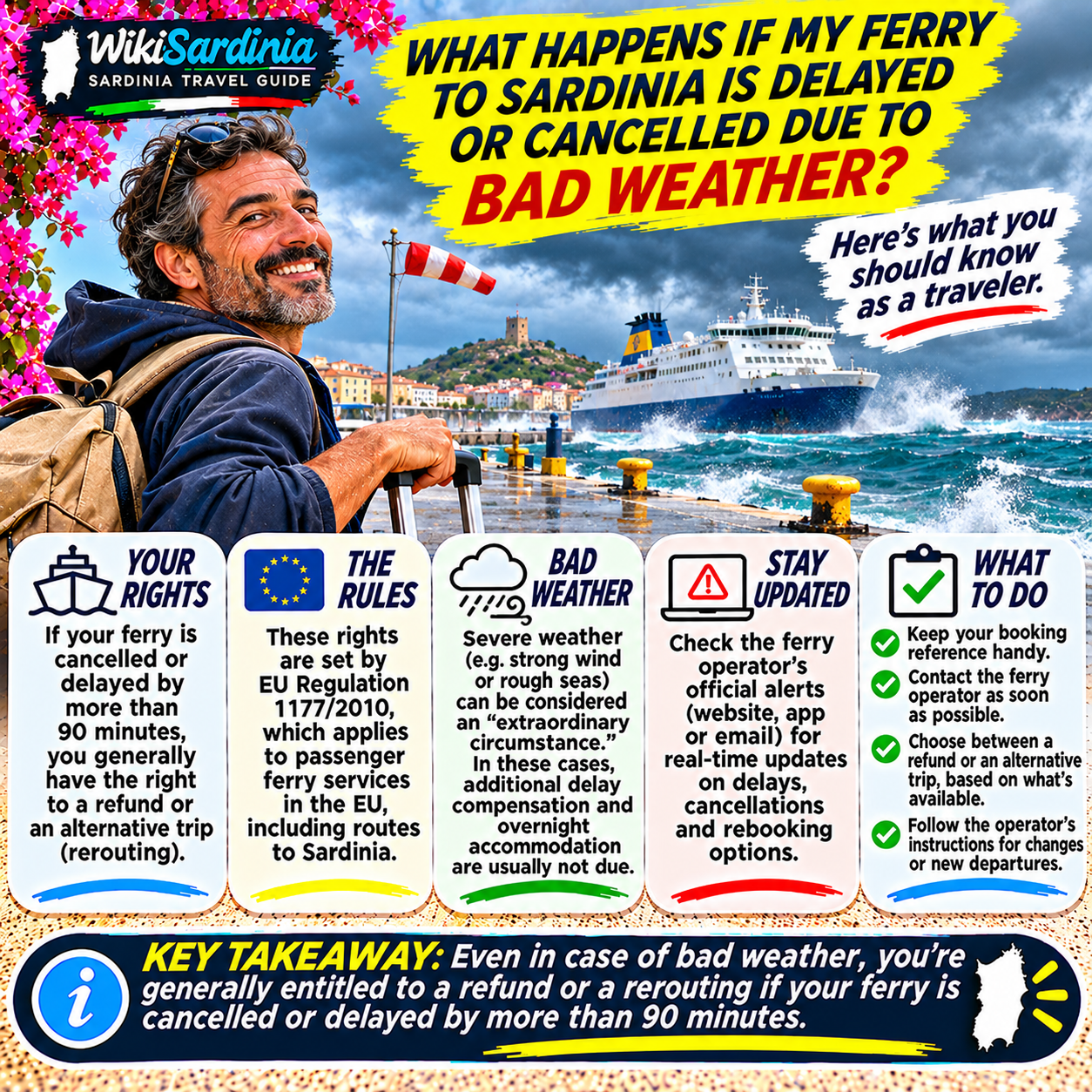
When a ferry to Sardinia is cancelled, or departure is delayed by more than 90 minutes, EU passenger-rights rules generally give you a choice between reimbursement and rerouting to your destination under comparable conditions at no additional cost. Bad weather can affect some additional entitlements, but it does not automatically remove this basic choice.
Why do ferries to Sardinia get cancelled?
Strong winds, high waves, difficult port conditions and other safety concerns can make a scheduled sailing unsafe. The captain and relevant authorities must prioritize safety over the timetable. Conditions may differ between routes, vessels and ports, so a ferry on one route may operate while another is postponed. Never assume a crossing is cancelled merely because the weather forecast looks bad: check the operator's actual service announcement.
What are my rights if the ferry is cancelled?
Under EU Regulation 1177/2010, a carrier that cancels a qualifying passenger ferry service must offer a choice between rerouting to the final destination under comparable conditions at the earliest opportunity and no additional cost, or reimbursement of the ticket price. Where relevant, reimbursement may also involve a free return to the initial departure point if the journey no longer serves its purpose. The regulation generally requires the reimbursement to be paid within seven days. These rules cover qualifying ferry services departing from Italian ports; specific exceptions to the regulation's scope can apply.
Official sources: Your Europe: ship passenger rights and Regulation (EU) No 1177/2010.
What if the departure is delayed instead?
If the carrier reasonably expects a qualifying ferry departure to be delayed by more than 90 minutes, it must generally offer the same choice between rerouting and reimbursement. For shorter delays, you may still be entitled to information about the disruption and the estimated departure and arrival times. The operator or terminal should provide information as soon as possible, and no later than 30 minutes after the scheduled departure where the regulation applies.
Does bad weather mean I get no refund?
No. This is an important distinction. Severe weather that endangers the safe operation of the ship can exempt the operator from paying certain additional compensation and providing overnight accommodation, but it does not automatically cancel the right to choose reimbursement or rerouting after a qualifying cancellation or long departure delay. Be cautious if someone says that every weather cancellation is simply 'non-refundable.' Ask the operator to explain the legal basis and the options offered.
Will I receive extra compensation for arriving late?
For eligible delays at the final destination, EU rules can provide compensation of 25% or 50% of the ticket price, depending on the scheduled crossing duration and length of delay. However, the carrier is not required to pay this arrival-delay compensation if it proves that weather conditions endangered the safe operation of the ship, or that qualifying extraordinary circumstances could not have been avoided despite reasonable measures. An ordinary late arrival is not automatically eligible for compensation, and the exemption must be assessed against the facts.
Will the ferry company pay for a hotel?
When a qualifying departure is cancelled or delayed for more than 90 minutes, the rules normally provide assistance such as refreshments where available or reasonably supplied, and necessary overnight accommodation and transport in eligible cases. The carrier may limit accommodation ashore to €80 per passenger per night for up to three nights. But overnight accommodation is not required when the cancellation or delay is caused by weather conditions that endanger the safe operation of the ship. If you must book a hotel yourself, ask the operator about its policy before spending money and check your travel insurance.
What happens if I am travelling with a car?
Contact the ferry operator and confirm whether a replacement sailing can accommodate both passengers and the booked vehicle. Do not assume that a new sailing has identical vehicle space, cabin availability or departure port. Keep the original ticket, vehicle details and booking reference. If the operator offers rerouting, ask for the revised booking in writing before driving to another port.
What if I booked a cabin or a return ticket?
Ask the operator how the disruption affects the cabin, passenger fares, vehicle booking and any linked return journey. The legal refund entitlement depends on the unused journey and, in some circumstances, portions already travelled that no longer serve the original plan. Do not cancel your booking through an ordinary voluntary-cancellation option without first understanding the operator's disruption procedure, as different terms may appear in the booking interface.
What about a missed hotel, tour or rental-car booking?
Ferry passenger-rights rules do not automatically require the ferry operator to reimburse every separately booked hotel night, tour or rental car affected by a weather disruption. Contact each provider promptly to ask about changes or refunds, and check whether your travel insurance covers the event and any exclusions. Keep written proof of the cancellation, as it may help with claims to insurers or other providers.
What should I do at the port?
First, verify the announcement using the ferry operator's official website, app, text messages, email or port staff. Keep your booking reference handy and ask whether the crossing is delayed, cancelled or being transferred to another departure. Request your options in writing, particularly if you need rerouting with a car or cabin. Save screenshots of notices, tickets, receipts and any messages about the cause of the disruption. If the port is crowded, follow staff instructions and do not leave the queue or vehicle holding area without checking the boarding arrangements.
How can I request a refund or make a complaint?
Use the carrier's official customer-service or passenger-rights channel. Under the EU regulation, complaints about rights under the regulation generally must be submitted within two months of the date on which the service was performed or should have been performed. The carrier must normally notify you within one month whether the complaint is substantiated, rejected or still being considered, and provide a final reply within two months of receiving it. Keep all supporting documents. If you are not satisfied, you can seek help from the competent national enforcement body or a European Consumer Centre where applicable.
How can I reduce disruption before travelling?
Monitor official sailing updates in the days before departure, especially during periods of strong wind or unsettled seas. Keep contact details current in the booking and allow some flexibility before time-sensitive connections. If you are travelling with children, pets or medication, keep essential supplies accessible rather than buried in the car. Consider travel insurance that explicitly covers the kinds of weather-related interruption relevant to your itinerary.
Useful Italian phrases
“Il traghetto è stato cancellato?” means “Has the ferry been cancelled?” “A che ora è prevista la partenza?” means “What time is departure expected?” “Posso avere un rimborso?” means “Can I get a refund?” “È possibile essere riprotetti su un'altra partenza?” means “Can I be rebooked on another sailing?” And “La nuova prenotazione include anche l'auto?” means “Does the new booking include the car too?”
The WikiSardinia takeaway
A ferry cancellation caused by bad weather does not mean your ticket is automatically lost. For qualifying sailings, EU Regulation 1177/2010 generally protects your choice of reimbursement or rerouting when a service is cancelled or departure is delayed by more than 90 minutes. Severe weather that makes sailing unsafe can exclude extra delay compensation and the duty to provide overnight accommodation. Check the operator's official updates, document the disruption and ask for your options before making alternative arrangements.