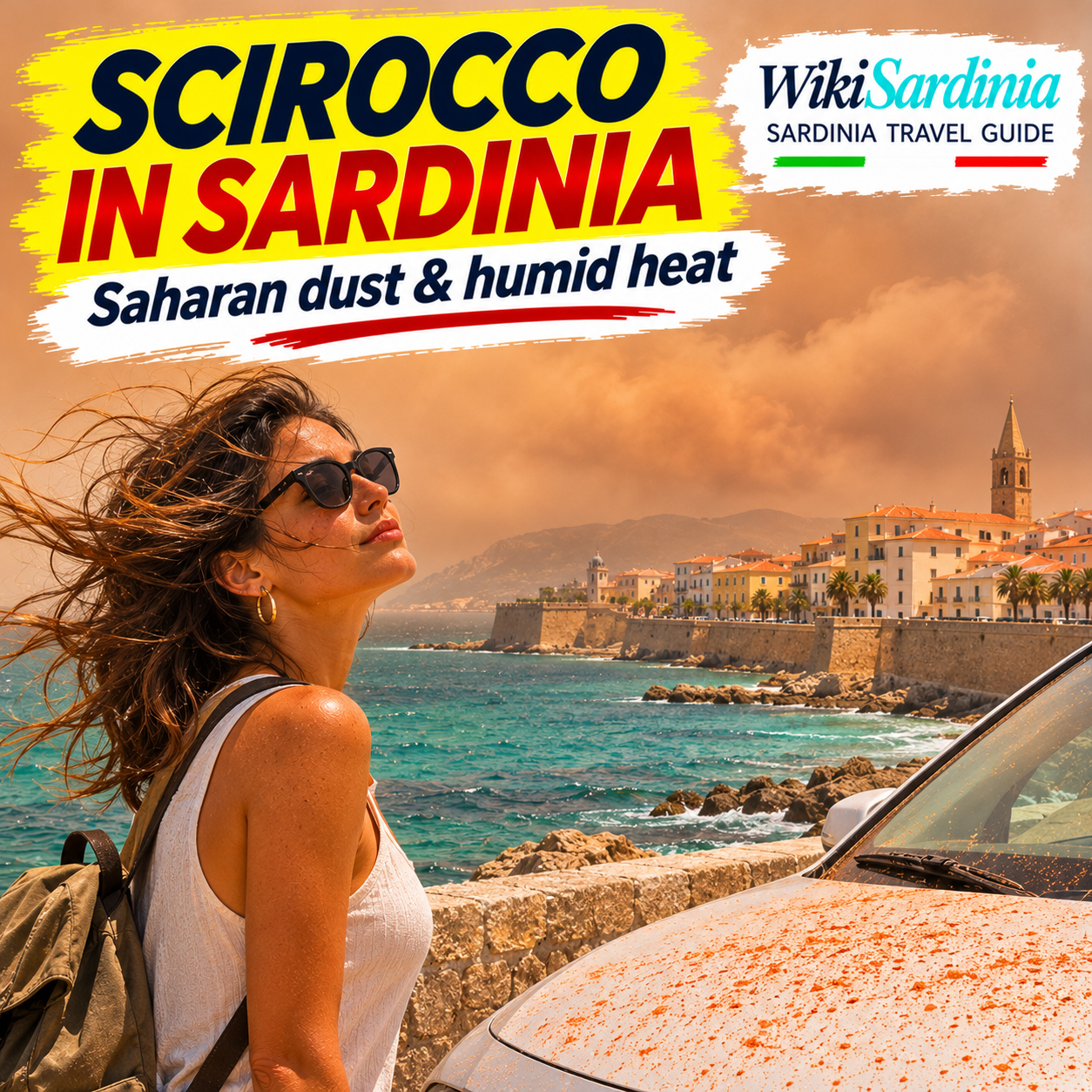
The Scirocco is a warm southerly to southeasterly wind that can reach Sardinia from North Africa, sometimes bringing Saharan mineral dust, hazy orange skies and oppressive humid heat. The key distinction is that the dust comes from desert surfaces, while much of the moisture is acquired as the air travels across the Mediterranean Sea. Not every Scirocco event is dusty, humid or equally strong.
What exactly is the Scirocco?
Scirocco (Italian: scirocco) is a Mediterranean wind associated with air moving northward from North Africa, often ahead of low-pressure systems. The UK Met Office describes it as hot and dry near the African coast but increasingly moist after crossing the Mediterranean. In Sardinia its local effects depend on wind direction, pressure patterns, season, coastline and terrain. A weather forecast showing southeasterly wind does not automatically mean a major dust storm.
Why does it carry red Saharan dust?
Strong winds over dry North African surfaces can lift fine mineral particles high into the atmosphere. Favorable circulation then transports them hundreds or thousands of kilometers over the Mediterranean. The reddish or orange appearance comes partly from iron-bearing mineral compounds, while haze and the scattering of sunlight can alter the apparent color of the sky. The airborne material is mainly fine dust rather than large grains of beach sand traveling all the way to Sardinia. Copernicus tracks these plumes with satellite observations and atmospheric forecasts.
Why does the Scirocco feel so humid?
Air arriving from the desert may initially be dry. As it passes over Mediterranean waters, evaporation can add water vapor to the lower atmosphere. When the warm air reaches Sardinia, humidity can make sweating less effective at cooling the body. This is why a day that looks merely warm on a thermometer may feel sticky and exhausting. However, humidity varies: some Scirocco episodes remain relatively dry, and inland areas can feel different from exposed coastal towns.
Does Scirocco always bring rain or orange mud?
No. If a dust plume coincides with rain, droplets can capture particles and leave orange-brown deposits on cars, terraces and windows after evaporation, commonly called pioggia di sabbia or muddy rain. Dust may also settle without rain. Conversely, Scirocco can bring cloud or rain without a dramatic dust event. Copernicus explains that both wet and dry deposition occur.
When does Scirocco occur in Sardinia?
It is not restricted to July and August. Southerly flows and Saharan dust outbreaks can occur across seasons; major European dust transport is particularly common in spring under favorable weather patterns. In summer, hot southerly air can intensify heat discomfort. For an actual trip, use the short-term forecast rather than assuming a fixed Scirocco season.
Which Sardinian beaches are affected?
Wind exposure depends on each beach's orientation, headlands and local topography. South- and southeast-facing coasts may experience onshore conditions during some southeasterly episodes, while other coves may be relatively sheltered. Offshore wind can also be dangerous, especially for inflatable toys, paddleboards and inexperienced swimmers. Do not rely on a simple north-versus-south rule: check the specific beach's wind, wave and swimming conditions, and obey lifeguard flags.
Is Saharan dust dangerous to breathe?
Elevated mineral dust can raise particulate concentrations, including PM10, and irritate eyes and airways. People with asthma or other respiratory sensitivities may be more affected. Copernicus documents the air-quality impact of Saharan dust in Europe. On a visibly dusty day, check official air-quality information, consider reducing strenuous outdoor exercise if pollution is elevated, and follow medical advice relevant to your health. An orange sky alone is not a quantitative air-quality measurement.
How can tourists check for Scirocco and dust?
Check wind direction and gust forecasts from a reliable meteorological service. For dust, use the Copernicus Atmosphere Monitoring Service (CAMS) and its dust forecasts; for local weather warnings consult ARPAS Sardegna and regional Civil Protection. A forecast of high Saharan dust aloft does not necessarily mean the same concentration at ground level. For outdoor plans, also check heat warnings, sea conditions and visibility.
What should you do during a strong Scirocco?
Carry water, take breaks in shade or air-conditioned places and avoid strenuous midday activity during hot, humid conditions. Secure loose balcony objects and beach umbrellas when gusts are strong. If dust is heavy, close windows when appropriate, protect your eyes and monitor air-quality guidance. For driving, reduce speed when visibility drops. Do not park under unstable trees or near exposed objects during severe gusts.
How should you clean Saharan dust off a rental car?
Do not rub dry dusty paint with a cloth: fine mineral particles may scratch the surface. Rinse with plenty of water first, then use suitable car-wash products. Avoid spraying abrasive dust directly into seals or sensitive equipment. If the vehicle is rented, check its cleaning conditions; ordinary weather-related dust should not be confused with damage, but specific rental policies vary.
Why does the sky sometimes turn yellow or orange?
Suspended particles scatter and absorb sunlight, changing the appearance of the sky and lowering visibility. Sunrise and sunset colors can become especially striking, but a colored sky can also have other causes. Confirm a Saharan dust event with meteorological or aerosol data rather than diagnosing it from photographs alone.
Is Scirocco the same as Mistral?
No. Scirocco is a warm southerly or southeasterly flow associated with North Africa. The Maestrale (Mistral) generally comes from the northwest and often brings a different, cooler and drier wind pattern. Both can create hazardous sea conditions, but their effects vary by coastline and weather situation.
Frequently asked questions
Does Scirocco come directly from the Sahara?
It is associated with southerly airflows from North Africa, but its precise trajectory and characteristics vary.
Why is the dust red?
Iron-bearing minerals contribute reddish tones; atmospheric light scattering also affects the sky's appearance.
Why is the air humid if it started over a desert?
Moisture can be picked up as air passes over the Mediterranean.
Does every Scirocco bring sand?
No. Dust transport requires favorable source and atmospheric conditions.
Can Scirocco cause muddy rain?
Yes, when precipitation washes airborne dust down to surfaces.
Is it safe to swim?
That depends on local wind, waves, currents and beach warnings, not just the wind's name.
Does Scirocco happen only in summer?
No. It can occur at different times of year.
How do I see a Saharan dust forecast?
Consult CAMS dust forecasts and local weather services, then check ground-level air quality separately.
The takeaway
Scirocco explains an unusual combination that visitors notice in Sardinia: warm southerly winds, occasionally red Saharan dust and, after crossing the sea, uncomfortable humidity. It is a normal Mediterranean weather phenomenon, not a permanent state of the island. Check wind, waves, heat and dust forecasts separately before choosing a beach or planning a long outdoor excursion.
Sources: UK Met Office — Winds of the world; Copernicus — Saharan dust explained; Copernicus — Desert dust Q&A; UK Met Office — Saharan dust; ARPAS — Sardinia weather.