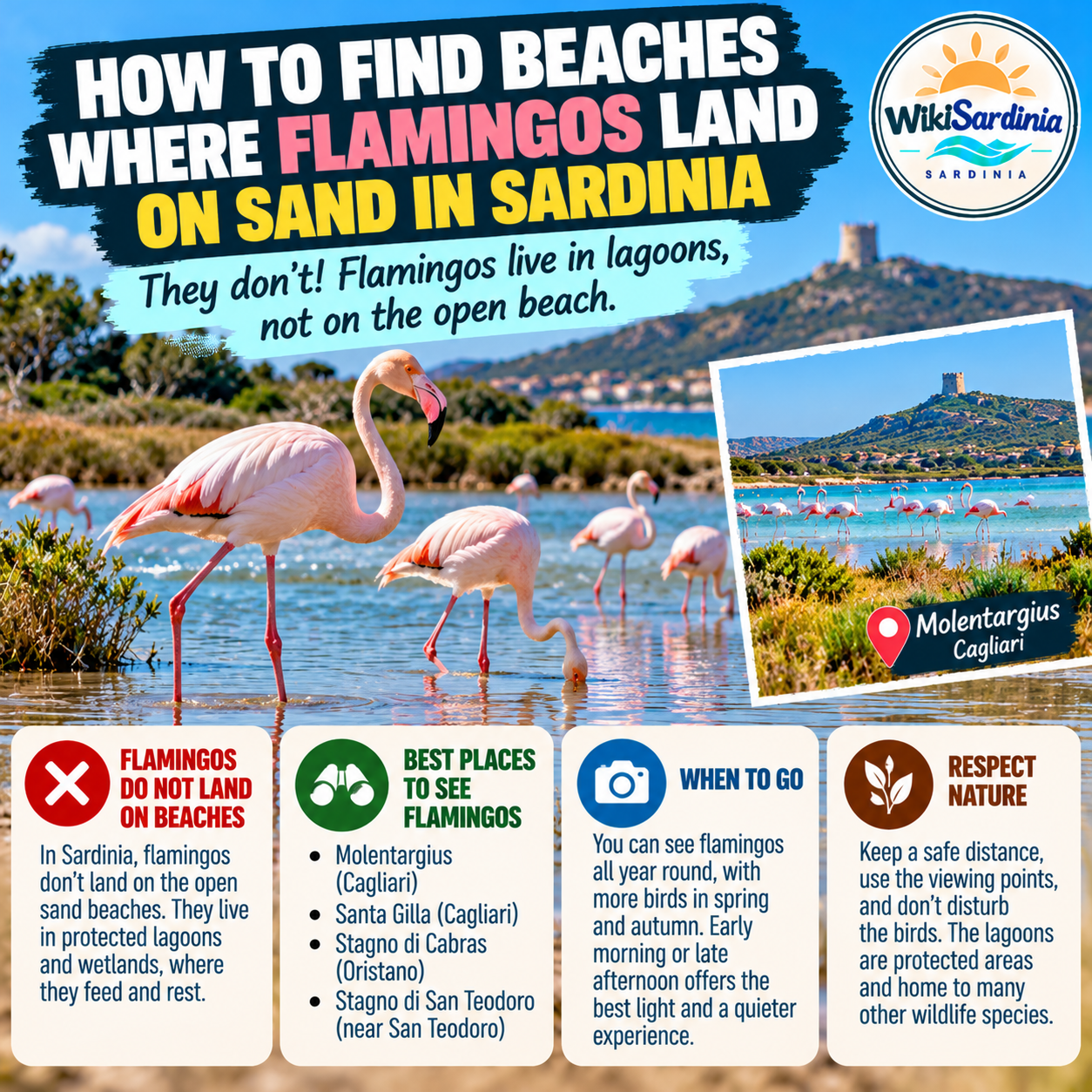
If you want to see pink flamingos in Sardinia, the best place to look is usually a shallow coastal lagoon or wetland, not the open sandy beach. Flamingos feed and rest in calm, shallow water where they can sift for small organisms. They may occasionally appear in different coastal settings, so it is too absolute to say they never visit a beach—but lagoons are the reliable habitat to seek out.
Where to see flamingos in Sardinia
Molentargius, near Cagliari
The Molentargius–Saline Regional Nature Park, between Cagliari and Quartu Sant’Elena, is one of Sardinia’s best-known places to observe flamingos. The wetlands and salt pans provide feeding and resting habitat, and birds can often be seen from permitted routes and viewing areas. Sightings vary with season, water conditions and the birds’ movements.
Santa Gilla lagoon, near Cagliari
The Santa Gilla lagoon system, west of Cagliari, is another important wetland for waterbirds, including flamingos. Because parts of the lagoon are environmentally sensitive or managed for specific uses, check which viewpoints and access routes are open to the public. Do not cross barriers or enter restricted shoreline areas to get closer.
Why flamingos prefer lagoons to open beaches
Flamingos are adapted to feeding in shallow, often saline or brackish water. They use their specialised bills to filter small food items from the water and sediment. Lagoons and salt pans can provide the right combination of shallow water, food and relatively undisturbed resting areas. An exposed sandy beach generally offers fewer of these feeding conditions.
When is the best time to look?
Flamingos may be present in Sardinia during different parts of the year, and their numbers and locations change. Early morning or late afternoon can offer pleasant light for watching and photography, but no particular time guarantees a sighting. Check current park information and local wildlife updates before travelling.
How to watch flamingos responsibly
- Stay on marked paths: use official trails and viewing points only.
- Keep your distance: use binoculars or a zoom lens rather than walking towards the birds.
- Never feed them: human food is not appropriate for wild birds.
- Keep dogs under control: follow park rules and leash requirements.
- Avoid loud noise and drones: disturbance can cause birds to take flight and waste energy.
- Respect closures: wetland access can be restricted to protect wildlife and habitats.
Can you see flamingos on the sand?
It is possible for birds to use different parts of a coastal landscape, but a sandy bathing beach is not the place to plan around if your goal is to see flamingos. Search for lagoons, salt pans and wetlands instead. In Sardinia, Molentargius and Santa Gilla are sensible starting points, provided you use areas that are officially accessible.
The best way to find them
For a good chance of seeing Sardinia’s flamingos, check the latest information from the Molentargius park or local nature authorities, then visit a permitted viewpoint around the wetlands. Be patient, bring binoculars and let the birds choose their own distance. The most memorable wildlife encounter is one that leaves the flamingos undisturbed.