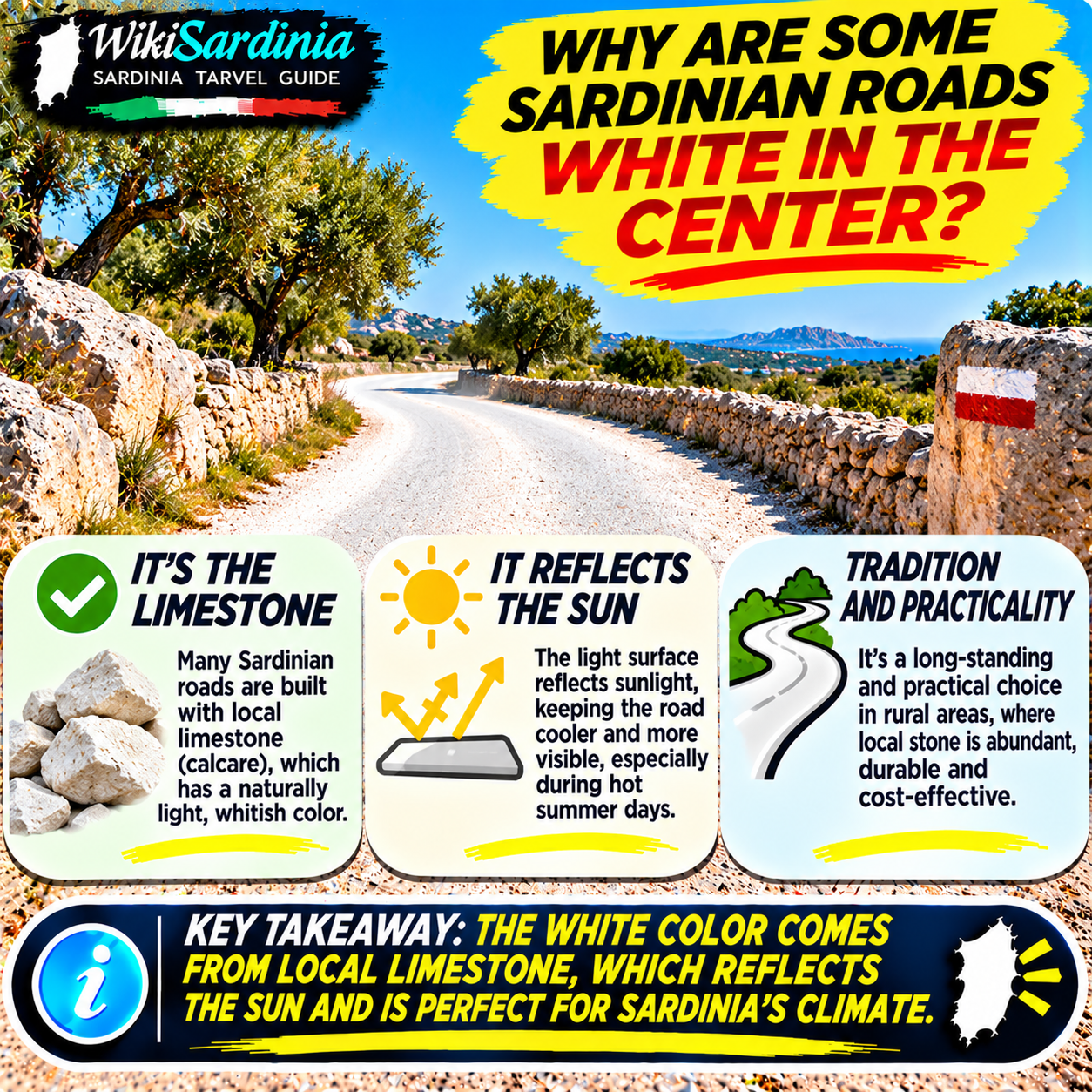
Drive into Sardinia's countryside and you may notice roads that look surprisingly pale, sometimes almost white in the middle. Often the explanation is simple: light-colored stone, gravel and dust on an unpaved road. These routes are commonly called strade bianche, or “white roads.” But not every pale road is made of limestone, and the white color is not necessarily a deliberate way to beat the summer heat.
What are Sardinia's strade bianche?
In Italian, strada bianca commonly means an unpaved road surfaced with compacted gravel, crushed stone or similar aggregate. The term describes the road's light, dusty appearance rather than a precise geological recipe. Sardinia has many rural access tracks serving farms, vineyards, grazing land and countryside properties. Some are public roads, while others are private tracks or routes with restricted access.
Why can the road look white?
The color depends on the local aggregate. Limestone is one possible source of pale, chalky-looking stone, particularly in areas with limestone geology. Other light-colored rocks and fine dust can produce a similar appearance. Tire wear and vehicle traffic may redistribute fine particles, making the most-used part of a track look different from its edges. A pale center does not by itself prove that the road is limestone.
Does the white surface reflect the sun?
Generally, a lighter surface reflects more incoming sunlight than a comparable dark one. This is known as higher albedo. But the actual surface temperature depends on material, moisture, shade and weather. It would be misleading to claim that Sardinian gravel roads were universally designed to stay cool: builders commonly choose local aggregate for availability, cost, drainage and road performance. Sun reflection is a possible physical effect, not necessarily the historical reason for construction.
What if you mean the white line in the middle of a paved road?
That is a different feature. On paved roads, white centerlines are traffic markings used to separate lanes or guide drivers. They are painted or applied with road-marking materials, not made white by limestone gravel. Follow the markings and posted road signs; a continuous line and a broken line do not mean the same thing.
Where might you encounter white country roads?
Unpaved rural tracks occur in various parts of Sardinia, including agricultural landscapes and inland areas. Their condition varies enormously. A route that looks smooth in a photograph may have potholes, ruts, loose gravel or washouts after rain. Do not assume a navigation app's shortcut is suitable for a regular rental car.
Can you drive a rental car on them?
Check your rental agreement before leaving paved roads: some contracts restrict driving on unpaved surfaces or exclude certain damage. Drive slowly where permitted, leave room for agricultural vehicles, and avoid entering private land. After heavy rain, muddy sections may be impassable. If in doubt, use a paved alternative.
Frequently asked questions
Are all white roads made of limestone?
No. Limestone can create a light surface, but other pale stone and dust can have the same effect.
Are white roads cooler than asphalt?
They can reflect more sunlight than dark asphalt, but temperature varies and the effect is not guaranteed for every surface or condition.
Are strade bianche always public?
No. Some are private agricultural tracks or have access restrictions. Respect signs, gates and property boundaries.
Why does the middle look lighter than the edges?
Traffic can move fine dust and expose different aggregate, while vegetation, shade and weathering may make the edges appear darker. The explanation varies from road to road.
The takeaway
Sardinia's pale country roads usually owe their appearance to light-colored gravel, stone and dust. Local limestone can contribute, and a light surface may reflect sunlight, but neither factor explains every road. If you are referring to the painted white stripe on an asphalt road, that is a traffic marking instead. Either way, pay attention to road conditions and signs when exploring Sardinia's countryside.
Further travel information: Sardegna Turismo.