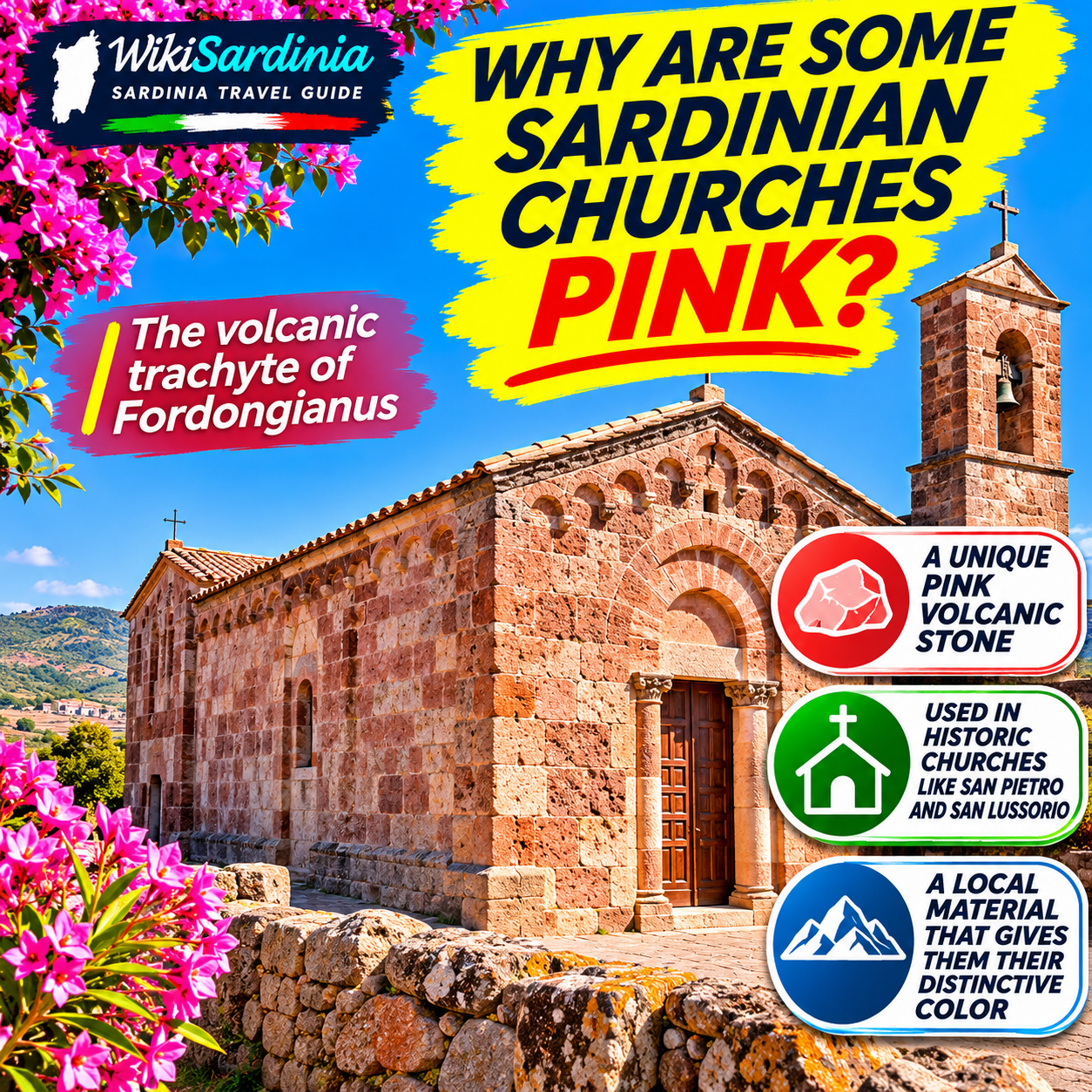
Some Sardinian churches look pink because they were built with locally quarried volcanic stone, especially the red and pink varieties traditionally called trachyte. One of the clearest places to see this is Fordongianus, a small town near the Tirso River in central-western Sardinia. Its historic quarries supplied colored building stone used in churches, houses and decorative details. The pink color is not paint and does not have one universal religious meaning: it comes primarily from the material chosen by local builders.
Why are some churches in Sardinia pink?
In parts of Sardinia, builders had access to volcanic rocks that could be cut into masonry blocks. The local stone occurs in shades ranging from pale rose and reddish brown to gray and greenish tones. When these blocks are used on a church façade, the building may appear pink, red or striped, particularly in warm sunlight. The color reflects local geology and the availability of workable construction stone, not a Sardinia-wide rule that churches should be pink.
What is pink trachyte?
Trachite rosa is the common Italian building-stone name for pink-toned volcanic material. The term trachyte is used widely in local architecture and stone commerce; geological classifications of the broader commercial group can include different volcanic rocks and pyroclastic materials. A regional catalogue of ornamental stones lists Fordongianus trachyte among volcanic materials with gray, greenish-blue and pinkish colors. It is therefore more accurate to say that local builders used stone traditionally known as trachyte than to claim every pink block has exactly the same geological composition. Autonomous Region of Sardinia — ornamental stone classifications.
Why is Fordongianus famous for colored stone?
Fordongianus is known for its historic quarries and for buildings made with red, pink, gray and greenish trachyte. The official Sardinia tourism portal specifically describes the town's stone-working tradition and its red-trachyte church of San Pietro Apostolo. A local Barigadu cultural guide also notes that the area's different stone colors have been used in houses and nearby villages. This makes Fordongianus a particularly good destination for travelers who want to understand why some Sardinian religious buildings have such distinctive colors. Sardegna Turismo — Fordongianus; Barigadu Library System — Fordongianus.
Which church should you see first in Fordongianus?
Start with San Pietro Apostolo, the parish church in the town itself. Its stonework includes red trachyte and contrasting tones. The local archdiocese identifies it as the parish church of Fordongianus, while the regional tourism portal highlights its construction in red trachyte. You can appreciate the exterior from the surrounding streets without arranging a formal tour, although entry to the interior depends on worship services and local opening arrangements. Archdiocese of Oristano — parish listing.
What makes the Church of San Lussorio special?
San Lussorio stands outside Fordongianus near an ancient cemetery area connected with the Roman settlement of Forum Traiani. The regional cultural heritage portal describes it as a Romanesque church built in red trachyte between the eleventh and twelfth centuries, later substantially reconstructed after a collapse. The façade was modified again in the Aragonese period and includes a Gothic-Catalan portal. Its combination of colored stone, layered history and rural setting makes it a compelling stop for architecture enthusiasts. SardegnaCultura — San Lussorio.
Are the churches really pink or more red?
Both descriptions can be reasonable depending on the individual stone, lighting and weathering. Fordongianus stone is often described as red trachyte, while some blocks have a distinctly rosy or salmon-colored appearance. Other blocks are gray or greenish. At sunrise or sunset, warm light may make the red tones look stronger; in diffuse daylight the same wall may appear more muted. A church may also combine stones from different phases of construction or restoration, so its façade is not necessarily a single uniform shade.
Why did medieval builders choose this stone?
Local availability was a major practical advantage. Stone sourced near a construction site could reduce the effort involved in transporting heavy masonry, while suitable volcanic materials could be cut and shaped into blocks, door surrounds and decorative details. The same stone-working knowledge was useful for churches, houses and civic buildings. Specific decisions about materials varied by site, patronage, construction phase and local geology; the pink appearance was not necessarily the primary reason for selecting the stone.
Does the pink color have a religious meaning?
There is no basis for claiming that all pink Sardinian churches were designed to symbolize a particular Christian virtue or liturgical color. Their appearance is primarily explained by the stones available to the builders. A church may, of course, have its own religious symbolism in its plan, sculpture or decoration, but that should be interpreted from evidence about the particular building. Avoid confusing the natural color of masonry with the liturgical use of rose-colored vestments on certain days in the Christian calendar.
Is trachyte found only in Fordongianus?
No. Sardinia has several areas where volcanic building stones were historically quarried and used. A regional study of ornamental stone describes warm pink and red varieties in communities including Fordongianus, Bosa, Ittiri and parts of Logudoro. However, each locality has its own stone types, construction traditions and architectural examples. It would be inaccurate to say every pink church in Sardinia uses stone from Fordongianus. Sardegna Ricerche — traditional building stones.
Why do some Sardinian churches have stripes of different colors?
Medieval builders sometimes combined contrasting stones, including volcanic materials, basalt and limestone, to create decorative patterns or to make use of different available materials. In some churches, the alternation of light and dark blocks is a major visual feature. The exact stone types and construction dates vary from building to building. A striped façade should not automatically be described as pink trachyte; it may combine several kinds of rock.
Is the stone volcanic or made from granite?
The trachyte traditionally associated with Fordongianus belongs to the island's volcanic stone heritage. Granite is a different broad family of igneous rock and can also be pink in Sardinia, particularly in parts of the northeast. The fact that a building is pink does not establish whether it is trachyte, granite or another material. If identifying the stone matters, use the building's heritage documentation or a reliable geological source rather than color alone.
How old are the pink churches of Fordongianus?
The churches are not all from the same period. San Lussorio has medieval origins and underwent major later alterations. San Pietro Apostolo has a more complicated building history, including a historic parish church and later rebuilding. The Archdiocese of Oristano identifies San Pietro's parish history and the presence of San Lussorio outside the town. The important point for visitors is that the colored stone tradition continued across different centuries rather than belonging to one single building campaign.
What else can you visit in Fordongianus?
The town is also known for the Roman thermal baths of ancient Forum Traiani, associated with hot spring waters near the Tirso River. The Casa Aragonese offers another example of historic local architecture and stonework. Combining the Roman remains, the town's stone buildings and San Lussorio makes a rewarding cultural outing. Check the official local visitor service for access, tickets, guided-tour options and current opening hours rather than relying on old travel-blog schedules. Sardegna Turismo — places to see.
How do you plan a visit to the two churches?
Begin in the center of Fordongianus, where you can admire San Pietro's exterior and the town's colored stonework. San Lussorio lies outside the main village area, so a car or another suitable means of transport may be helpful. Do not assume the church interior is open every day; religious sites may have restricted access outside services or special events. If you want to photograph interior architectural details, contact the parish or local visitor office in advance and respect worshippers.
Is Fordongianus worth visiting if you are not interested in churches?
Yes, particularly if you enjoy Roman history, geology, traditional architecture and small inland towns. Fordongianus offers an opportunity to see how one local building material can influence the appearance of an entire settlement. Its stone colors, thermal heritage and river setting make it different from Sardinia's better-known beach destinations. It works best as a cultural excursion rather than a substitute for a coastal beach day.
Can you see the pink color better at sunrise or sunset?
Warm, low-angle light can accentuate reddish and rose tones and bring out the texture of masonry blocks. However, the effect depends on the building's orientation and weather. Midday light may make architectural details easier to photograph, while softer light can help avoid harsh shadows. For accurate color documentation, take an additional photograph in neutral daylight rather than relying entirely on a dramatic sunset image.
Can you touch or collect pieces of the stone?
Admire historic masonry without scratching, chipping or removing material. Church façades and archaeological sites are cultural heritage, not sources of souvenirs. Loose stone near a monument may also be protected or belong to private property. If you want a legitimate piece of Sardinian stone craftsmanship, look for an authorized artisan product rather than collecting fragments from a historic building or quarry.
Is pink trachyte still used by artisans?
Stone-working remains part of the region's cultural identity, and local sources describe the continuing work of stonecutters using trachyte for architectural and decorative purposes. Not every shop sells locally quarried material, so ask artisans where their stone comes from and whether the item is handmade. The material's traditional uses include surrounds for doors and windows, decorative elements and other stonework beyond churches.
Useful Italian phrases
“Perché questa chiesa è rosa?” — Why is this church pink? “È costruita in trachite?” — Is it built from trachyte? “La pietra viene da Fordongianus?” — Does the stone come from Fordongianus? “La chiesa di San Lussorio è visitabile?” — Can visitors enter the Church of San Lussorio? “Dove si trovano le antiche cave?” — Where are the old quarries? “Vorrei fotografare la facciata.” — I'd like to photograph the façade.
Sources and further reading
Sardegna Turismo — Fordongianus; SardegnaCultura — Church of San Lussorio; Barigadu Library System — local trachyte and heritage; Archdiocese of Oristano — Fordongianus parish; Sardegna Ricerche — stone and architectural heritage; Regional catalogue — Sardinian ornamental stones. Opening hours and any access fees must be checked with the local site before traveling.
The WikiSardinia takeaway
Some Sardinian churches are pink because their builders used local volcanic stone, especially pink and red trachyte. Fordongianus is one of the best places to understand this tradition: its quarries shaped the appearance of the town, and churches such as San Pietro Apostolo and San Lussorio show how the same material became part of religious architecture. The color is a story of geology, craftsmanship and place—not a universal rule about Sardinian churches.