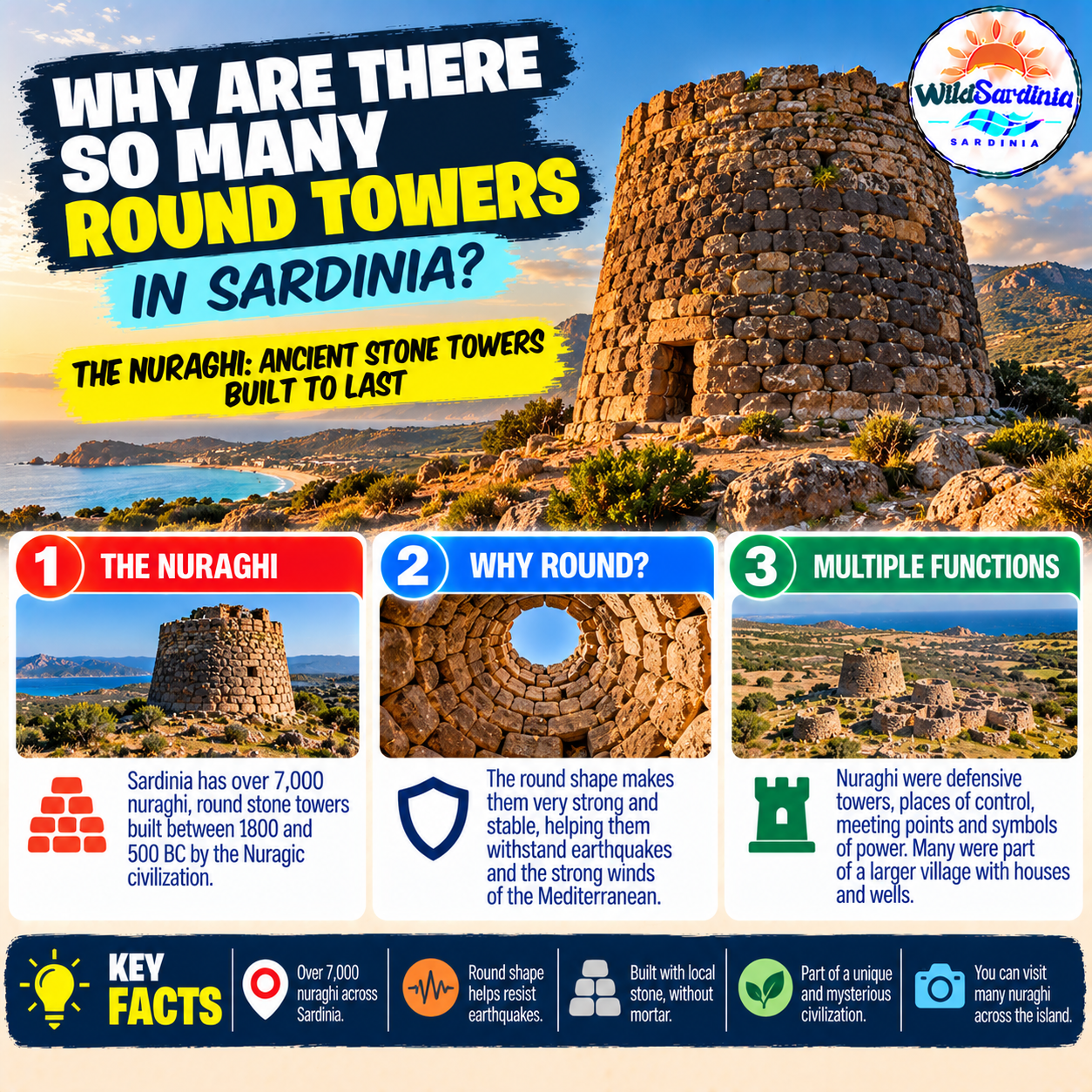
Across Sardinia, thousands of ancient stone towers rise from hillsides, fields and archaeological sites. They are called nuraghi, and they were built by the Nuragic civilization during the Bronze Age. Their circular shape is one of the most recognisable features of Sardinia’s ancient landscape—but the idea that they were built specifically to resist earthquakes is not an established archaeological explanation.
What are the nuraghi?
Nuraghi are distinctive stone structures found across Sardinia, generally built as truncated-cone towers with thick walls and internal chambers. Many classic examples date to the Middle and Late Bronze Age, broadly around 1600–1200 BCE, although the development and use of nuragic structures continued over a long period.
The best-known example is Su Nuraxi di Barumini, a UNESCO World Heritage Site. Its central tower was originally more than 18 metres high and was later incorporated into a larger complex of towers, walls and a settlement.
Why are the towers round?
The circular plan was part of a sophisticated building tradition. Nuragic builders arranged large stones in courses that narrowed towards the top, creating internal chambers with corbelled, beehive-like roofs. The broad base, thick masonry and carefully arranged stones helped create substantial structures using the materials and techniques available at the time.
However, archaeologists do not identify earthquake resistance as the proven reason for the round shape. The design should be understood in the context of Nuragic construction methods, defensive needs and the evolution of local society—not reduced to a single modern engineering explanation.
Were nuraghi defensive towers?
Many nuraghi occupy elevated or strategically placed positions, and official archaeological descriptions identify defensive functions as central to the early complexes. Their height and location could help people observe the surrounding landscape, while thick walls and controlled entrances offered protection.
Not every nuraghe necessarily served exactly the same purpose throughout its life. Some isolated towers grew into larger complexes with additional towers, enclosing walls and nearby villages. Over time, certain nuraghi were also incorporated into changing social and ritual settings.
Why are there so many across Sardinia?
The nuraghi were not a single isolated project. They were built by communities across the island over generations, making use of local stone and established construction knowledge. Their distribution reflects the scale and organisation of Nuragic society, as well as the importance of settlements, territory and local networks.
Thousands of these structures survive in different conditions, from impressive multi-tower complexes to isolated ruins. Their variety is one reason it is misleading to treat every nuraghe as an identical watchtower.
Did people live inside them?
The answer depends on the site and period. Some towers likely had residential or leadership-related functions, while larger complexes were connected to surrounding settlements. At Su Nuraxi, for example, archaeologists have documented circular huts and other remains around the fortified central complex.
As Nuragic society changed, some structures were adapted for new purposes. Archaeological evidence indicates that certain nuraghi later took on ritual or communal significance. Their functions could evolve rather than remain fixed from the day they were built.
Where can you see the most impressive nuraghi?
- Su Nuraxi, Barumini: a major multi-tower complex and Sardinia’s best-known UNESCO-listed nuragic site.
- Santu Antine, Torralba: a remarkable complex known for its central tower and connected structures.
- Nuraghe Arrubiu, Orroli: one of the island’s notable multi-tower nuraghi.
- Nuraghe Losa, Abbasanta: a striking stone complex in central-western Sardinia.
Check official opening times, guided-visit arrangements and access restrictions before travelling. Some sites have uneven ground, steps or narrow internal spaces, so follow the instructions of site staff and never climb on fragile masonry.
A stone legacy, not an earthquake-proof mystery
Sardinia’s round towers are remarkable because they show the building skill, social organisation and changing needs of the Nuragic civilization. Their circular plans, thick stone walls and corbelled chambers are important architectural features, but it is not accurate to claim that they were designed specifically to withstand earthquakes. The best way to understand them is through the archaeological evidence at sites such as Su Nuraxi, where towers, walls and village remains tell a much richer story.
Official sources: UNESCO World Heritage Centre — Su Nuraxi di Barumini; Italian Ministry of Culture — Su Nuraxi di Barumini.