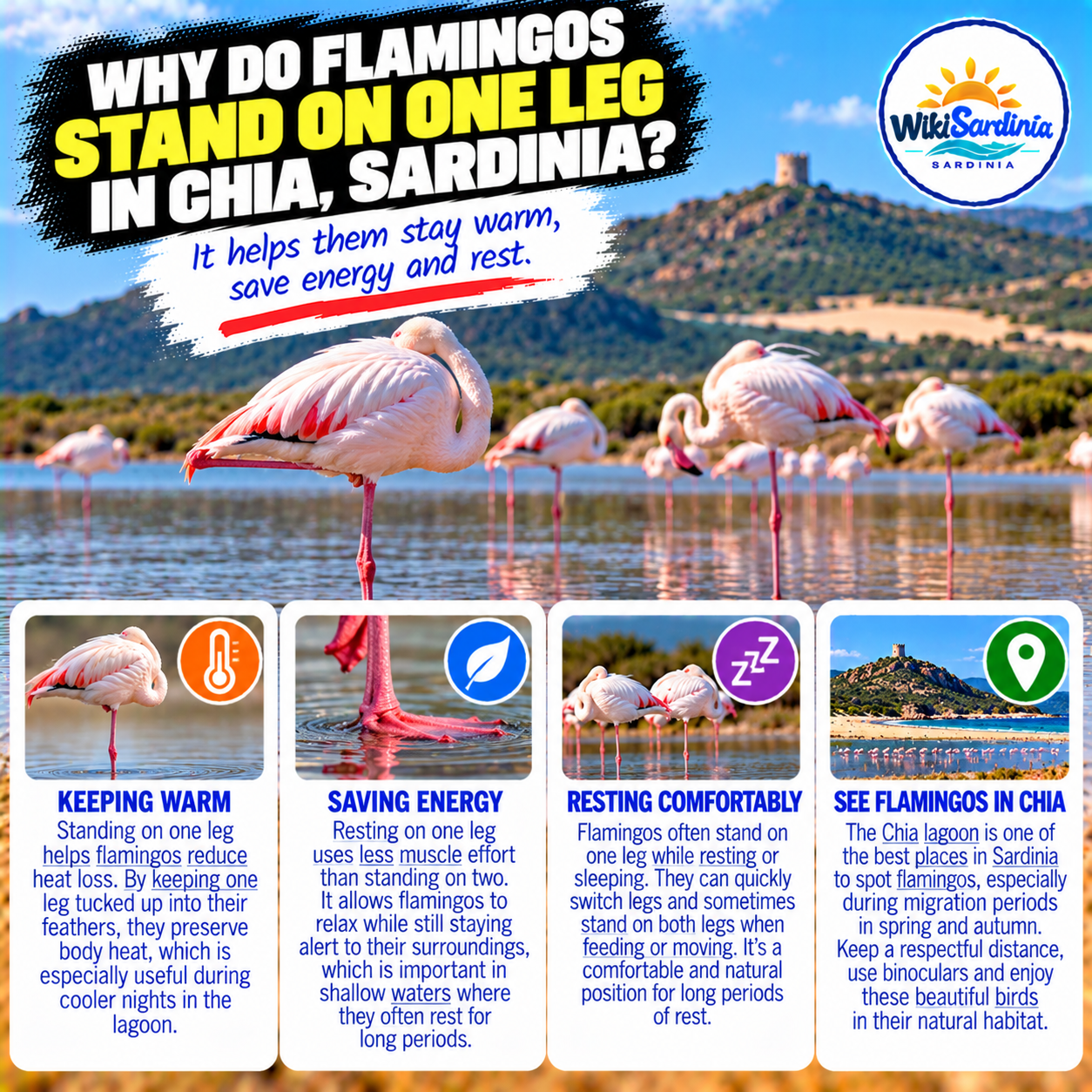
If you have ever watched flamingos in a Sardinian lagoon, you may have noticed something that seems almost impossible: a tall pink bird resting perfectly still on just one slender leg. Around the wetlands near Chia, this elegant pose is part of the magic of birdwatching. But why do flamingos stand on one leg? Are they cold, tired or simply showing off their balance?
Scientists have investigated the behaviour, and the answer is fascinating. Standing on one leg can help flamingos conserve body heat, while their anatomy also makes the position remarkably stable and energy-efficient. The two explanations complement each other, rather than competing.
Why flamingos lift one leg out of the water
Flamingos spend long periods standing in shallow water, where their legs are exposed to temperatures that can be cooler than their bodies. Because the legs have relatively little insulation compared with the feathered torso, they can lose heat to the surrounding water or air. Tucking one leg up into the feathers reduces the surface area exposed and can help limit heat loss.
Researchers studying captive flamingos have found that one-legged standing becomes more common under cooler conditions, supporting the idea that thermoregulation is one reason for the behaviour. It does not mean every flamingo standing on one leg is cold, however. Birds also adopt the pose in warm weather.
How can a flamingo balance without falling over?
The secret is not constant muscular effort. Flamingos have an unusual standing mechanism that allows the body to remain supported with very little active muscle work. In a 2017 study published in Biology Letters, researchers showed that flamingo cadavers could remain upright in a one-legged stance without active muscle control, demonstrating a passive support mechanism. Experiments with living birds also found that the pose can involve very little body sway.
In other words, what looks like a difficult balancing act may be a surprisingly economical way for a flamingo to rest. The bird's joints, posture and centre of mass work together to support its weight.
Does standing on one leg save energy?
Yes, in the sense that the stance can be maintained with little muscular activity. Flamingos do not need to strain continuously to hold themselves up. But it would be too simple to claim that scientists have measured an exact universal percentage of energy saved by every flamingo in every situation. Conditions, individual birds and behaviour all vary.
The main lesson is that the one-legged pose is a natural, mechanically efficient resting posture—not a sign that the animal is injured or struggling.
Do flamingos sleep standing on one leg?
They often rest with one leg tucked away and their head turned back into their feathers. Some may doze while standing, while others change posture or use both legs. Flamingos can also sleep in different positions depending on their surroundings. The familiar one-legged silhouette is common, but it is not the only way these birds rest.
Why are flamingos pink?
The pink colouring comes mainly from carotenoid pigments in their diet. Flamingos feed on small aquatic organisms, including crustaceans and other foods containing these pigments. Their digestive and metabolic processes help deposit the colour in their feathers. Young flamingos are generally greyish rather than bright pink, and the colour develops with age and diet.
The species most commonly seen in Sardinia is the greater flamingo, Phoenicopterus roseus, a bird closely associated with the island's coastal wetlands.
Can you see flamingos around Chia?
The Chia area, in the municipality of Domus de Maria in southern Sardinia, includes coastal wetlands and lagoon habitats where flamingos and other waterbirds may be observed. Sightings depend on water conditions, season and the movements of the birds, so no single viewpoint guarantees a flock on any given day.
One of the area's best-known wetland settings is Stagno di Chia, close to the beaches and dunes. Observing birds here adds another dimension to a visit that might otherwise focus entirely on the sea. Keep to public paths and authorised viewpoints, and avoid entering marsh vegetation or approaching roosting birds.
Where else can you see flamingos in Sardinia?
Southern Sardinia is especially famous for its flamingos. The wetlands around Molentargius-Saline, between Cagliari and Quartu Sant'Elena, are among the island's most celebrated sites, including for breeding flamingos. Other coastal lagoons and saltwater wetlands across Sardinia can also attract these birds. Their numbers and distribution change with water levels, weather and the annual cycle.
When is the best time to photograph them?
Early morning and late afternoon often provide softer light and a more comfortable experience for birdwatchers. A pair of binoculars or a telephoto lens lets you watch natural behaviour without getting too close. Rather than chasing a particular photograph, stay still and allow the birds to move normally.
Breeding areas and sensitive roosting sites may have seasonal restrictions. Always respect signs, fencing and conservation guidance.
What should you avoid when watching flamingos?
Do not feed them, use drones near flocks, enter restricted wetland areas or try to make the birds move for a photograph. If birds stop resting, repeatedly turn toward you or move away as you approach, you are probably too close. Step back and give them space.
The answer: warmth, balance and rest
Flamingos stand on one leg because the posture can reduce heat loss and because their bodies are specially adapted to maintain it with very little effort. It is a comfortable, efficient way to rest while remaining upright in shallow water. So when you spot a flamingo balancing peacefully in the lagoons of Chia, you are witnessing a beautiful example of how evolution turns an apparently difficult pose into something effortless.