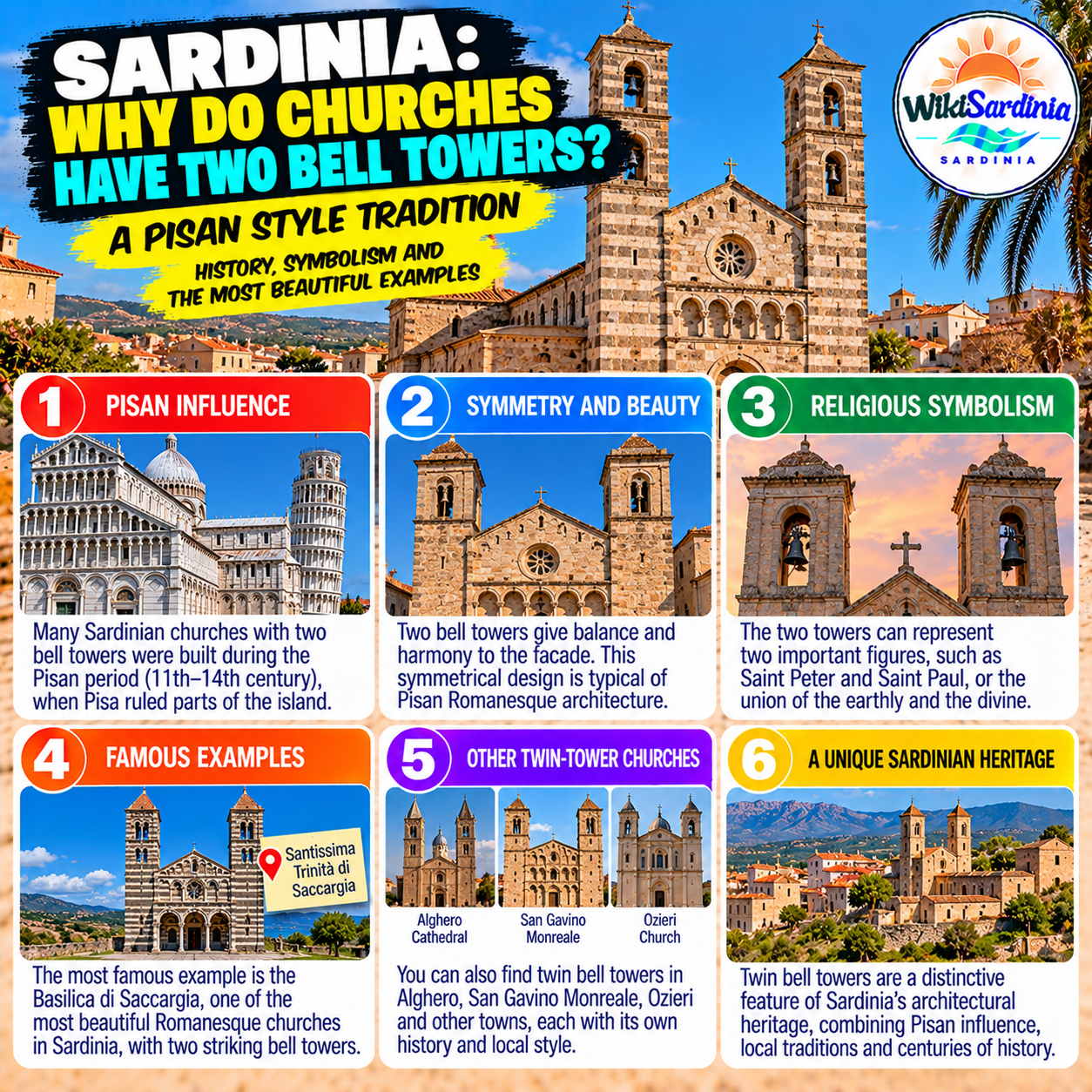
When exploring Sardinia, you may notice churches whose façades are framed by two towers or whose bell towers create a strikingly balanced silhouette. The island’s medieval architecture reflects a meeting of local building traditions and influences from across the western Mediterranean, including the Romanesque styles associated with Pisa. But there is no single explanation for every pair of towers, and not all Sardinian churches have two.
The influence of Pisan Romanesque architecture
During the Middle Ages, Pisa had strong political, commercial and religious connections with Sardinia. These links helped shape the island’s Romanesque architecture, alongside influences from other Italian regions and the wider Mediterranean. Builders adopted and adapted forms such as rounded arches, stone arcades, decorative façades and carefully proportioned church fronts.
Where a church has two towers flanking its main body, the arrangement may reflect wider European architectural ideas rather than a uniquely Sardinian rule. The precise origin depends on the building’s date, patronage, later alterations and local context.
Why build two towers?
Twin towers can create a balanced, monumental façade and make a church stand out in the surrounding town or countryside. Depending on the building, towers may have served practical purposes connected with bells, access or the church complex. Their function and history need to be understood case by case; a pair of towers does not automatically have one fixed meaning.
Is it a symbol of two saints?
You may come across explanations linking twin towers to particular saints or to a symbolic pairing. Such interpretations should not be assumed without evidence from the specific church’s history or documentation. In many cases, the design is better understood through architectural style, construction phases and the needs of the religious community.
Look closely at the building, not just the towers
When visiting a medieval church, notice the stonework, arches, columns, decorative patterns and the way the façade is divided. Some buildings use alternating stone colours, carved capitals or arcades to create visual rhythm. These details can reveal connections with Romanesque architecture even when the church has only one bell tower.
Also look for signs of different construction periods. A tower may have been added or altered long after the main church was built, so the current appearance may represent several centuries of change.
Sardinia’s churches do not all follow the same plan
The island has a rich variety of religious architecture, from rural Romanesque churches to Gothic, Baroque and later buildings. Many churches have a single bell tower, while others have different arrangements or separate campaniles. Twin towers are one architectural feature among many, not a universal pattern for Sardinian churches.
The Basilica of Santissima Trinità di Saccargia, for example, is particularly celebrated for its Romanesque architecture and distinctive alternating stonework. Before attributing a specific tower arrangement or symbolism to any monument, check reliable documentation for that building rather than relying on a general rule.
How Pisan influence became Sardinian heritage
Architectural influence does not mean simple copying. Sardinian builders and communities adapted ideas to local materials, skills, religious needs and landscapes. The result is an architectural heritage that can feel connected to Pisa and other Mediterranean centres while remaining distinctly Sardinian.
The short answer
When a Sardinian church has two bell towers, the design may reflect Romanesque traditions, regional connections and the choices made during its construction. Pisan influence is an important part of Sardinia’s medieval architectural story, but it is not a complete explanation for every building. The best way to understand a particular church is to look at its own history, structure and local context.