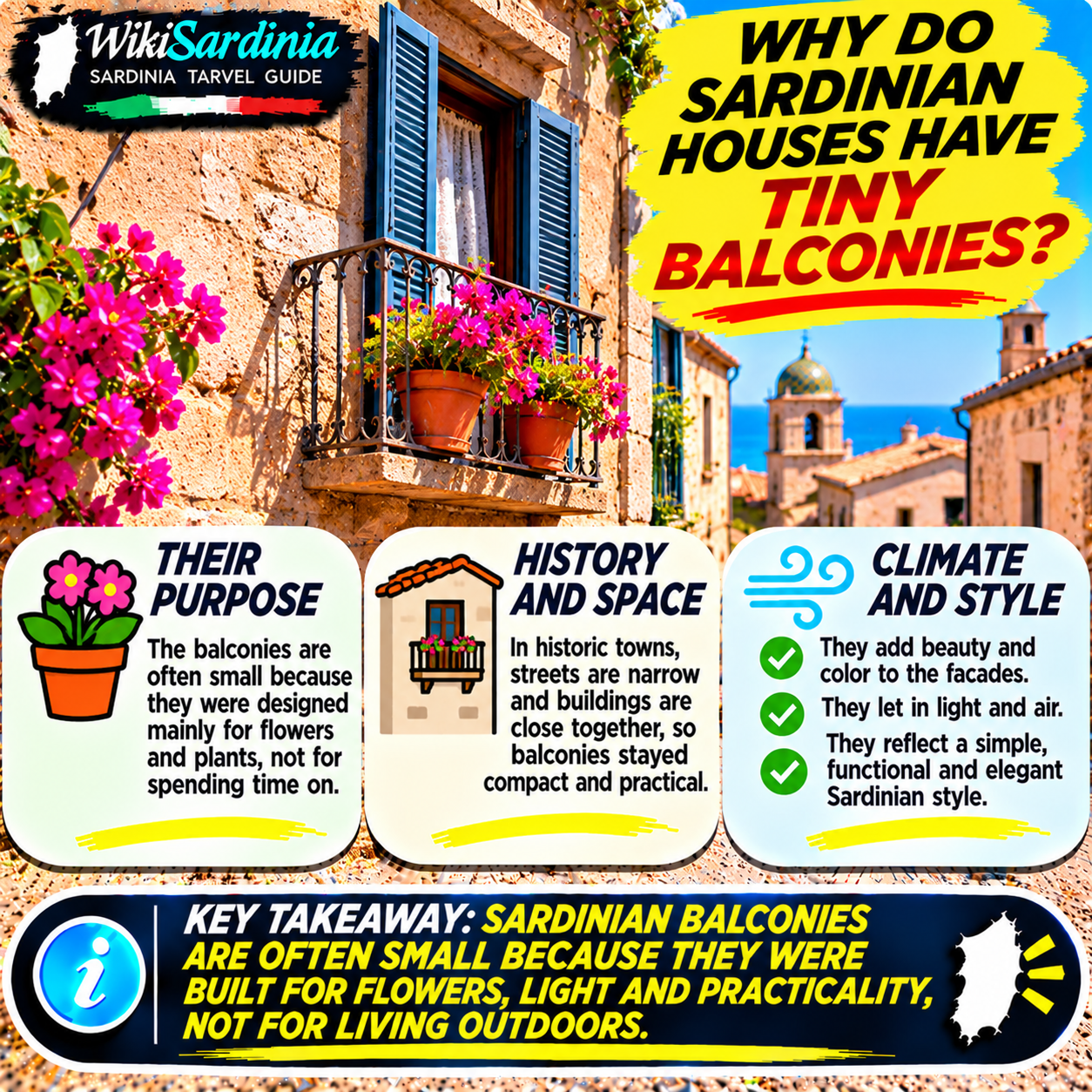
Walk through a historic Sardinian village and you may spot a balcony so narrow that it seems designed for a flowerpot rather than a chair. Some traditional houses in Sardinia have tiny balconies because of the architecture of dense old streets, limited projection space and the way upper-floor openings were built. Flowers often make them beautiful today, but it would be too simple to say they were all originally designed only for plants.
Why are some balconies so narrow?
Historic centers often developed along narrow streets, with buildings standing close together. A shallow balcony could provide a railing and a small outdoor projection without occupying as much space above the street as a deep terrace. Building age, structural techniques, local rules and individual owners' choices all influenced dimensions. There is no single Sardinia-wide rule explaining every balcony.
Were they built just for flowers?
Not necessarily. Flowerpots are a common and charming use for small balconies, but a shallow balcony could also allow someone to stand briefly at an upper-floor doorway, look onto the street or enjoy fresh air. Some openings have little more than a protective railing, resembling what English speakers call a Juliet balcony. Others have a narrow projecting stone or masonry slab. These are different architectural arrangements and should not be confused.
What about light and ventilation?
The door or tall window associated with a balcony can admit daylight and air. The balcony itself is not what creates ventilation; it is the opening and the building's layout. In warm Mediterranean weather, shutters and window placement help occupants manage light and airflow. A small balcony may be useful without functioning as an outdoor dining space.
Where can visitors notice them?
Look up while walking through the historic streets of Alghero, Bosa and other older Sardinian towns. You may see wrought-iron railings, stone brackets, painted shutters and pots of geraniums or other flowers. These details vary greatly by period and neighborhood. Some houses have larger balconies or terraces; others have none.
Is this architecture unique to Sardinia?
No. Narrow balconies and decorative iron railings are common across parts of Italy and the wider Mediterranean. Sardinian towns have their own local materials, construction histories and styles, but a tiny balcony alone does not identify a building as uniquely Sardinian or establish its age.
Can people stand on these balconies?
Some small balconies were built to support people, while others are essentially railings across a doorway or window. Never assume a historic balcony is safe to stand on. Its condition and load-bearing capacity matter, especially in older buildings. Visitors staying in a historic apartment should follow the property's instructions and avoid leaning on damaged railings or placing heavy pots on uncertain supports.
Why are flowers so common?
Plants can bring color to compact façades without requiring a garden. Flowerpots on railings and window ledges are part of the visual character of many Mediterranean towns, though not every resident uses a balcony this way. Secure pots carefully: objects falling onto a street below can be dangerous.
Frequently asked questions
Are tiny Sardinian balconies meant only for decoration?
Some are largely decorative, but others have practical uses. The original function depends on the building and design.
Is a Juliet balcony the same as a small balcony?
Not exactly. A Juliet balcony generally consists of a protective railing at a tall window or door with little or no usable platform, while a small projecting balcony has at least some exterior floor area.
Do tiny balconies keep houses cooler?
Not by themselves. Shutters, ventilation, wall construction and shade influence indoor comfort more directly.
Why don't all Sardinian houses have them?
Architecture varies by location, period, construction type, available space and household needs.
The takeaway
Tiny balconies are one of the delightful details of Sardinia's historic streets. Their compact dimensions often relate to building form and limited space, while flowers and decorative ironwork give them character. They were not universally built only for plants or universally unsuitable for people: every historic building tells a slightly different story.
Further destination information: Sardegna Turismo.