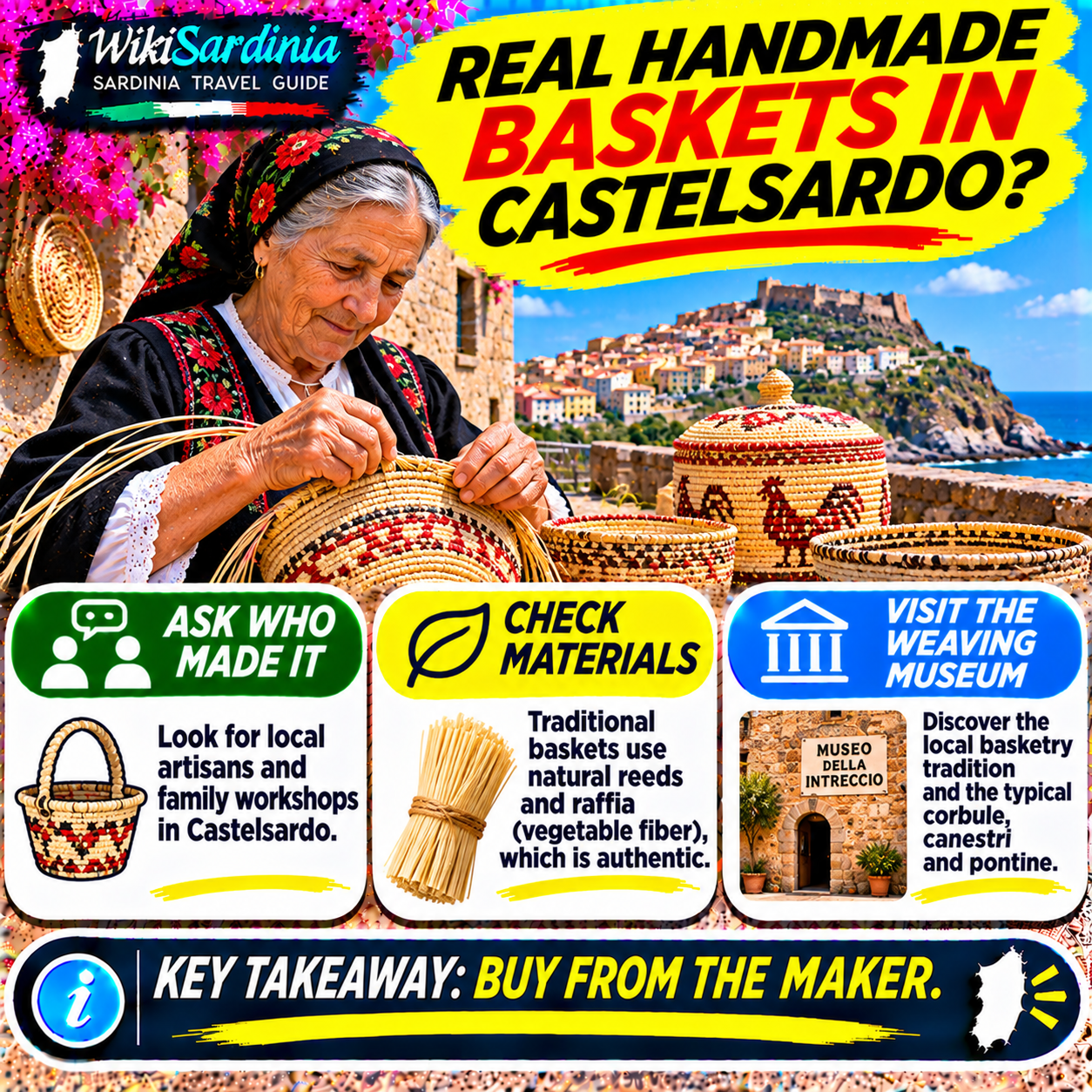
Yes, Castelsardo still has a genuine handmade basket-weaving tradition—but that does not mean every basket in every souvenir shop was woven locally. This spectacular hilltop town in northern Sardinia is famous for its intricate intreccio, or weaving, and visitors can find artisan work alongside more generic merchandise. The most reliable approach is to ask who made the item, where it was woven and which materials were used. A traditional-looking pattern or a “Sardinia” label alone does not establish provenance.
Why is Castelsardo famous for baskets?
For generations, weaving has been part of everyday life in Castelsardo. Local makers traditionally produced practical containers for carrying, storing and handling food and household goods. Over time, these functional objects became highly skilled decorative crafts, with tightly woven patterns and recognizable shapes. The town's Museo dell'Intreccio Mediterraneo, housed in the Doria Castle, documents the local tradition and places it alongside related Mediterranean basket-making cultures. This is a living heritage, not simply a modern souvenir style.
Are the baskets in tourist shops really handmade?
Some are, but you should verify each purchase individually. A shop may carry work from a local artisan, pieces made elsewhere in Sardinia, or manufactured and imported products. There is no reliable basis for declaring that all Castelsardo shops sell authentic local work—or that most sell imports. A basket's appearance, its price and the shop's location cannot prove its origin. Ask the seller for the maker's name, place of production and whether the piece was woven entirely by hand. A knowledgeable seller should be able to explain the object's origin without relying solely on generic phrases such as “typical Sardinian.”
What traditional basket types should I look for?
Castelsardo's weaving heritage includes corbule, canestri and other woven containers, including forms sometimes called pòntine. Shapes, functions and local terminology can vary, so it is worth asking what a particular basket was traditionally used for. Some pieces are shallow and circular, others deeper or more decorative, and the designs may use contrasting fibers to form geometric motifs. The museum is a useful place to learn what distinguishes Castelsardo's tradition before shopping.
What materials are authentic?
Traditional basketry uses plant-based materials and locally developed techniques. Raffia is not automatically a sign of a fake. Raffia and other vegetable fibers can appear in legitimate handmade work, while reeds, rushes and related fibers may be used in different basket-making traditions. A basket made from natural materials is not necessarily from Castelsardo, however. The important questions are who made it, how it was constructed and whether its materials match the seller's description. Conversely, a brightly colored or contemporary design can still be a genuine artisan creation.
How can I recognize a handmade basket?
Look closely at the weaving rather than expecting obvious imperfections. Handmade baskets often show small variations in tension, spacing or the way a fiber is joined, but excellent artisans can produce exceptionally even work. Check the rim, base, handles and finishing: they should be secure and appropriate for the object's intended use. Ask how long the piece took to make and whether the maker uses a particular local technique. These are useful clues, not a laboratory test. A machine-made basket can imitate irregularities, and a perfectly regular handmade basket is not automatically inauthentic.
What should I ask the shopkeeper?
Try these direct questions: “Chi ha realizzato questo cestino?” (Who made this basket?), “È stato intrecciato a mano a Castelsardo?” (Was it woven by hand in Castelsardo?), and “Posso sapere il nome dell'artigiana o dell'artigiano?” (May I know the maker's name?). You can also ask “Di che materiale è fatto?” (What material is it made from?) and “Avete un laboratorio dove si può vedere la lavorazione?” (Do you have a workshop where I can see the weaving?). A seller may legitimately stock Sardinian work made in another town; the key is accurate labeling, not insisting that every authentic Sardinian basket must originate within Castelsardo's town limits.
Is there a label or certificate guaranteeing authenticity?
Do not assume there is a single universal certification for every traditional basket sold in Castelsardo. A maker's card, workshop details, receipt identifying the artisan, or a documented commission can strengthen the evidence of origin, but none should be treated as an automatic government guarantee unless the specific scheme can be verified. Ask whether the item was produced by the seller, sourced from a named workshop or purchased through a wholesaler. If provenance matters to you, keep the receipt and any written maker information.
Where can I learn about authentic weaving before buying?
Start with the Museo dell'Intreccio Mediterraneo in Castelsardo's Doria Castle. Its displays explain the role of basketry in the town and the wider Mediterranean, with examples of traditional forms and techniques. It is also an opportunity to appreciate the time and skill involved before comparing prices in nearby shops. The official SardegnaTurismo visitor information identifies the museum as a key attraction and documents the importance of Castelsardo weaving. Confirm current opening hours, admission and accessibility with the municipal museum operator before arriving.
Can I watch artisans weaving?
Sometimes, but a live demonstration is not guaranteed on any given day. Depending on the season and individual artisans' availability, visitors may encounter makers working in shops or public spaces, or may be able to arrange a workshop visit. Ask permission before watching closely or taking photographs. If you want a demonstration rather than simply a purchase, contact the tourist office or a named artisan in advance and ask whether appointments are possible, whether there is a fee and whether an English explanation is available.
Where should I shop in Castelsardo?
The historic center around the castle has craft and souvenir shops, making it convenient to compare objects while exploring the old town. However, a picturesque shopfront does not establish where its stock was made. Rather than recommending an unverified business as a guaranteed producer, this guide suggests using the museum as a reference point and then seeking out sellers who can identify their makers. If you can buy directly from a working artisan, you gain a clearer connection to the person and technique behind the object.
Are imported souvenirs necessarily bad?
No. An inexpensive manufactured souvenir may be perfectly acceptable if you simply want a decorative keepsake. The problem arises when a mass-produced item is represented as locally handmade or priced on that assumption. Be clear about what you are paying for: a generic basket, a handmade piece from elsewhere, or a documented Castelsardo artisan creation. Visitors who value the local craft should prioritize transparency and fair compensation for the maker, not judge every shop by appearance alone.
Why can handmade baskets cost more?
Traditional weaving requires preparation of fibers, knowledge of shapes and patterns, sustained manual work and careful finishing. More intricate pieces can demand substantial time. Prices depend on size, materials, complexity, the maker and the retail arrangement, so there is no reliable universal price for an authentic Castelsardo basket. A high price does not prove authenticity, and a modestly priced small basket is not necessarily fake. Ask about the work involved rather than relying on a price threshold.
How should I transport a basket home?
Choose a size that fits your luggage without crushing the rim or handles. Ask the maker how the material responds to pressure, humidity and temperature changes. For air travel, a small basket may be easier to carry in hand luggage, subject to your airline's dimensions and restrictions; larger pieces may need protective packing. Do not tightly compress a rigid woven object merely to save space. If returning to the United States or another country, declare plant-based goods when required and check applicable agricultural import rules, especially if the basket contains untreated seeds, soil, bark or other raw plant material. A shop purchase does not automatically establish admissibility at a foreign border.
What if I am visiting with limited mobility?
Castelsardo's historic center has steep streets, steps and uneven paving. The Doria Castle and surrounding lanes can be difficult for visitors using wheelchairs or walking aids. Ask the museum and shops about step-free access before planning a route, and consider arranging a meeting with an artisan at a more accessible location if available. Do not assume a store is accessible simply because it appears close on a map.
Can I find handmade baskets outside Castelsardo?
Yes. Basketry is practiced in several parts of Sardinia, with different shapes, materials and regional styles. An item woven elsewhere on the island can still be authentically Sardinian even if it is not specifically from Castelsardo. If you are looking for a Castelsardo-made piece, ask for that exact provenance. If your aim is to support Sardinian craftsmanship more broadly, other regional makers are also worth discovering.
A practical shopping checklist
- Visit the weaving museum to understand traditional shapes and techniques.
- Ask for the maker's name and town, not just whether the basket is “Sardinian.”
- Check the materials and finishing while remembering that raffia can be authentic.
- Ask whether you can see a workshop or examples of the artisan's process.
- Compare several pieces for workmanship and suitability, not only price.
- Keep provenance information and a receipt if authenticity is important.
Useful Italian phrases
“È fatto a mano?” — Is it handmade? “È stato realizzato qui a Castelsardo?” — Was it made here in Castelsardo? “Chi è l'artigiano?” — Who is the artisan? “Che fibre avete usato?” — Which fibers did you use? “Posso vedere come viene intrecciato?” — May I see how it is woven? “È un prodotto locale o importato?” — Is it a local or imported product?
Sources and further reading
SardegnaTurismo — Castelsardo and its craft heritage; SardegnaTurismo — Museum of Mediterranean Weaving; Municipality of Castelsardo — local cultural and visitor information. For any individual shop, maker, current opening time or product claim, obtain confirmation directly: these sources document the tradition, not the origin of every item for sale.
The WikiSardinia takeaway
Castelsardo is a genuine center of Sardinian basket-making, but authenticity belongs to each individual object, not automatically to every souvenir shop. Traditional handmade baskets exist, as do generic tourist products. Learn the craft at the Museum of Mediterranean Weaving, ask who made the basket and where, and choose a seller who can explain its provenance. The best souvenir is not necessarily the most elaborate one—it is the one whose story is true.