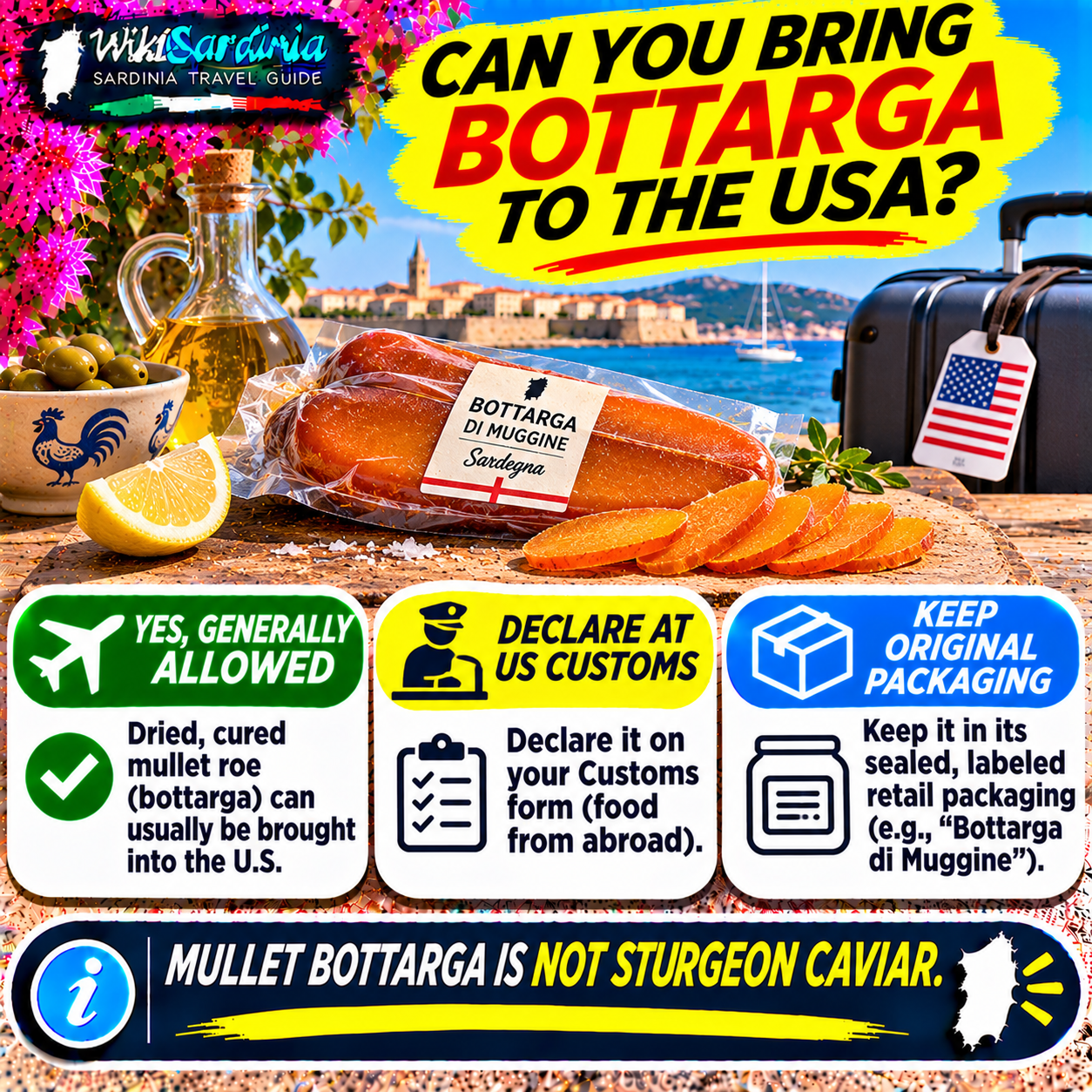
Yes. Travelers can generally bring authentic Sardinian bottarga made from cured mullet roe into the United States in checked luggage for personal use, provided they declare it to U.S. Customs and Border Protection (CBP). U.S. CBP says most personal quantities of seafood are admissible, although protected species and other restrictions may apply. The final decision belongs to the inspecting officer. Buying a sealed, clearly labelled package and keeping the receipt makes the process easier.
Is Sardinian bottarga allowed through U.S. Customs?
Usually, yes. Traditional bottarga di muggine is salted and dried mullet roe, a fish product rather than meat or dairy. CBP's official seafood guidance states that most personal quantities of seafood can enter the United States and are not subject to FDA approval as personal imports. USDA APHIS likewise explains that it does not regulate most seafood products, referring travelers to CBP, FDA and the U.S. Fish and Wildlife Service for relevant restrictions. This is a general admissibility rule, not a guarantee that every particular product will be accepted.
What is the difference between bottarga and caviar?
This distinction matters at customs. Sardinian bottarga di muggine is produced from mullet roe, traditionally from the grey mullet. Sturgeon or paddlefish caviar comes from different fish and is subject to specific wildlife-trade rules. U.S. Fish and Wildlife Service guidance establishes a 125-gram personal-effects exemption for certain sturgeon and paddlefish caviar under CITES. That limit does not automatically apply to ordinary mullet bottarga. If a product is described as caviar, mixed roe, or roe from a protected species, check the species and applicable restrictions before travel.
Should I put bottarga in checked luggage or carry-on?
Checked luggage is a practical option, especially for vacuum-sealed whole bottarga or jars of grated bottarga packed in oil. Carry-on rules can differ depending on whether a product is solid, spreadable or contains liquid. A jar of bottarga in oil may be treated as a liquid or gel at security, so checked baggage is generally simpler. Check your airline's rules for food, weight and temperature-sensitive items, as well as security rules at your departure and transit airports.
Does it have to be vacuum-sealed?
U.S. CBP does not state that every admissible personal seafood item must be vacuum-sealed, but commercially sealed, clearly labelled packaging is strongly recommended. It helps inspectors identify the product, fish species, producer and country of origin, and it reduces odor or leakage in your suitcase. Avoid repacking roe into an unlabelled bag or container. Keep the original package intact and bring the shop receipt if possible.
What should the label say?
Look for a clear description such as “Bottarga di muggine” or “uova di muggine salate ed essiccate” (salted and dried mullet roe). A label showing the producer, ingredients, storage instructions and origin is useful. If you buy bottarga di tonno (tuna roe), it is a different fish product and should be described accurately. Do not label all fish roe as “caviar,” because that can create unnecessary confusion about species-specific restrictions.
How much bottarga can I bring?
There is no universal 125-gram limit for ordinary mullet bottarga under the sturgeon-caviar rule. However, CBP distinguishes reasonable personal quantities from commercial imports, and other agency rules may apply depending on the species and product. A few commercially packaged pieces intended as gifts or for home cooking are easier to explain than a suitcase full of identical products. If you plan to bring a large quantity, or you are importing for resale, contact CBP and the relevant U.S. agencies in advance. Do not assume that all seafood imports have unlimited quantities.
Do I need to declare bottarga even if it is sealed?
Yes. USDA APHIS and CBP require travelers to declare food, agricultural and wildlife products when entering the United States. This includes food in checked baggage, commercially packaged gifts and products purchased at an airport. Follow the declaration procedure presented by CBP, whether electronic, verbal or on a paper form. You can say: “I have commercially packaged, cured mullet roe from Italy for personal use.” Be ready to show the package and receipt. Declaring a product does not mean it will automatically be confiscated.
What happens if Customs inspects it?
An officer may ask what the product is, whether it contains any other animal ingredients, where it was purchased and whether it is for personal use. They may inspect the packaging or refer it for an agricultural or wildlife inspection. If an item is prohibited or cannot be admitted, it may have to be surrendered. APHIS says travelers who truthfully declare agricultural products are not penalized merely because an inspector decides the products cannot enter. Failing to declare can result in confiscation and penalties.
Can I bring grated bottarga in a jar or bottarga in olive oil?
Possibly, but check the complete ingredients and packaging. Pure cured fish roe in a sealed jar is different from a prepared sauce containing other animal ingredients. Oil-based products are also more vulnerable to leakage and may trigger carry-on liquid restrictions. For a straightforward souvenir, whole vacuum-packed bottarga with a clear species label is often the easiest choice. If the product contains additional fish or animal ingredients, disclose those accurately and confirm the rules for that particular product.
Does bottarga need refrigeration during the flight?
Follow the manufacturer's storage instructions rather than assuming all cured bottarga is shelf-stable. Some products require refrigeration even before opening; others may be sold as shelf-stable when properly packaged. A long journey with transfers and checked baggage can interrupt the cold chain. Ask the seller how long the unopened product can remain unrefrigerated and whether insulated packing is necessary. Do not use an ice pack or dry ice without checking airline and security requirements. If the product cannot be kept at its required temperature, choose another product or avoid transporting it.
Where should I buy authentic Sardinian bottarga?
Look for reputable food shops, fishmongers or producers in Sardinia, including shops in areas associated with traditional bottarga such as Cabras. Ask whether the roe is from mullet (muggine), where it was processed, and whether the package has a complete label and suitable storage instructions. “Sardinian-style” does not necessarily mean the fish was caught in Sardinia, so check origin claims if local provenance matters to you. Keep the purchase receipt with your travel documents.
Can I bring bottarga as a gift?
Generally yes, under the same personal-import and declaration principles. A sealed package for friends or family is still a food product that must be declared. Customs may ask about the value and quantity of gifts, and normal customs allowance or duty rules may apply. Do not describe a commercial shipment as personal gifts to avoid import requirements.
What if I connect through another country?
Check the rules of every country where you must clear customs or recheck baggage. A product admissible to the United States may be restricted by a transit country's food or wildlife rules. If your bags are checked through without customs entry, the practical process may differ, but do not assume transit is irrelevant. Check with your airline and the relevant customs authority before departure.
Checklist before flying home
- Buy commercially packaged bottarga di muggine with a clear ingredient and species label.
- Keep the original sealed package and purchase receipt.
- Read storage instructions and ensure safe transport temperatures.
- Pack securely in checked luggage, protecting against crushing, leaks and odors.
- Check airline baggage and any transit-country restrictions.
- Declare the product to CBP when entering the United States, even if it is a gift.
- Answer inspection questions accurately; the officer makes the final admissibility decision.
Useful Italian phrases
“È bottarga di muggine?” — Is this mullet bottarga? “È confezionata sottovuoto?” — Is it vacuum-packed? “Serve conservarla in frigorifero?” — Does it need refrigeration? “Posso avere lo scontrino?” — Can I have the receipt? “L'etichetta indica la specie del pesce?” — Does the label identify the fish species? “È adatta a un viaggio in aereo?” — Is it suitable for air travel?
Official sources
U.S. Customs and Border Protection — Importing Seafood; USDA APHIS — International Travelers: Meats, Poultry and Seafood; USDA APHIS — Traveling From Another Country; CBP — What Items Must I Declare?; U.S. Fish and Wildlife Service — CITES Personal Effects Exemption for Sturgeon and Paddlefish Caviar. Regulations and enforcement practices may change; confirm current requirements before travel.
The WikiSardinia takeaway
Authentic Sardinian mullet bottarga is generally allowed in checked luggage when brought to the United States for personal use, but you must declare it. Choose an intact, clearly labelled package, keep your receipt, follow storage instructions and distinguish mullet roe from regulated sturgeon caviar. The 125-gram CITES exemption for sturgeon and paddlefish caviar is not a blanket limit on Sardinian bottarga. CBP makes the final decision at the border.