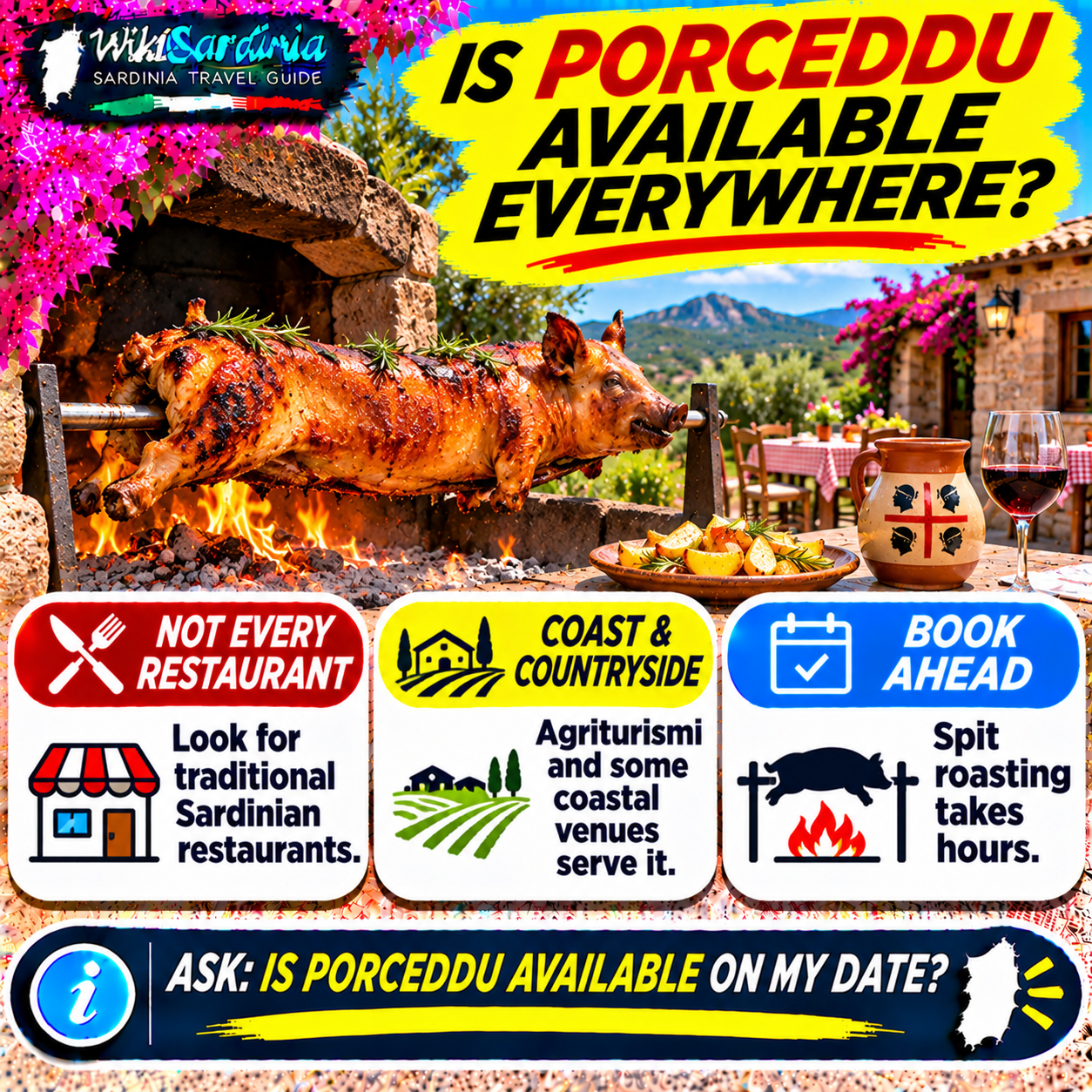
Porceddu, Sardinia's traditional roast suckling pig, is not available at every restaurant—and you do not have to travel deep into the mountains to eat it. You can find it in inland agriturismi, rural restaurants near coastal resorts, and some conventional restaurants. The important detail is availability on your particular date: traditional spit-roasting takes hours, so many kitchens prepare porceddu only for scheduled services or confirmed bookings.
What exactly is porceddu?
Porceddu (also spelled porcheddu, porcetto or maialetto sardo) is young suckling pig, traditionally slowly roasted over a wood fire on a spit. The result is crisp skin and tender meat. The Michelin Guide describes wood-fired spit-roasting as central to the dish's traditional preparation. It is different from mainland Italian porchetta, typically made from a larger seasoned pig, often boned, rolled and sliced. Source: Michelin Guide — Il Porceddu.
Is porceddu served everywhere in Sardinia?
No. Not every pizzeria, seafood restaurant, hotel or beachside trattoria serves it. Some traditional restaurants include it on their regular menu, others offer it on particular evenings or Sundays, and others require an advance order. A restaurant's description as “typical Sardinian cuisine” does not guarantee porceddu is being cooked that day. Check the actual menu and confirm with the kitchen.
Do you have to visit an inland agriturismo?
No. Agriturismi are a classic setting because many serve traditional farm-style multi-course meals, but coastal areas also have restaurants and countryside venues that prepare porceddu. You can search around Alghero, Arzachena and Cannigione, Olbia, Cagliari, Nuoro, Dorgali and other parts of the island. The key is finding a venue that actually serves it on your visit date, not assuming that a certain town or region guarantees it.
Why is advance booking so common?
Traditional porceddu is not a dish that can be cooked from raw in a few minutes after you sit down. Spit-roasting requires time, equipment and a kitchen plan. Restaurants may prepare a whole animal for a particular service, especially where guest numbers are predictable. This is why booking the table and confirming the porceddu separately are two different steps. A published coastal restaurant menu from Isola dei Gabbiani explicitly lists “Porcetto locale (su prenotazione)”—local suckling pig by reservation. That illustrates the practice but does not confirm today's availability at that venue. Source: Isola dei Gabbiani published menu.
How far in advance should you book?
There is no Sardinia-wide minimum notice period. A useful practical approach is to contact the restaurant at least a day or two before your visit, and earlier for August, weekends, large groups or a special occasion. Some venues may have porceddu already planned for that evening; others may require more notice or a minimum number of diners. Ask for confirmation rather than treating 24 or 48 hours as a guaranteed booking rule.
Is it served only at dinner?
No. Porceddu may be offered at Sunday lunch, evening agriturismo meals, festivals, family celebrations or special menus. Some kitchens operate only at specific mealtimes or on reservation. For example, Agriturismo Is Perdas in Gergei publishes a reservation-only dining policy, with a Sunday fixed-menu lunch and different weekday arrangements. This demonstrates how agriturismo dining can be scheduled, but it does not establish that porceddu is included on any particular day. Always ask.
What is the difference between porceddu in an agriturismo and in a restaurant?
An agriturismo may serve porceddu as the centerpiece of a fixed menu that also includes antipasti, traditional pasta, dessert and house wine. A conventional restaurant may sell a single portion à la carte. Neither format guarantees a particular cooking method or quality. Ask whether the pig is roasted on-site over wood, cooked in an oven, or prepared ahead and reheated. The cooking method can matter more than whether the address is rural or coastal.
How much does porceddu cost?
There is no standard island-wide price. The published Isola dei Gabbiani menu lists a reserved portion of local suckling pig at €22, but that is a menu example rather than a verified current offer. Agriturismi may charge for a full fixed meal instead of one portion. Is Perdas, for instance, advertises a €45 Sunday fixed menu with several courses and drinks, although porceddu is not guaranteed as a component. Compare what is included, not simply the number on the menu, and request the current price when booking.
Can one person order porceddu?
Sometimes. If the restaurant has prepared a pig for the day's service, individual portions may be available. Other venues may require a minimum group, a set-menu reservation or a special order. Solo travelers should ask whether they can order a single portion without booking an entire group meal. Do not assume that reserving a table for one automatically secures the dish.
Can children eat porceddu?
Families commonly share traditional meals, but porceddu is served with bones and sometimes crisp skin. Adults should check for small bones and ensure the meat is appropriately prepared before giving it to young children. Ask whether the restaurant offers smaller portions or a children's menu. If a family member has allergies or dietary requirements, notify the restaurant when booking and ask about ingredients, preparation and cross-contact.
Is porceddu the same as porchetta?
No. Porceddu generally refers to a small suckling pig roasted whole or in large sections, traditionally over wood, and served hot. Porchetta generally describes a seasoned, often rolled roast from a larger pig. They share pork as an ingredient, but the preparation and eating experience are different. If you want the Sardinian specialty, ask for porceddu or maialetto sardo, not simply “roast pork.”
What should you ask before reserving?
- “Do you serve porceddu on the date we are coming?”
- “Must we reserve the porceddu itself, not just a table?”
- “Is it roasted on a wood-fired spit or cooked another way?”
- “Can we order individual portions, or is there a minimum group size?”
- “Is it included in a fixed agriturismo menu? What is the total price per person?”
- “What time is it served, and are there any cancellation conditions?”
Useful Italian phrases
“Fate il porceddu?” — Do you serve suckling pig? “È disponibile domani a cena?” — Is it available tomorrow for dinner? “Bisogna prenotare il maialetto in anticipo?” — Do we need to order the suckling pig in advance? “È cotto allo spiedo con la legna?” — Is it wood-fired and spit-roasted? “Il porceddu è compreso nel menù fisso?” — Is porceddu included in the set menu? “Possiamo ordinare una porzione per una persona?” — Can we order one individual portion?
Can you see the porceddu being cooked?
Some venues have a visible spit or offer cooking experiences, but do not assume every kitchen permits guests near its preparation area. If watching the roasting process matters, ask in advance whether it is visible to diners or whether the restaurant offers a demonstration. Respect food-safety and staff-only areas.
How to plan a porceddu meal during a short Sardinian holiday
First choose a traditional restaurant or agriturismo near your existing itinerary rather than committing to a long drive solely on the basis of an old menu. Contact the venue directly and ask about porceddu availability, service time and the price. For a more immersive meal, allow time for a multi-course agriturismo lunch or dinner. For a quick meal, look for a restaurant selling individual portions. If you plan to drink wine, arrange a designated driver or transport in advance, particularly in rural areas where taxis may not be easy to find.
Sources and further reading
Michelin Guide — Il Porceddu (traditional dish and preparation); Isola dei Gabbiani — published menu showing porcetto by reservation; Is Perdas — official agriturismo dining and reservation information. Published menus and operating policies can change, and none of these references establishes real-time table or dish availability.
The WikiSardinia takeaway
Porceddu is found across Sardinia, not just in remote inland agriturismi—but it is not served everywhere or every day. Book ahead when possible, confirm that the pig itself will be available, and ask whether the price covers a single portion or a full traditional menu. If you want the classic wood-fired experience, ask how it is cooked rather than relying only on the restaurant's location.