You stop in a beautiful Sardinian mountain village, order two coffees and a pastry, and reach for your credit card. Then a thought crosses your mind: will the café accept it? Should you have brought cash?
The short answer is that credit and debit cards are widely used in Sardinia, including many inland communities, but carrying a modest amount of euro cash is still a sensible backup. You do not need to arrive with a wallet full of banknotes, and you should not assume every village is cash-only. Equally, it is unwise to depend entirely on one card or one mobile payment app when travelling away from major towns.
What currency does Sardinia use?
Sardinia is part of Italy and uses the euro (€). There is no separate Sardinian currency. Euros work everywhere on the island, from the historic centre of Alghero to mountain villages in Barbagia and the countryside of Gallura. If you are arriving from the United States or another country outside the euro area, check your card’s foreign transaction fees before departure.
Are credit cards accepted in Sardinia’s inland villages?
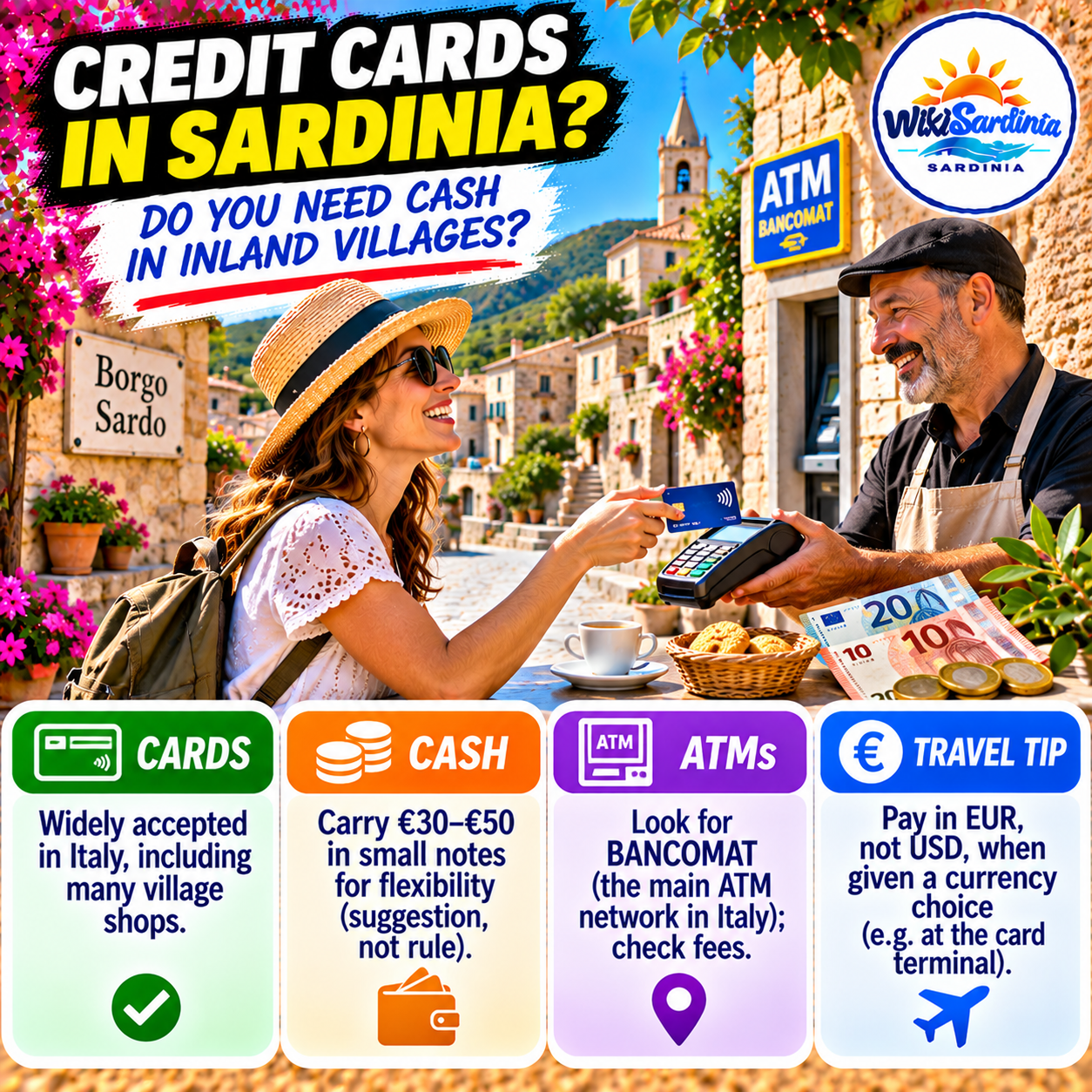
Yes, many village restaurants, supermarkets, pharmacies, accommodation providers and shops accept electronic payments. Visa and Mastercard are useful choices for international travellers, although acceptance depends on the individual business and card network. American Express and some other cards may be less consistently accepted, especially by small merchants.
Do not confuse the size of a village with a complete lack of modern payment facilities. Many family-run businesses use portable contactless terminals. Still, an occasional terminal outage, weak mobile connection or incompatible card can make cash useful.
According to Banca d’Italia’s reporting on payment habits, cash remains common in Italy even as electronic payments continue to expand. That national picture does not prove a specific acceptance rate for Sardinia’s inland villages, but it explains why travellers benefit from having both options.
When is cash particularly useful?
Consider carrying small euro notes and coins for markets, village festivals, informal stalls, minor purchases and occasional services where electronic payments may be temporarily unavailable. Some places accept cards perfectly well for a €2 coffee, while others may have connectivity problems or other practical limitations. Ask politely rather than assuming.
A cash reserve of €30–€50 per person is a reasonable optional starting point for a day trip, not a rule or official recommendation. Your needs may be greater if you are travelling with a family, paying for activities, or visiting an isolated area for the entire day. There is no reason to carry large sums unnecessarily.
Where can you find an ATM?
In Italy, an ATM is usually called a bancomat. Look for the word “BANCOMAT” near a bank or on an ATM sign. Larger towns tend to offer more withdrawal options than very small villages, and an ATM shown on a map may not always be operational or accessible when you arrive.
If you are planning a long drive through remote areas, withdraw any cash you may need before leaving a larger town. Check your bank’s withdrawal charges, the ATM operator’s fees and your card’s daily limits. When possible, prefer an ATM at a recognised bank and review the fees displayed before confirming a transaction.
Should Americans pay in euros or US dollars?
When a card terminal or ATM offers to convert a payment into US dollars, you are being offered dynamic currency conversion (DCC). That conversion can include an exchange-rate markup or extra fees. In many cases, selecting the local currency—euros—is the better choice, leaving conversion to your card issuer. Check your card’s terms, because its own foreign transaction fees may still apply.
Visa explains that customers must be given a choice when DCC is offered. You do not have to accept the merchant’s currency conversion simply to complete the transaction.
Will Apple Pay and Google Pay work?
Contactless payments are common where compatible terminals are available. If your phone wallet uses a supported card, it may work at many restaurants and shops. However, mobile payments still depend on merchant acceptance and functioning equipment. Carrying a physical card is a useful backup in case your phone battery dies or a payment fails.
Can a business refuse card payments?
Italian rules generally require businesses covered by the electronic-payment obligations to accept card payments, with limited exceptions. The practical situation can still vary when equipment fails or a transaction cannot be processed. A small village is not, by itself, an exemption from payment rules. If there is a problem, ask whether another electronic method is available, or use cash if you prefer to resolve the purchase quickly.
It is wise not to make blanket assumptions about individual merchants or claim that a particular shop is breaking the law without knowing the circumstances.
What about agriturismi, village festivals and local markets?
For an agriturismo or a rural guesthouse, ask about payment arrangements when you reserve. Some businesses accept cards at checkout; others may request a deposit or use an online payment link. At temporary events and market stalls, acceptance may vary from vendor to vendor. A little cash offers flexibility without suggesting that the whole inland economy operates outside modern banking.
Useful Italian phrases
“Posso pagare con carta?” — Can I pay by card?
“Accettate Visa o Mastercard?” — Do you accept Visa or Mastercard?
“Dov’è il bancomat più vicino?” — Where is the nearest ATM?
“Posso pagare in contanti?” — Can I pay in cash?
“Vorrei pagare in euro.” — I would like to pay in euros.
Frequently asked questions
Do I need cash in Sardinia?
Not for every purchase, but a small euro reserve is useful, particularly on rural day trips or when electronic payment systems are temporarily unavailable.
Are Visa and Mastercard accepted in small villages?
Often, yes. Individual acceptance varies, so bring a backup payment method.
Is American Express accepted everywhere?
No. Do not rely on American Express as your only card.
Can I use US dollars in Sardinian shops?
The local currency is the euro. Do not assume businesses will accept US dollars in cash.
How much cash should I carry?
For a normal day trip, €30–€50 per person in small denominations is one practical suggestion, adjustable to your plans. It is not a legal requirement.
Will every village have an ATM?
No. Check ahead if you are travelling into a remote area.
The best strategy: card first, cash as backup
You can explore Sardinia’s inland villages without worrying that modern payments disappear the moment you leave the coast. Cards are useful across the island, but a few euros in your pocket make spontaneous stops easier. Bring a physical card, know where to find a bancomat, check fees, and choose euros rather than an offered home-currency conversion when appropriate.
That way, your attention can stay on what matters: the villages, the people, the food and the remarkable landscapes of Sardinia.