You're floating in Sardinia's famously clear turquoise sea in July or August when someone on the beach calls out: “Meduse!” Should you get out of the water immediately? Are jellyfish a constant summer problem on the island, or are sightings relatively unpredictable?
Jellyfish do occur in Sardinian waters, including during peak summer, but their presence is not a daily problem on every beach. Sightings can vary greatly from one place and day to another. Some species can sting painfully, while others are much less troublesome to swimmers. The sensible approach is awareness rather than anxiety.
How common are jellyfish in Sardinia?
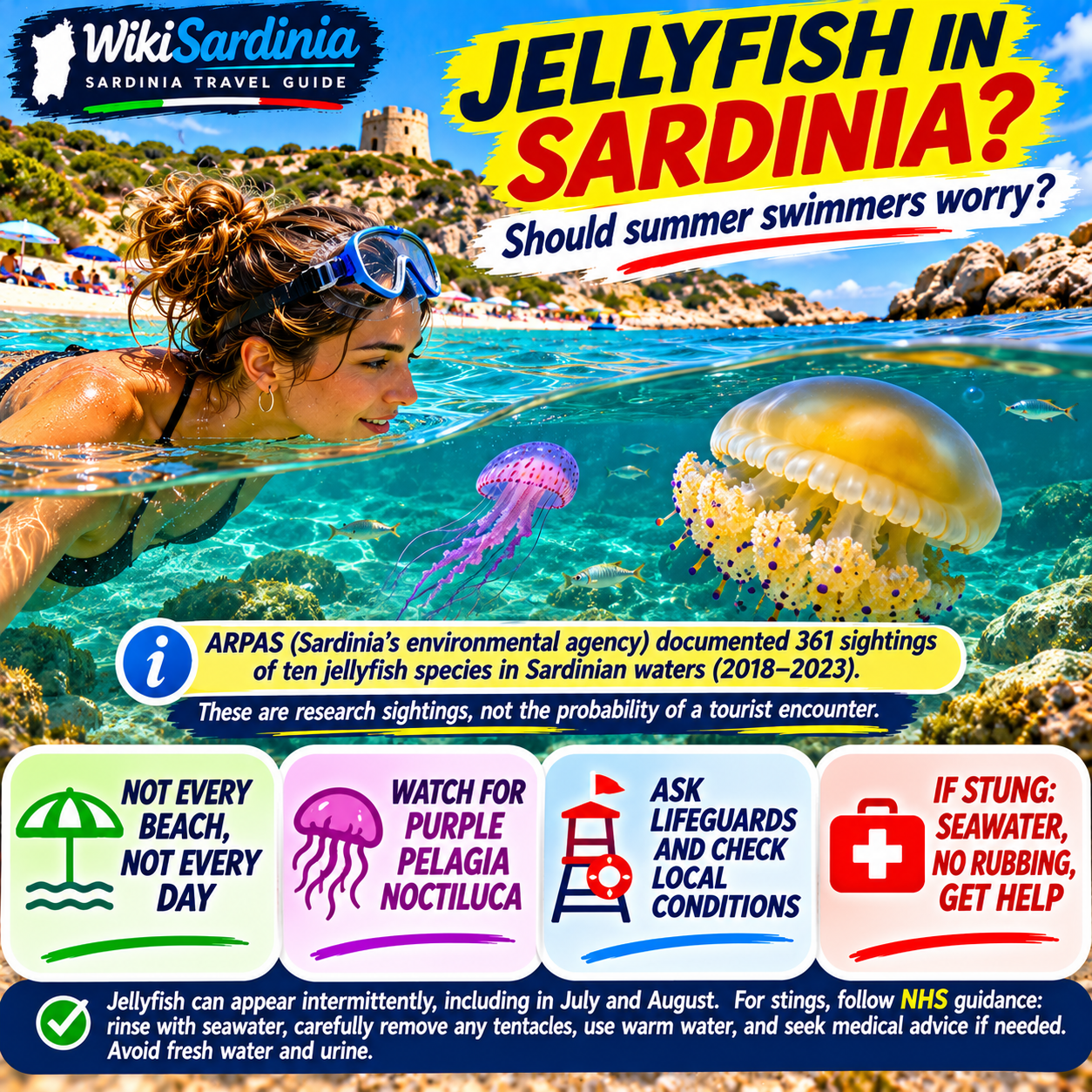
Sardinia has a diverse marine environment, and jellyfish are a natural part of it. The island's regional environmental agency, ARPAS, published a guide in 2025 summarising jellyfish monitoring conducted between 2018 and 2023. Researchers recorded 361 sightings involving ten jellyfish species across the monitored marine areas.
These are scientific observations—not a count of beach closures, a measure of stings, or the probability of meeting a jellyfish during a holiday. The report cannot tell us that one in a certain number of swimmers will be stung, nor can it predict the conditions at a particular beach next August.
According to the regional summary, the northern Sardinian sector around Porto Torres recorded the greatest number of observations in the monitoring dataset, while the Villasimius sector showed the highest species diversity. That does not establish that Porto Torres beaches are inherently more dangerous for swimmers.
Are jellyfish worse in July and August?
Summer is a period when many people swim and therefore notice jellyfish more often. Some jellyfish species are more frequently encountered in warmer seasons, but species differ in their life cycles, and wind, currents and local conditions can affect where they appear.
It would be misleading to say that Sardinia has a predictable 'jellyfish season' in which all beaches become unsafe. Sightings can occur outside the peak holiday months too. For example, WWF Italy reported a notable stranding of Pelagia noctiluca near Alghero in January 2019.
The most useful question is not “Are there jellyfish in Sardinia in August?” but “Are jellyfish being reported at the beach I plan to visit today?”
Which jellyfish should swimmers recognise?
Pelagia noctiluca: the purple or mauve stinger
Pelagia noctiluca, often called the mauve stinger or medusa luminosa in Italian, is one of the main species to recognise. It may appear pink, purple or mauve and has trailing tentacles containing stinging cells. Contact can cause a painful burning sensation and skin irritation.
ARPAS identifies this species among the jellyfish observed in Sardinian waters and notes its stinging capability. Avoid contact even if the animal appears small or has washed ashore: detached tentacles can still cause irritation.
Cotylorhiza tuberculata: the fried-egg jellyfish
This distinctive species has a rounded yellowish centre that resembles an egg yolk. It is sometimes called the Mediterranean fried-egg jellyfish. It is generally regarded as much less troublesome to people than the mauve stinger, although sensitive individuals may still react to contact.
It is best to admire it without touching or removing it from the water. Jellyfish are part of the marine ecosystem, not beach litter.
Rhizostoma pulmo: the barrel jellyfish
The barrel jellyfish can be large and impressive, with a pale bell and substantial oral arms. It is another species recorded in Sardinia. Its sting is generally less severe than that of Pelagia noctiluca, but avoid direct contact and do not rely on a casual visual identification to decide that an unfamiliar jellyfish is safe.
Other species and unfamiliar jellyfish
ARPAS has also monitored non-native jellyfish, including the spotted jellyfish Phyllorhiza punctata in port and gulf areas such as Olbia and Cagliari. The ecological significance of an introduced species is different from its direct risk to swimmers. If you cannot identify a jellyfish confidently, simply give it space.
Which Sardinian beaches have the most jellyfish?
There is no scientifically reliable, permanent list of Sardinia's “jellyfish beaches” or “jellyfish-free beaches.” A bay that is clear one day can receive drifting organisms under different conditions, and a beach where jellyfish were reported last year may have none when you visit.
Wind and currents can move jellyfish toward or away from particular stretches of coastline. Local beach shape, water circulation and species behaviour also matter. Avoid simple claims that one named coast is always safe or that one wind direction guarantees a jellyfish-free swim.
Before swimming, look at the water from shore, check any beach warnings and ask a lifeguard or local operator whether there have been recent sightings.
What should you do if you see a jellyfish while swimming?
Stay calm and move away without trying to touch, chase or pick up the animal. If you see several jellyfish or long trailing tentacles, leave the water carefully and warn nearby swimmers. Follow instructions from lifeguards and local authorities.
Never try to move jellyfish with bare hands, and do not encourage children to play with stranded specimens. A dead or stranded jellyfish may still have functioning stinging cells.
How can families reduce the chance of a sting?
Choose a supervised beach when possible, especially when swimming with young children. Check local conditions before entering the water, and encourage children to report anything unusual rather than touching it.
A rash vest or wetsuit can reduce exposed skin, although it cannot eliminate all risk. Swimming goggles may help you see objects in clear water, but visibility varies. Do not let fear of jellyfish distract from more common beach hazards such as currents, waves, sun exposure and dehydration.
What does a jellyfish sting feel like?
A sting may cause immediate burning, stinging pain, redness, raised lines or itching. The severity depends on the species, the amount of contact and individual sensitivity. Most minor stings can be managed with first aid, but some reactions need medical assessment.
Symptoms such as difficulty breathing, collapse, severe swelling, chest pain or other signs of a serious allergic reaction require urgent emergency assistance. In Italy, call 112 for emergencies.
What should you do after a jellyfish sting?
First, get out of the water safely and ask a lifeguard or first-aid provider for help. According to NHS guidance and Italian environmental health advice, sensible immediate steps include:
- Rinse with seawater, not fresh water. Fresh water can trigger additional discharge from some stinging cells.
- Do not rub the area with sand, towels or your hands.
- Remove visible tentacles carefully using tweezers or the edge of a card, avoiding bare-hand contact.
- Use very warm water, as hot as can comfortably be tolerated without causing burns, for about 30 minutes to help relieve pain, following local medical advice.
- Seek medical advice if pain is severe, symptoms persist, a large area is affected or the person is a child or has a medical vulnerability.
Emergency symptoms require immediate medical help. The correct approach can vary with the species, so follow local healthcare instructions if they differ from general first-aid advice.
Should you use vinegar, urine or fresh water?
Do not use urine: it is not a recommended treatment. Avoid rinsing a sting with fresh water, and do not rub the skin or scrape aggressively. Vinegar is sometimes mentioned in online advice, but its effects depend on the jellyfish species; it is not a universal first-aid remedy for Mediterranean stings. Do not apply it automatically without reliable species-specific medical guidance.
Likewise, do not assume that every internet home remedy is safe. If you are unsure what caused the sting, ask a lifeguard or healthcare professional.
Should you cancel a Sardinia holiday because of jellyfish?
For most travellers, no. Jellyfish are one of several natural features of Mediterranean swimming, not a reason to assume Sardinia's beaches are unusable in summer. The situation is local and changeable. If a particular beach has many jellyfish, choosing another safe location or enjoying a land-based activity that day is usually a more proportionate response than worrying about the entire holiday.
Frequently asked questions
Are there jellyfish in Sardinia in August?
Yes, they can occur in August, but their presence varies by beach and day. August is not a guarantee of either jellyfish or jellyfish-free water.
Are jellyfish common around Alghero?
Jellyfish have been observed near Alghero, including documented strandings in past years. That does not mean its beaches are constantly affected.
Are the jellyfish in Sardinia dangerous?
Some, especially Pelagia noctiluca, can cause painful stings. Others are less troublesome. Avoid touching any unfamiliar jellyfish.
Do jellyfish only appear when the water is hot?
No. Different species occur at different times, and sightings can also happen outside summer.
Does the Maestrale bring jellyfish?
Wind and currents can influence where jellyfish accumulate, but there is no simple rule that the Maestrale always brings them to—or removes them from—every Sardinian beach.
Can a jellyfish sting you if it is washed up on sand?
Yes. Stinging cells can remain active in stranded animals or detached tentacles. Do not handle them.
What number should I call for a severe reaction?
Call 112, Italy's emergency number, if there are serious symptoms such as breathing difficulties or collapse.
The bottom line
Jellyfish are part of Sardinia's marine wildlife, and occasional encounters are possible even during the busiest summer weeks. But there is no reason to treat every beach as a jellyfish hotspot. Check the day's conditions, keep your distance from unfamiliar animals, listen to lifeguards and know basic sting first aid. With those precautions, most visitors can focus on what they came for: enjoying Sardinia's beautiful sea.