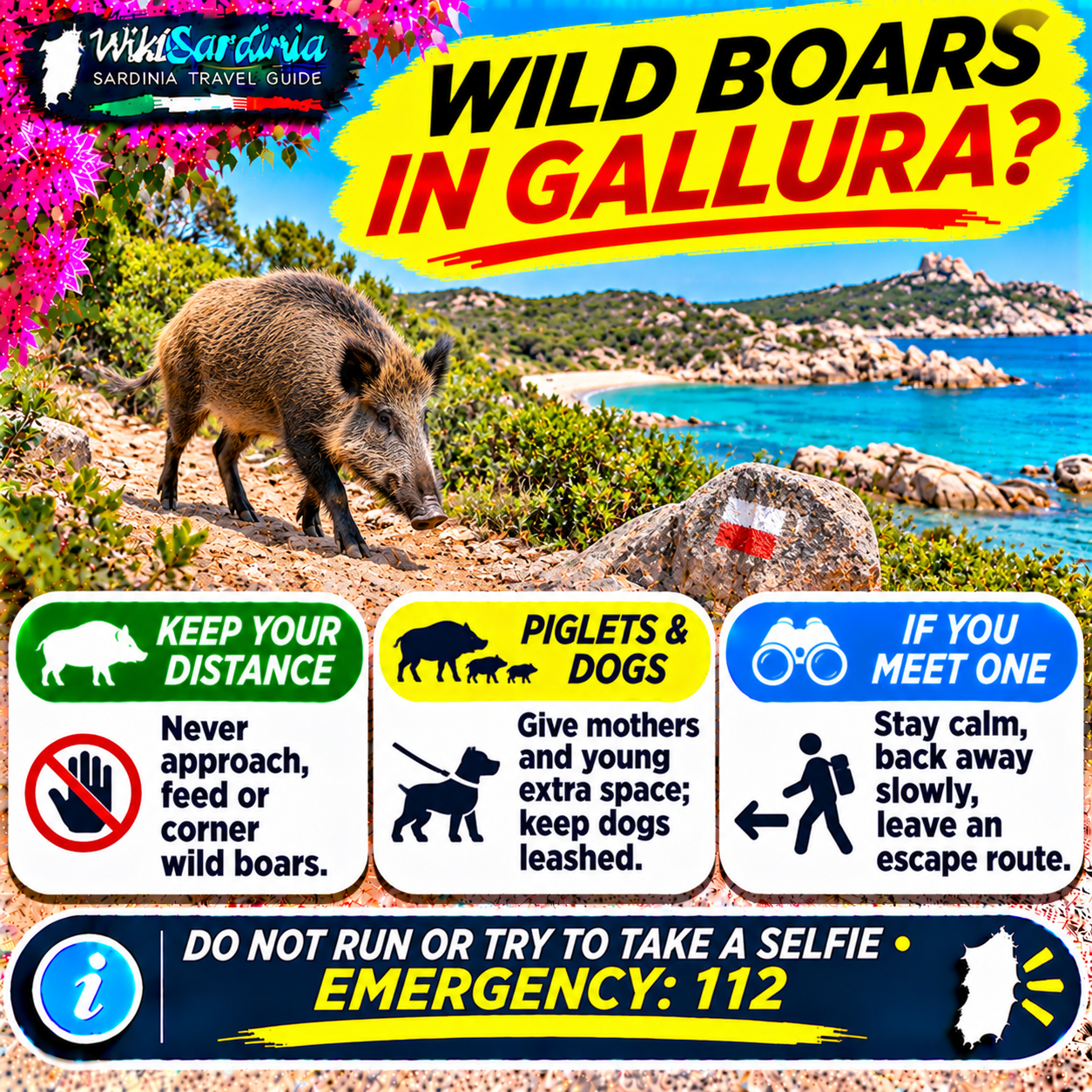
Wild boars (cinghiali) live in Sardinia, including Gallura, and encounters can happen on hiking trails, near rural roads and occasionally at beaches. Most animals avoid humans when given space, but a boar can cause serious injuries if startled, cornered, approached around its piglets or drawn into contact with people and dogs. The safest response is simple: stay calm, keep your distance, leave the animal a clear escape route and move away slowly. Never feed, chase or photograph a boar at close range.
Are wild boars a real concern in Gallura?
Yes, although an encounter is not inevitable and the presence of boars does not mean every beach or hiking route is unsafe. The issue is documented locally. In June 2024, reports from Spargi in the La Maddalena archipelago described boars searching beach bags for food. In December 2025, Sardinia's regional authorities approved a management plan for wild boars in the peripheral areas of Olbia, citing risks around roads and human settlements. These are documented examples, not evidence that a particular beach has boars today.
What should I do if I see a boar on a trail?
- Stop and assess the situation. Do not walk closer to get a photograph.
- Stay calm and avoid sudden movements. Do not shout at, throw objects at or try to frighten the animal.
- Back away slowly while watching where the animal is. Give it enough space to leave.
- Do not block its escape. If it is standing in a narrow path, retreat and choose another route instead of squeezing past.
- Never run toward it or try to outrun it. Sudden flight can make an already tense encounter more unpredictable.
- If there is immediate danger, move behind a substantial barrier or into a secure building or vehicle if you can do so safely, and call 112 for emergency assistance.
These recommendations reflect guidance from wildlife authorities, including Italy's Castelli Romani Regional Park and Singapore's Animal & Veterinary Service, and should be adapted to the actual terrain and circumstances.
Why are females with piglets more dangerous?
A female with young may respond defensively if she believes the piglets are threatened or cannot escape. Do not approach piglets even if they appear alone, and do not position yourself between a mother and her young. If you see several small boars, assume an adult may be nearby and retreat without trying to investigate.
What if a boar approaches my beach towel or picnic bag?
Do not offer food or attempt to grab food back from an animal at close range. Keep children and pets away, step back and let the boar leave. Secure food and rubbish when it is safe to do so; feeding wildlife, intentionally or through accessible leftovers, can encourage animals to return. On Spargi, 2024 reporting described boars investigating visitors' bags, demonstrating why food management matters on otherwise beautiful beaches. Notify beach staff or the relevant local authority if animals repeatedly approach people.
Can a boar attack an adult or child?
Yes. Wild boars are powerful animals with tusks and can inflict serious wounds. Attacks are not the expected outcome of an ordinary distant sighting, but risk increases if an animal is injured, trapped, frightened, protecting young or accustomed to being fed. Children should never approach a boar, and adults should avoid treating a sighting as a wildlife-photo opportunity.
What should I do when hiking with a dog?
Keep the dog on a leash and under close control. A barking or chasing dog may provoke a defensive response, and the dog may run back toward its owner with a boar following. If a boar is nearby, do not let the dog investigate bushes or follow animal tracks. Sardegna Sentieri's official hiking-safety guidance also advises keeping dogs leashed in areas where wildlife and hunting activity may be present.
Are boars more active at night?
Wild boars are often active at dusk, during the night and around dawn, though they may appear in daylight, including in tourist areas where food is available. On rural roads, slow down when visibility is poor and watch for animals crossing. Do not assume that a daytime beach or path is automatically boar-free.
What if a boar blocks a narrow trail?
Wait at a safe distance or turn back. Do not force the animal into a dead end, approach from behind or try to pass between adults and piglets. If a path is narrow with rocks or dense scrub on both sides, retreat to a wider, safer section. If the animal remains in the area, choose a different route rather than trying to move it yourself.
What if I see an injured or trapped boar?
Do not touch, feed, restrain or attempt to rescue it. An injured animal may bite or charge in self-defense. Keep others away and report the location to the appropriate local wildlife or forest authorities. If people are in immediate danger, call 112. Give a precise location, preferably GPS coordinates, and describe whether the animal is injured, trapped or blocking a public route.
What if someone is injured?
Move away from the animal only when it is safe. Call 112 for urgent medical assistance, give the exact location and describe the injuries. Apply firm direct pressure to significant bleeding with a clean cloth or dressing while awaiting help, unless emergency dispatchers instruct otherwise. Do not attempt to approach the boar again. Even apparently small puncture wounds deserve prompt medical evaluation because of the risk of deep injury and infection; a clinician can assess wound care and tetanus protection.
Are there specific warnings for Spargi, La Maddalena or Olbia?
Past incidents and management plans should not be confused with a live warning. Spargi had documented beach encounters in June 2024. The Sardinian regional bulletin published an Olbia-area boar-control plan approved in December 2025. Before a hike or boat trip, ask local park staff, the municipality or your guide whether there are current closures, sightings or restrictions. Do not infer that every location in the archipelago has the same risk.
How can families reduce the chance of an encounter?
- Stay on marked paths and avoid entering thick vegetation without visibility.
- Keep toddlers close and dogs leashed.
- Never feed wild boars or leave picnic food and rubbish accessible.
- Give animals room to move away, particularly if piglets are present.
- Do not approach for selfies or try to scare animals away with stones or loud noises.
- Check local notices and tell someone your hiking route when visiting remote areas.
Useful Italian phrases
“C'è un cinghiale sul sentiero.” — There is a wild boar on the trail. “Ci sono dei cuccioli.” — There are piglets. “Non avvicinatevi.” — Do not approach. “Tenete il cane al guinzaglio.” — Keep the dog on a leash. “L'animale è ferito.” — The animal is injured. “Abbiamo bisogno di soccorso.” — We need help. “La nostra posizione è…” — Our location is…
Official sources and local reporting
Parco dei Castelli Romani — what to do when encountering a wild boar; Animal & Veterinary Service — wild boar safety guidance; Sardegna Sentieri — hiking safety and dogs; Sardinia regional bulletin — Olbia wild boar management decree, December 2025; L'Unione Sarda — Spargi beach sightings, June 2024; SardegnaTurismo — safe holidays and emergency contacts. Reports of sightings are historical; current conditions must be checked locally.
The WikiSardinia takeaway
Wild boars in Gallura are usually best avoided rather than feared. Most encounters end safely when visitors maintain distance and allow the animal to leave. The greatest concern is a close surprise, a mother with piglets, an animal that has been fed by people or an uncontrolled dog. Back away calmly, never chase or feed a boar, and call 112 if anyone is injured or in immediate danger.