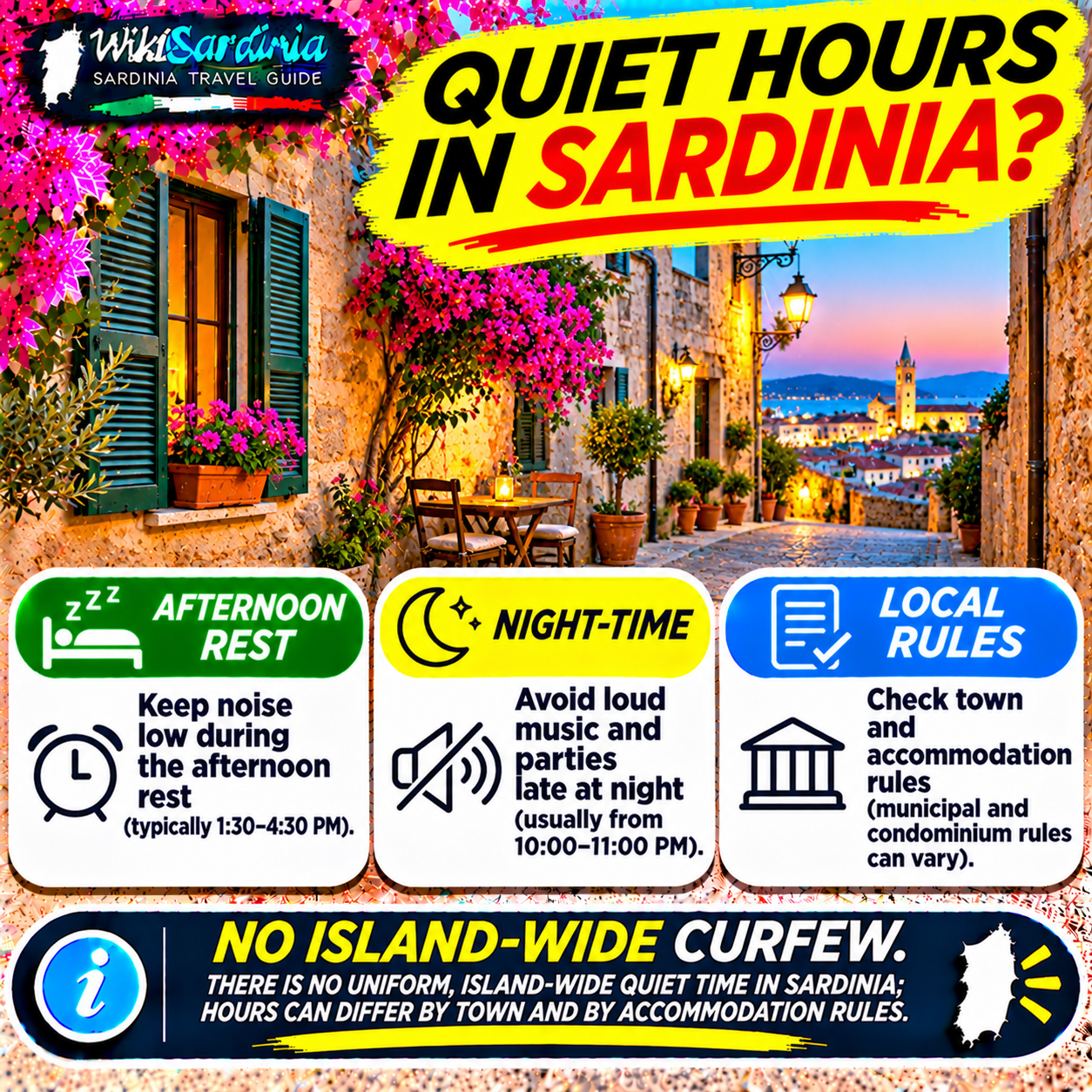
There is no island-wide summer curfew in Sardinia, and there is no single legally mandated quiet-hour schedule for every home or holiday rental. What visitors call coprifuoco is usually the local custom of riposo—respecting afternoon and nighttime rest—or a specific rule in a municipal ordinance, condominium regulation or accommodation policy. You can go out, walk home and enjoy an evening in town. The practical rule is to avoid disturbing neighbors, especially where homes are close together and windows are open in summer.
Is there a summer curfew in Sardinia?
No general curfew applies simply because it is summer. A curfew would restrict people's movements; quiet hours instead concern noise. Restaurants, festivals and public events may operate late under their own rules or authorizations, while guests in a residential building may be asked to keep noise down much earlier. A lively town square does not mean loud music on a nearby apartment balcony is acceptable.
What time is afternoon rest?
In many Italian residential settings, people try to keep noise low around lunchtime and early afternoon, often approximately 1:00–4:00 PM. These are illustrative cultural expectations, not uniform legal hours for Sardinia. A particular building might specify 1:30–3:30 PM, another might have no written afternoon period, and a municipality may regulate only certain noisy activities. Ordinary conversation and normal domestic living are not automatically prohibited during riposo; drilling, loud speakers and shouting are much more likely to cause complaints.
What time does nighttime quiet begin?
Many residential regulations or house rules emphasize quiet from approximately 10:00 or 11:00 PM until morning, but the exact hours vary. Do not treat either time as a universal legal threshold. A loud party can be problematic even before 10 PM, while quiet movement or conversation after midnight is not inherently illegal. Read the house rules and ask your host about any local ordinances.
Who decides the rules?
Three layers may matter. Municipal regulations and ordinances can control specific noise sources, activities, venues and times. Condominium rules may specify quiet periods for residents and guests in an apartment building. Rental or hotel house rules can impose additional conditions on guests. Beyond those written rules, Italian civil law addresses noise exceeding normal tolerability under Article 844 of the Civil Code, and Article 659 of the Criminal Code addresses certain disturbances to people's occupations or rest. These provisions are not a universal ban on making any sound after a set hour.
Do the rules change in summer?
They can. Municipalities may adopt seasonal measures for building works, outdoor entertainment or other noisy activities. For example, the Municipality of Palau's 2025 notice describes a suspension of specified noisy construction and trade activities from August 1 to September 15 under its local police regulation, with limited ordinary gardening hours and exceptions for urgent public works. That example concerns regulated noisy work; it is not a town-wide ban on residents talking or tourists walking outside. Always check whether a particular ordinance is still in force for your travel dates.
What about music, parties and outdoor dinners?
A family dinner at normal speaking volume is different from amplified music or a large party. In tightly packed historic neighborhoods, voices and speakers can carry into bedrooms through open windows and stone courtyards. Keep balcony and terrace music low, avoid shouting across streets, and move late gatherings indoors if your host permits them. Do not assume a private pool or detached villa gives unlimited permission to make noise; neighbors may still be affected.
Are children expected to stay silent?
No. Normal everyday sounds from children are part of residential life, but parents should still avoid preventable excessive noise, especially late at night. Encourage indoor play rather than ball games against shared walls during rest periods, and check whether your apartment complex has specific pool or courtyard hours. A crying baby is not the same as an intentionally loud party; respond considerately without assuming ordinary family life is forbidden.
Can I run the washing machine or use a vacuum cleaner?
There is no single Sardinian rule covering every washing machine or vacuum cleaner. In apartment buildings, house rules may discourage loud appliances during afternoon rest and at night, particularly where vibrations travel through floors. Ask the host if the laundry area is shared or close to neighboring bedrooms. Drilling, hammering, moving furniture and power tools are more likely to be restricted than ordinary quiet household tasks.
What if a nearby bar or festival is loud?
Licensed venues and authorized events may have operating conditions or special permissions that differ from residential house rules. If you need a quiet night's sleep, ask the host about nearby nightlife, summer festivals and street-facing bedrooms before booking. If you encounter ongoing excessive noise, speak with your host or the venue first when safe and appropriate. For persistent disturbance, the local Polizia Locale can explain municipal rules and reporting procedures. Call emergency services only for genuine emergencies, not routine neighbor disputes.
What if a neighbor complains?
Lower the noise immediately, ask politely what is causing the problem, and consult the property's written rules. If the complaint concerns an activity such as outdoor speakers or a party, stop or move it rather than arguing over an assumed nationwide 10 PM deadline. If there is a formal allegation or fine, request the specific municipal rule or documented violation and speak with the accommodation host or a qualified adviser. Penalties depend on the actual provision and circumstances; there is no single automatic “quiet hours fine” for all of Sardinia.
How do I find the correct rules for my town?
- Read the holiday rental, hotel or condominium house rules.
- Search the municipality's official website for regolamento di polizia urbana, ordinanza rumore, quiete pubblica or attività rumorose.
- Check the publication date, applicable season, area and type of activity: construction restrictions are not necessarily household restrictions.
- Ask your host whether the building has a designated afternoon rest period or nighttime quiet hours.
- When in doubt, keep amplified sound low and avoid disruptive work during early afternoon and late evening.
Useful Italian phrases
“Quali sono gli orari di riposo?” — What are the quiet hours? “C'è un regolamento condominiale?” — Is there a condominium regulation? “Possiamo cenare in terrazza la sera?” — Can we have dinner on the terrace in the evening? “Ci scusiamo per il rumore.” — We're sorry about the noise. “Abbassiamo subito la musica.” — We'll turn the music down right away. “Ci sono ordinanze comunali sul rumore?” — Are there municipal noise ordinances?
Legal and municipal references
Normattiva — Italian legislation, including Civil Code Article 844 and Criminal Code Article 659; Municipality of Palau — summer restrictions on noisy work, 2025. For exact quiet periods and any penalties, consult the applicable municipality's current regulations and your accommodation's house rules rather than relying on generalized time ranges.
The WikiSardinia takeaway
In Sardinia, “quiet hours” are about courtesy and specific local rules, not an island-wide curfew. Be considerate during the afternoon rest period and late at night, particularly in historic residential streets and apartment buildings. You can still enjoy dinner, evening walks and local festivals; just keep music and voices at a level that does not disturb nearby residents. Always verify the precise rules for your town and accommodation.