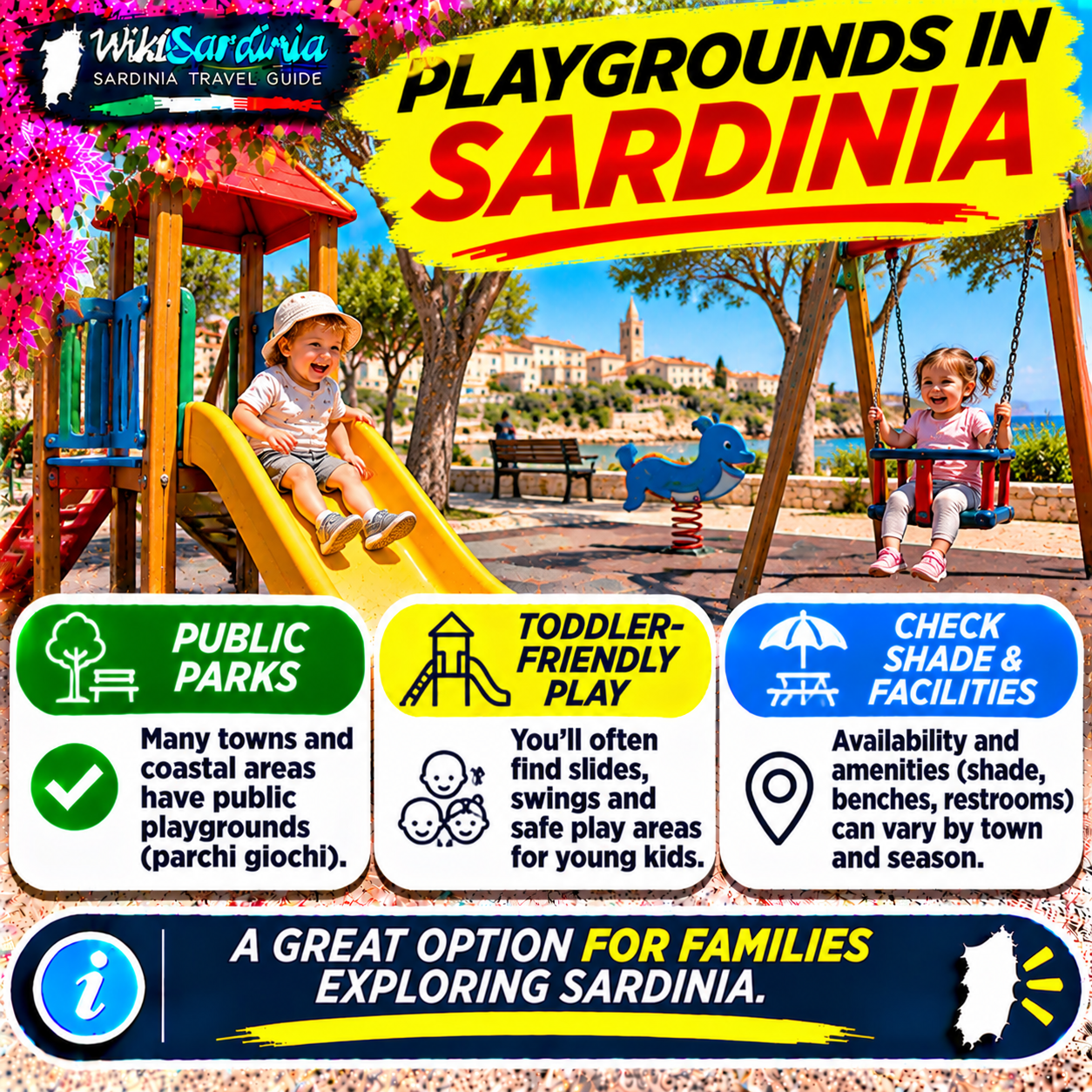
Yes. Public playgrounds (parchi giochi) are found in many Sardinian towns, including smaller coastal communities, and they can be a useful stop when travelling with toddlers. You will often find swings, slides, spring riders and small play areas in municipal parks, gardens or public squares. However, there is no guarantee that every village has a playground within walking distance, or that every play area has equipment suitable for children under three. Check the exact location, age suitability, shade and condition before setting out.
Are playgrounds common outside the main cities?
Many municipalities provide public play spaces, but provision varies from town to town and even between neighbourhoods. Some are full parks with benches, trees and toilets; others are a small fenced corner with a slide and a couple of swings. Coastal resorts may have a playground near a promenade or central square, while inland villages may have a modest municipal garden. Treat a playground as a useful local amenity to look up, not something guaranteed in every village.
Examples of public playgrounds in Sardinia
Alghero: The municipality lists several family-friendly public parks. The Giardini Giuseppe Manno are fenced and include shaded seating, toilets, a refreshment point and play equipment. The municipal description also mentions accessible paths and a play area with swings, climbing equipment and spring riders. Parco Tarragona is another fenced park with shaded seating and equipment for different ages, including a slide area described for children aged 0–6. In Fertilia, Parco Le Ginestre has swings, a climbing-and-slide structure and spring riders.
Cagliari: The city has several large green spaces with play areas. Parco di Terramaini has four children's play areas, refreshment points and accessible paths. Parco Giovanni Paolo II includes a children's play area, lawns, benches and a refreshment point. In December 2025, the municipality also announced a new play area at the Parco della Musica, with slides, swings and a drawing board.
Porto Torres: The municipality describes Parco Belvedere in Via Balai as a family-friendly park with numerous games for younger children. Its municipal page states that it opens from dawn to sunset.
Arzachena: The Parco XVIII Novembre and Tanca di Lu Palu includes a children's play area, benches, relaxation spaces and a large nearby parking area.
Tortolì: The Ogliastra tourism service lists La Sughereta in Portu Frailis as an urban park with children's play areas, walking and cycling paths and sports equipment. It notes that there are no refreshment facilities inside the park, so bring a snack and water.
Smaller towns: New play areas also appear in smaller communities. For example, a playground in Piazza Galileo Galilei in Villaputzu was inaugurated in April 2026. Local municipal news and maps are often the best way to find these smaller facilities.
Are the playgrounds suitable for toddlers?
Some are, but check the equipment rather than assuming that every public playground is designed for very young children. Look for low slides, toddler swings with a secure seat, spring riders and equipment marked for ages 0–3 or 0–6. Larger climbing frames may be intended for school-age children. If there is no age sign, supervise closely and decide whether the equipment is appropriate for your child's size and abilities.
Are playgrounds fenced and shaded?
Some municipal parks are fenced and have mature trees or shaded benches; others are open spaces with little natural shade. Alghero's Giardini Giuseppe Manno and Parco Tarragona are examples of fenced parks with shaded seating listed by the municipality. This does not mean every piece of play equipment stays in the shade throughout the day. In summer, visit in the morning or later afternoon, check the temperature of slides and metal surfaces, and bring water and sun protection.
Are there toilets, changing tables and cafés?
Facilities vary. Some larger parks have toilets, cafés or refreshment points, while small playgrounds may have none. The municipal description of Giardini Giuseppe Manno in Alghero lists toilets and a refreshment point; Parco Terramaini in Cagliari lists refreshment facilities. Do not assume there is a baby-changing table just because toilets are available. If you need somewhere to change a toddler, check directly or plan to use facilities at a nearby café or shopping area.
Can you take a stroller?
Often, yes, particularly in larger municipal parks with paved paths. But the route from the street to the play area may include steps, gravel, uneven paving or sand. Some play surfaces are not easy to cross with a stroller. Check the municipal description and recent photographs, and consider bringing a carrier if you plan to visit a small or uneven play area.
Are public playgrounds free?
Municipal playgrounds are generally free to use, although a park may have separate paid attractions, events or nearby commercial rides. Check signs at the entrance and respect opening hours. Some parks close at night, and individual areas may be temporarily closed for maintenance or safety work.
What should families bring?
- Water and a small snack, especially in parks without a café.
- A hat and sunscreen; shade may be limited or move during the day.
- Wet wipes and a change of clothes for younger children.
- A small first-aid kit and any essential medication.
- A stroller for paved routes or a carrier for uneven paths.
- Closed shoes or suitable play shoes, rather than slippery sandals.
How do you find a playground near your holiday accommodation?
Search online maps for parco giochi, area giochi, giardini pubblici or parco comunale plus the town name. Then check the municipality's website: official pages often provide the address, opening hours, facilities and sometimes the equipment available. Search results and map listings can be out of date, so look for recent municipal notices about maintenance or temporary closures. Your accommodation host or local tourist office may also know which playground is best maintained and has the most shade.
Useful Italian phrases
“Dov'è il parco giochi più vicino?” — Where is the nearest playground? “Ci sono giochi per bambini piccoli?” — Is there equipment for toddlers? “È recintato?” — Is it fenced? “C'è ombra?” — Is there shade? “Ci sono i bagni?” — Are there toilets? “Il parco è aperto?” — Is the park open? “Ci sono altalene con il seggiolino per i più piccoli?” — Are there swings with toddler seats?
The WikiSardinia takeaway
Public playgrounds are available in many Sardinian towns and can make travelling with toddlers easier, but the facilities are not identical everywhere. Alghero, Cagliari, Porto Torres, Arzachena and Tortolì all have documented public play spaces, while smaller villages may have a simple square or neighbourhood garden. Check age-appropriate equipment, shade, toilets, opening times and the route from your accommodation before making a special trip.
Sources
Municipality of Alghero — Giardini Giuseppe Manno; Municipality of Alghero — Parco Tarragona; Municipality of Alghero — Parco Le Ginestre; Cagliari Tourism — Parco Terramaini; Municipality of Cagliari — Parco Giovanni Paolo II; Municipality of Cagliari — Parco della Musica play area, December 2025; Municipality of Porto Torres — Parco Belvedere; Municipality of Arzachena — Parco XVIII Novembre; Ogliastra tourism service — children's itineraries and La Sughereta.