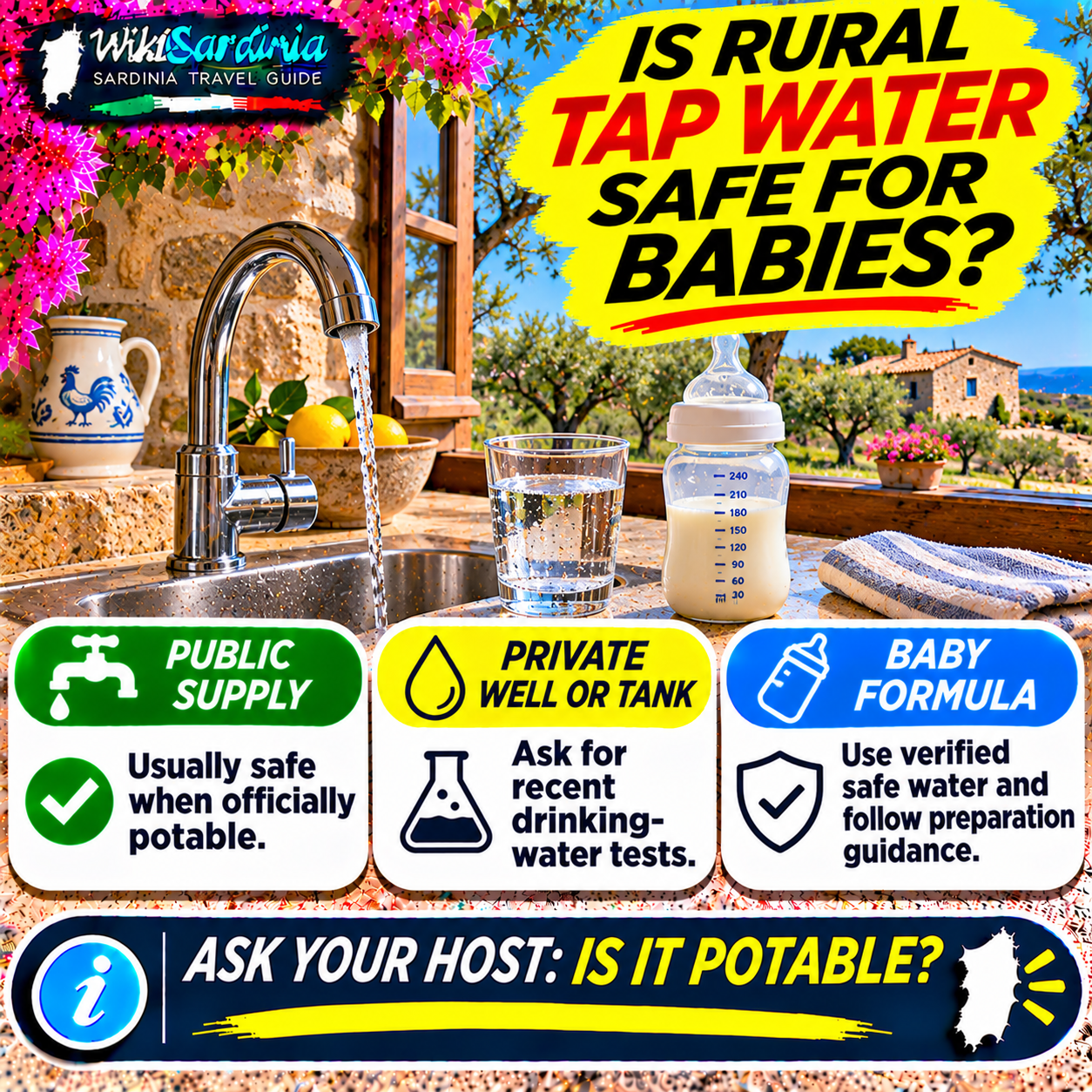
Tap water in Sardinia is generally safe when it comes from a monitored public drinking-water supply and there is no active warning. But a rural villa or agriturismo may use a private well, storage tank or other system, so never assume the kitchen tap is safe for a baby's food or bottle without checking. The key is not whether the property is in the countryside, but whether its particular water supply is certified as potable and properly maintained. For infant formula, water quality is only one part of safe preparation: powdered formula itself is not sterile.
Is tap water in Sardinia safe to drink?
Italy's public drinking-water system is subject to legal standards and monitoring. The Istituto Superiore di Sanità (ISS) explains that regulated tap water is safe for health, just as regulated bottled water is. However, this general statement does not establish that every tap in every remote rental is connected to a monitored public supply, or that there are no temporary restrictions. A municipal non-potability order, a supply interruption or problems within a private property's plumbing or storage system can change the answer.
Why do rural villas and agriturismi need extra checks?
Country properties may obtain water from the municipal aqueduct, a private well (pozzo), a storage tank (cisterna) or a combination. A well or tank is not automatically unsafe, but it requires appropriate management, cleaning and water-quality verification. The appearance, taste and smell of water cannot reliably establish that it is safe. Ask the host exactly where the kitchen tap water comes from, whether it is officially potable, and when a private supply was last tested. If they cannot provide a clear answer, use a verified safe alternative for the baby's food and drinking-related tasks.
Can I use the tap for brushing my toddler's teeth?
Yes, if the water is confirmed potable and no relevant warning applies. If the water is not safe to drink, do not use it for brushing teeth, especially for young children who may swallow some. Use safe bottled water or another source approved by the relevant health authority. The ISS advises using safe water for toothbrushing during water-safety emergencies. A tap marked acqua non potabile means non-drinking water: do not use it for the child's teeth, formula, ice or food preparation.
Can I cook baby food or boil vegetables with it?
If the water is confirmed potable, it can normally be used for cooking baby food, washing produce and cleaning feeding equipment, following age-appropriate food safety guidance. If there is a non-potability warning, the correct action depends on the reason for the warning. Water with microbiological contamination may sometimes be made safer by boiling, if local authorities explicitly recommend it. Boiling does not remove nitrates, heavy metals or other chemical contaminants. If the water source or cause of contamination is unknown, use safe bottled water or a verified alternative instead of assuming that boiling fixes everything.
Can I prepare powdered infant formula with Sardinian tap water?
Only use water from a confirmed safe source and follow the formula manufacturer's preparation instructions and pediatrician's advice. The U.S. CDC says that for most babies, safe tap water can be used to prepare powdered formula according to the product label. However, powdered formula is not sterile and can occasionally contain harmful germs such as Cronobacter. For babies younger than two months, premature babies or those with weakened immune systems, the CDC recommends additional precautions: boil safe water, allow it to cool for about five minutes, then mix it with the powder while it remains very hot (around 70°C/158°F), and cool the prepared feed to a safe temperature before feeding. Follow the product's specific instructions and seek pediatric advice for a medically vulnerable baby.
Is bottled water always safer for babies?
Bottled water can be a practical alternative when a property's tap-water status is uncertain, but ordinary bottled water is not necessarily sterile. The U.S. FDA says bottled water is not sterile unless specifically labelled as such. Select a reputable drinking-water product, follow the formula preparation instructions, and check with your pediatrician about appropriate mineral content for your infant if needed. Bottled water does not eliminate the need for careful handling of powdered formula. Ready-to-feed liquid formula, which does not require adding water, can be a safer option during a water-supply emergency, especially for medically vulnerable infants.
What if the villa uses a private well?
Ask whether the water has been tested recently by a qualified laboratory for drinking-water suitability, including microbiological quality and relevant chemical contaminants such as nitrates. Nitrates are especially important for young infants because elevated concentrations can cause serious health problems. Do not rely on a host's assurance that “we have always drunk it” in place of testing. If the property cannot establish that the well water is potable, do not use it for baby formula or drinking-related food preparation. Boiling can actually concentrate some dissolved chemicals as water evaporates.
What if the property uses a cistern or water tank?
Ask whether the tank holds public drinking water, whether it is cleaned and maintained, and whether water quality is checked at the tap. A storage tank can affect water quality even if the water entering it was potable. Do not assume that a household filter or jug filter makes uncertain water safe: most common filters are not designed to remove every pathogen or chemical hazard. Ask the owner for documentation or use verified drinking water.
How do I check for a non-potability notice?
Ask the host and check notices from the local Comune, the relevant water operator and the regional health authority. In many Sardinian municipalities the public water utility is Abbanoa, but the applicable supplier and local notices depend on the property. Search for ordinanza di non potabilità, acqua non potabile or avviso acqua plus the municipality name. An old notice found online may have been lifted; verify the date, affected streets or zones, reason for the restriction and any official revocation. If a warning applies, follow its precise instructions rather than relying on generic advice.
Does a water warning mean I cannot shower or wash my hands?
Not necessarily. Restrictions differ according to the contaminant and official notice. Some warnings prohibit drinking and food preparation but allow certain other uses; others may require stricter precautions. For a baby, ask specifically about bathing, washing bottles and cleaning food-preparation surfaces. Follow the local authority's directions, especially if chemical contamination is suspected. Do not assume that water declared unsafe for drinking is automatically safe for every other purpose.
What should I do after a water outage?
If the supply has been interrupted or water returns cloudy, discoloured or with an unusual smell, ask the host or water provider whether the supply has been declared safe. Temporary supply disruptions can require flushing, testing or other instructions. Until the situation is clarified, use verified safe water for baby formula, drinking, toothbrushing and food preparation. Do not use a kettle or ordinary filter as a substitute for an official safety determination.
How should I prepare and store formula safely?
- Wash hands and clean the preparation surface and feeding equipment.
- Use water from a verified safe source.
- Follow the product's exact powder-to-water ratio; measure water first and use the scoop supplied with that formula.
- For babies who require extra precautions, follow CDC or pediatrician guidance on mixing with very hot water, then cool before feeding.
- Use prepared formula within two hours of preparation and within one hour of the start of feeding; if not used promptly, refrigerate immediately and use within 24 hours, according to CDC guidance.
- Discard unfinished formula after a feed and clean bottles and nipples properly.
Never add extra water to stretch formula: incorrect dilution can be dangerous. If safe water and clean feeding equipment cannot be guaranteed, ask a pharmacist or pediatrician about suitable ready-to-feed formula.
Questions to ask your villa host before booking
- Is the kitchen tap connected to the public drinking-water network or a private well or tank?
- Is the water officially potable (potabile) and safe for drinking and cooking?
- For a private well or tank, can you provide recent water test results and maintenance information?
- Are there any active municipal non-potability orders or recent water interruptions?
- Can you supply safe bottled water on arrival, especially if we are travelling with an infant?
- Is there a clean kettle, refrigerator and suitable space for preparing baby food and bottles?
Useful Italian phrases
“L'acqua del rubinetto è potabile?” — Is the tap water safe to drink? “L'acqua arriva dall'acquedotto o da un pozzo?” — Does the water come from the public supply or a well? “C'è una cisterna?” — Is there a storage tank? “Avete analisi recenti dell'acqua?” — Do you have recent water test results? “Ci sono ordinanze di non potabilità?” — Are there any official non-potability notices? “Possiamo usare quest'acqua per preparare il latte artificiale?” — Can we use this water to prepare baby formula? “Serve acqua in bottiglia per lavare i denti al bambino?” — Do we need bottled water to brush the child's teeth?
Official sources
Istituto Superiore di Sanità — safety of regulated tap water; ISS EpiCentro — safe water during emergencies; U.S. CDC — infant formula preparation and storage; U.S. FDA — safe handling of infant formula; Abbanoa — water utility and service notices. Property-specific water quality and current municipal restrictions must be confirmed locally; these sources cannot certify an individual villa.
The WikiSardinia takeaway
Rural Sardinian tap water is not automatically unsafe, but you should verify its source and potability before using it for a baby. Publicly supplied drinking water is generally safe when no warning applies. Private wells and storage tanks require appropriate testing and maintenance, and boiling does not remove chemical contaminants. For brushing teeth, preparing baby food and mixing formula, use verified safe water and follow age-appropriate infant-feeding guidance. When in doubt, ask the host and use a safe alternative until the answer is clear.