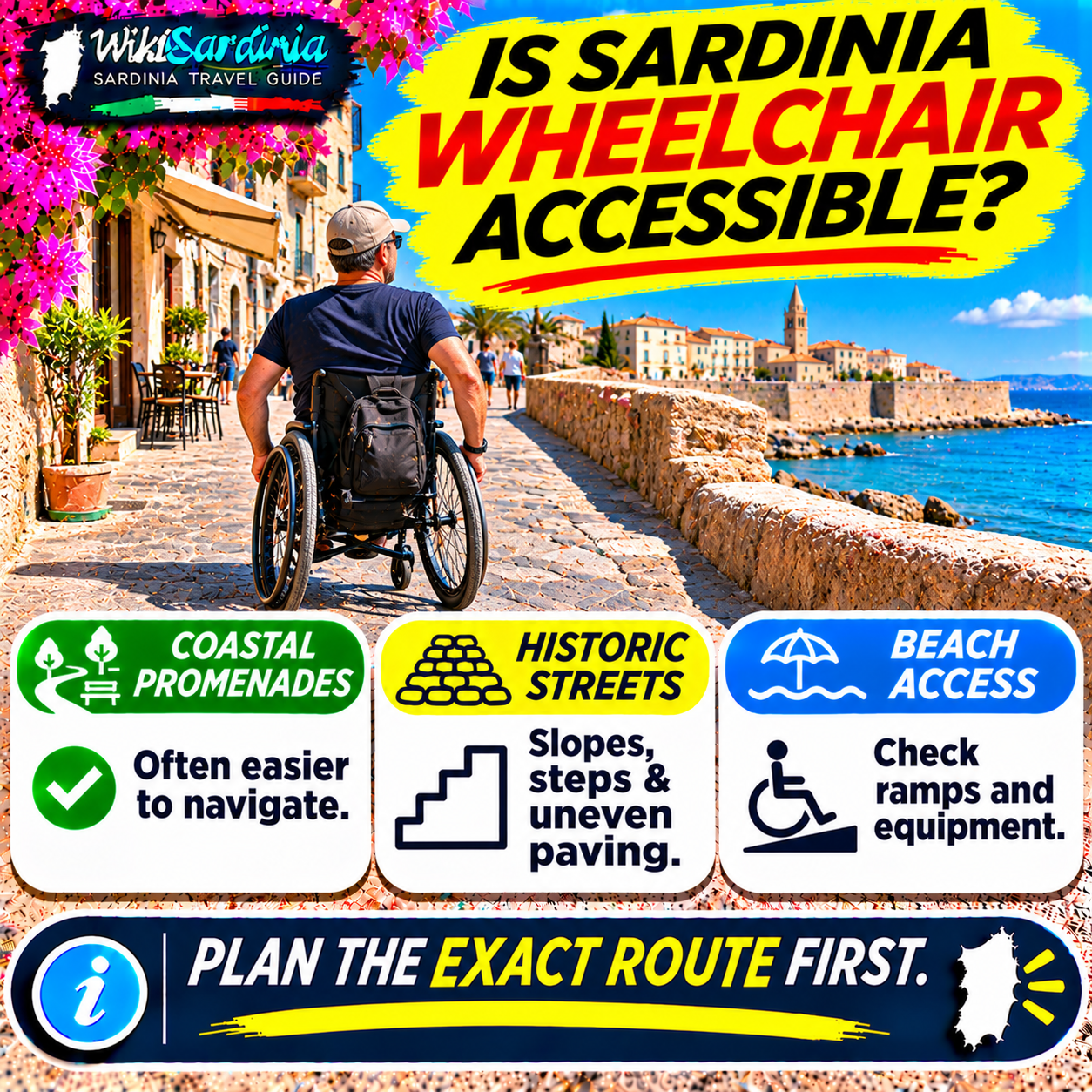
Many Sardinian coastal towns can be enjoyed by wheelchair users, but accessibility varies dramatically from one street, building and beach entrance to another. Waterfront promenades and newer districts may be easier to navigate than historic centers with irregular stone paving, steep gradients, steps and narrow doorways. Do not assume a whole town is either accessible or inaccessible: plan the exact route between your accommodation, parking, restaurants and attractions.
Are steep cobblestones a major barrier?
They can be, especially for manual wheelchair users. Old paving stones, joints, drainage channels and uneven surfaces may cause vibration or catch small front casters. Steep ramps can be exhausting or unsafe, while staircases and raised thresholds may make a route impossible without an alternative entrance. Powered wheelchairs can also encounter problems with turning space, traction, gradients and battery range. A scenic pedestrian street is not necessarily a step-free accessible route.
Is Alghero's old town wheelchair accessible?
Alghero has attractive waterfront routes and a relatively compact historic center, but its paved lanes, thresholds and individual entrances require route-by-route checks. Some areas near the port and seafront can be more manageable than older side streets. The local tourism brochure Alghero Ticket uses distinct symbols for accessible sites, sites requiring a companion and inaccessible sites, an important reminder that not every historic attraction has the same level of access. Ask your hotel for a tested step-free route to the old town, not just the distance to the center. The Municipality of Alghero announced further work on accessible tourism in July 2026; that initiative does not establish that every existing street is barrier-free.
What about Cagliari?
Cagliari has both lower coastal areas and elevated historic neighborhoods. A route along a waterfront or beach promenade may be easier than one climbing into the upper old town. The city's steep streets and stairs can make a seemingly short distance impractical for wheelchair users. Choose accommodation with convenient access to the places you want to visit, and ask whether your intended route has an elevator, a continuous ramp or a step-free alternative. Do not rely on a mapping app's walking-time estimate to assess wheelchair accessibility.
Are smaller coastal villages easier?
Not automatically. Some modern waterfront areas offer relatively level routes, while older hilltop centers and fishing villages can have steep alleys, irregular surfaces and few alternative paths. Castelsardo, Bosa and other picturesque destinations should be evaluated street by street. If a town is built on a hillside, verify where an accessible parking area or vehicle drop-off is located and whether you can reach your intended viewpoint without stairs. A wheelchair-friendly beach does not guarantee an accessible old town nearby.
Which Sardinian beaches offer wheelchair access?
The official SardegnaTurismo accessible-travel guide says some beaches provide walkways toward the sea, beach wheelchairs and adapted facilities, while urging visitors to contact local tourist offices or municipalities to confirm the exact services. Its Lazzaretto beach page lists the main beach near Alghero as accessible. That label does not prove that every cove, path, restroom or water-entry point is independently accessible.
What changed in 2026?
The Sardinian regional government launched the L'Isola che accoglie initiative for more accessible beach tourism in 2026. Its 2026 results report describes a pilot setup at Monti d'A Rena on La Maddalena with a modular walkway, accessible beach area and SeaTrac equipment to assist entry into the sea. The same report documents SeaTrac equipment, a walkway and bathing chairs at Punta Tegge, while identifying improvements still needed at Cala Spalmatore. These are location-specific facilities, not a guarantee that equipment is available year-round or without booking. Ask about operating dates, trained staff, transfer assistance, tide and weather conditions before travelling.
Is Poetto beach in Cagliari accessible?
Cagliari has operated targeted beach-access support at Poetto. A municipal announcement for summer 2026 describes services including a wheelchair-equipped vehicle for eligible users and assistance at the Golfo 1 and Golfo 7 beach stations on specified days. That announcement describes a particular 2026 program, not a permanent daily guarantee or automatic eligibility for visiting tourists. Contact the municipality or beach operator for current conditions, availability and booking rules.
What should I ask about beach access?
Ask whether there is an accessible route all the way from the parking area to the usable beach surface, whether a boardwalk reaches the water, whether beach wheelchairs or SeaTrac equipment are operational, whether staff assistance is provided and whether adapted toilets and changing rooms are open. Also ask whether the service requires a reservation, has seasonal dates or charges a fee. A beach may have a ramp to the sand but no safe way to enter the sea.
How can I choose an accessible hotel?
Do not rely only on a generic “accessible” badge. Request measurements and photographs of the entrance, elevator, door clearances, bed transfer space, bathroom turning area and shower. Confirm whether the room is reached without steps, whether the shower is roll-in and whether grab bars and shower chairs are available. Ask about steep access roads and the route from the room to breakfast, the pool and the beach. If you use a powered wheelchair, verify charging arrangements and any equipment weight restrictions. Obtain written confirmation of the features you require.
Are buses, trains and taxis wheelchair accessible?
Accessibility varies by operator, vehicle, stop and route. SardegnaTurismo notes that many public vehicles have boarding platforms but that boarding may not always be possible without assistance. Ask the specific transport company whether your service is accessible, whether assistance must be booked and whether the boarding point is suitable. Accessible taxis or adapted transfers should be reserved well ahead where possible; a regular taxi with a large trunk is not the same as a vehicle that can carry an occupied wheelchair safely.
Can I use a US disability parking permit?
The official regional tourism guidance says Italy recognizes disability parking permits from several non-EU countries, including the United States, but local municipalities regulate the use of reserved spaces. Do not assume a US placard automatically grants every local parking or restricted-traffic-zone privilege. Contact the municipal police (Polizia Locale) to confirm documentation, display requirements and any registration needed for access to a ZTL. Accessible parking spaces may still be a distance from the entrance you need.
What about restaurants and historic attractions?
Call ahead and ask whether there is a step-free entrance, an accessible restroom and enough turning space at the table. A restaurant may have an accessible dining room but a restroom down a staircase. Historic towers, churches, archaeological sites and viewpoints may have unavoidable stairs or restricted access to upper levels. Ask what part of the attraction is accessible, whether a companion is needed and whether alternative visitor experiences are available. “Wheelchair accessible” should describe a specific route and service, not simply a ground-floor doorway.
How should I plan a day out?
- Choose one or two destinations rather than assuming every nearby historic site is easy to connect on foot.
- Ask your accommodation for a tested step-free route and identify the nearest appropriate drop-off point.
- Check the surface, gradient, curb cuts and steps using current photos, official access information or direct local confirmation.
- Confirm toilets, restaurants and transport accessibility, not only the main attraction.
- Allow extra time and identify a fallback route if construction, market stalls or parked vehicles obstruct the pavement.
- In summer, carry drinking water, plan shaded breaks and avoid being stranded on an exposed steep route.
Useful Italian phrases
“È accessibile in sedia a rotelle?” — Is it wheelchair accessible? “C'è un ingresso senza gradini?” — Is there a step-free entrance? “La strada è ripida?” — Is the street steep? “Ci sono sampietrini o pavé sconnesso?” — Are there uneven paving stones? “Avete un bagno accessibile?” — Do you have an accessible restroom? “È disponibile una sedia da mare?” — Is a beach wheelchair available? “Serve prenotare l'assistenza?” — Must assistance be booked? “Dov'è il parcheggio riservato più vicino?” — Where is the nearest designated accessible parking?
Official sources
SardegnaTurismo — disabled travellers; SardegnaTurismo — accessible beaches; Alghero Ticket — attraction accessibility symbols; Municipality of Alghero — accessible tourism initiative, July 2026; Region of Sardinia — 2026 beach-access project results; Municipality of Cagliari — 2026 Poetto assistance program.
The WikiSardinia takeaway
Sardinia can be a rewarding wheelchair-accessible destination, but its historic coastal towns are not uniformly barrier-free. Waterfront promenades, selected beaches and some modern facilities may be manageable, while cobblestones, steep streets, steps and narrow doorways can be serious barriers. The most useful planning question is not “Is this town accessible?” but “Can I travel safely and independently along this exact route, at the dates I am visiting?” Confirm each essential link in advance.