Sardinia's west coast is spectacular: long sandy beaches, powerful Atlantic-facing-looking surf and dramatic stretches of open Mediterranean shoreline. But if you're planning to swim near Oristano, the Sinis Peninsula, Bosa or other exposed areas, you may have heard warnings about strong currents or risacca. Are those warnings justified?
Yes. Dangerous currents can form on Sardinian beaches, particularly where breaking waves and local seabed conditions create rip currents. Exposed west-coast beaches deserve special care when wind and swell increase. However, not every west-coast beach is dangerous, and conditions can change substantially from one day—or one section of beach—to another.
What is a rip current?
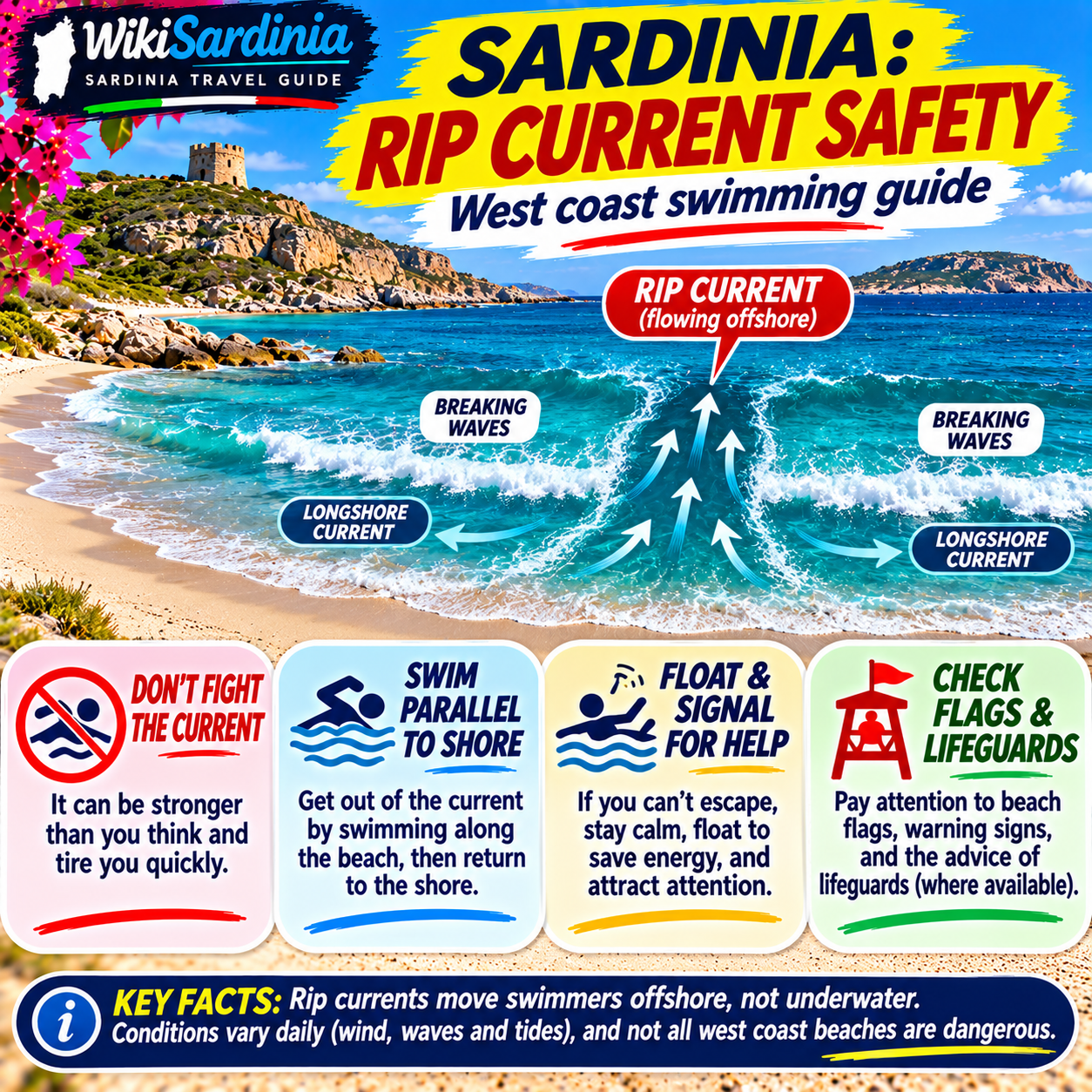
A rip current, known in Italian as a corrente di ritorno, is a relatively narrow, sometimes fast-moving flow of water travelling away from the shore through the surf zone. Waves push water toward the beach; under certain conditions, part of that water returns offshore through channels or gaps in the breaking waves.
Rip currents can form where waves break over sandbars, near gaps in sandbanks and around certain coastal structures. They can affect swimmers of all abilities. Their strength can fluctuate quickly, so a beach that seemed manageable moments earlier may become difficult.
Italy's environmental research institute ISPRA identifies rip currents among the principal physical hazards at Italian bathing beaches.
Do rip currents pull you underwater?
No. A rip current typically carries a swimmer away from the shore, not downward beneath the water. The danger is that a person may panic, become exhausted trying to swim directly against the flow, or end up too far from shore to return safely.
The English word undertow is often used loosely and can be misleading. Water flowing back down the beach after a breaking wave—called backwash—may knock people off their feet, especially children, but it is not the same as a narrow rip current moving offshore. The US National Weather Service explains these differences in its beach-safety guidance.
Why can Sardinia's west coast be challenging?
Parts of the western Sardinian coastline face a broad stretch of open sea and can receive substantial wave energy when the wind and swell approach from exposed directions. The Maestrale, a northwesterly wind familiar across the island, can contribute to rough seas on exposed coasts, although the actual effect depends on wind direction, beach orientation and local geography.
Breaking waves and the shape of the seabed may create channels where water flows seaward. Longshore currents can also move swimmers sideways along the beach. None of this means the entire west coast is permanently unsafe: sheltered bays may behave differently from broad open beaches, and the same beach may change character with the weather.
The Italian Civil Protection Department advises avoiding swimming and boating during strong wind and storm-surge conditions.
Which beaches should visitors be especially careful at?
Approach exposed surf beaches with caution, including long open stretches along Sardinia's western side and beaches where waves are visibly breaking strongly. Areas around the Sinis Peninsula, Bosa and other western coastal destinations are examples of places where it is sensible to check sea conditions before swimming—not a scientifically established ranking of the island's most dangerous beaches.
Even a familiar, popular beach can become hazardous on a rough day. Conversely, a west-facing beach may be calm and suitable for swimming under favourable conditions. Avoid judging safety from the beach's reputation alone.
How can you recognise a possible rip current?
Look from a safe vantage point before entering the sea. Signs may include a darker-looking channel or gap between lines of breaking waves, a narrow strip of choppy water, or foam, sand and floating debris moving steadily away from the beach.
ISPRA highlights breaks in the surf line and offshore-moving foam or debris as potential clues. However, not every rip current is clearly visible, and a deceptively calm-looking gap between waves can sometimes be the most dangerous section. If you are unsure, ask a lifeguard rather than trying to diagnose the water yourself.
What should you do if caught in a rip current?
First, stay as calm as possible and do not try to overpower the current by swimming directly toward shore. Fighting it can rapidly exhaust even a strong swimmer.
- Do not fight the current. Conserve your energy and focus on breathing.
- Try to move sideways. If you can swim safely, move parallel to the shoreline to escape the narrow offshore flow, then head toward the beach at an angle when clear.
- Float if necessary. If you cannot escape immediately, float or tread water calmly to save energy.
- Signal for help. Raise an arm, shout and attract the attention of lifeguards or people on shore.
These steps reflect guidance from the National Weather Service. The safest response depends on your strength, distance from shore, surf conditions and available assistance.
What if you see someone else struggling?
Alert the lifeguard immediately. If no lifeguard is available, call 112, Italy's emergency number, and give the exact beach location. If possible, throw a suitable flotation aid from a safe position.
Do not rush into the surf without rescue training and equipment: untrained rescuers can quickly become additional victims. Continue to direct the person to float and signal while professional help is on the way.
Do beach flags and lifeguards matter?
Absolutely. Pay attention to local warning flags, signs and instructions from the beach rescue service. A red flag is a serious warning of unsafe swimming conditions; do not enter the water when swimming is prohibited or lifeguards advise against it.
Flag systems and lifeguard coverage can vary by location and season. An unguarded beach is not necessarily safe because no warning flag is visible. If conditions look rough and there is nobody to ask, choosing not to swim is a sensible decision.
Are rip currents dangerous for children?
Yes. Children and inexperienced swimmers are particularly vulnerable because a sudden offshore flow, breaking wave or steep drop-off can overwhelm them quickly. Keep young children within close, active supervision, not merely in sight from a distant beach towel.
Shallow water is not automatically risk-free. Breaking waves and backwash can knock children off their feet, and a sloping seabed can become deep abruptly. If surf is strong, enjoy the beach from dry sand rather than entering the water.
Can strong swimmers or surfers ignore the risk?
No. Experienced swimmers can also be caught in strong rip currents. Surfers may sometimes use currents strategically, but that requires local knowledge and does not make the same conditions suitable for casual swimming.
Do not rely on swimming ability alone. Respect local restrictions, never swim alone in challenging conditions and do not assume a bodyboard or inflatable toy is adequate rescue equipment.
How do wind and the Maestrale affect swimming?
Wind direction and strength can change the height and direction of waves and influence nearshore currents. On an exposed beach, persistent onshore winds can produce a powerful surf zone. Offshore winds can create different risks, including pushing inflatable devices away from shore.
The safest plan is to check official weather and marine forecasts, look for Civil Protection alerts and assess conditions on arrival. If there is a warning for strong winds or stormy seas, avoid swimming.
Can you find a safer beach when the west coast is rough?
Sometimes another coastline or a more sheltered bay may have calmer conditions, but do not assume a particular beach is safe solely because it faces a different direction. Swell can wrap around headlands, local currents can still form and lifeguard availability varies.
Choose a supervised beach with calm water, follow current local advice and avoid unfamiliar remote beaches when conditions are unsettled. If no suitable beach is available, switch to sightseeing or another land-based activity.
Frequently asked questions
Are Sardinia's west-coast beaches always dangerous?
No. Conditions vary with weather, waves, seabed shape and location. The risk rises on exposed beaches when surf is strong.
Do rip currents drag swimmers underwater?
No. They move water and swimmers away from the shore. Panic and exhaustion are major dangers.
What is the difference between a rip current and undertow?
A rip current is a channel of water moving offshore through the surf. “Undertow” is often used inaccurately for this process; nearshore backwash can knock people over but is different.
Can I spot a rip current by looking for calm water?
A gap in breaking waves may be a clue, but it is not a reliable test on its own. Ask a lifeguard and heed warnings.
Should I swim directly against the current?
No. Conserve energy. If possible, move parallel to the shore to leave the current, then return toward land.
What if I am too tired to swim sideways?
Float or tread water, remain calm and wave or shout for help.
Can children swim safely in shallow surf?
Not necessarily. Breaking waves, backwash and sudden changes in depth can be dangerous even close to shore. Active supervision is essential.
Who do I call for a water emergency in Sardinia?
Call 112 and provide your location. Alert a lifeguard immediately if one is present.
The bottom line
Sardinia's western beaches can be wonderful places to swim, but open-sea exposure deserves respect. Learn to recognise rip-current clues, check flags and forecasts, and never fight a current that is carrying you offshore. If the sea looks rough or local warnings advise against bathing, stay out of the water. The best beach day is one that ends safely.