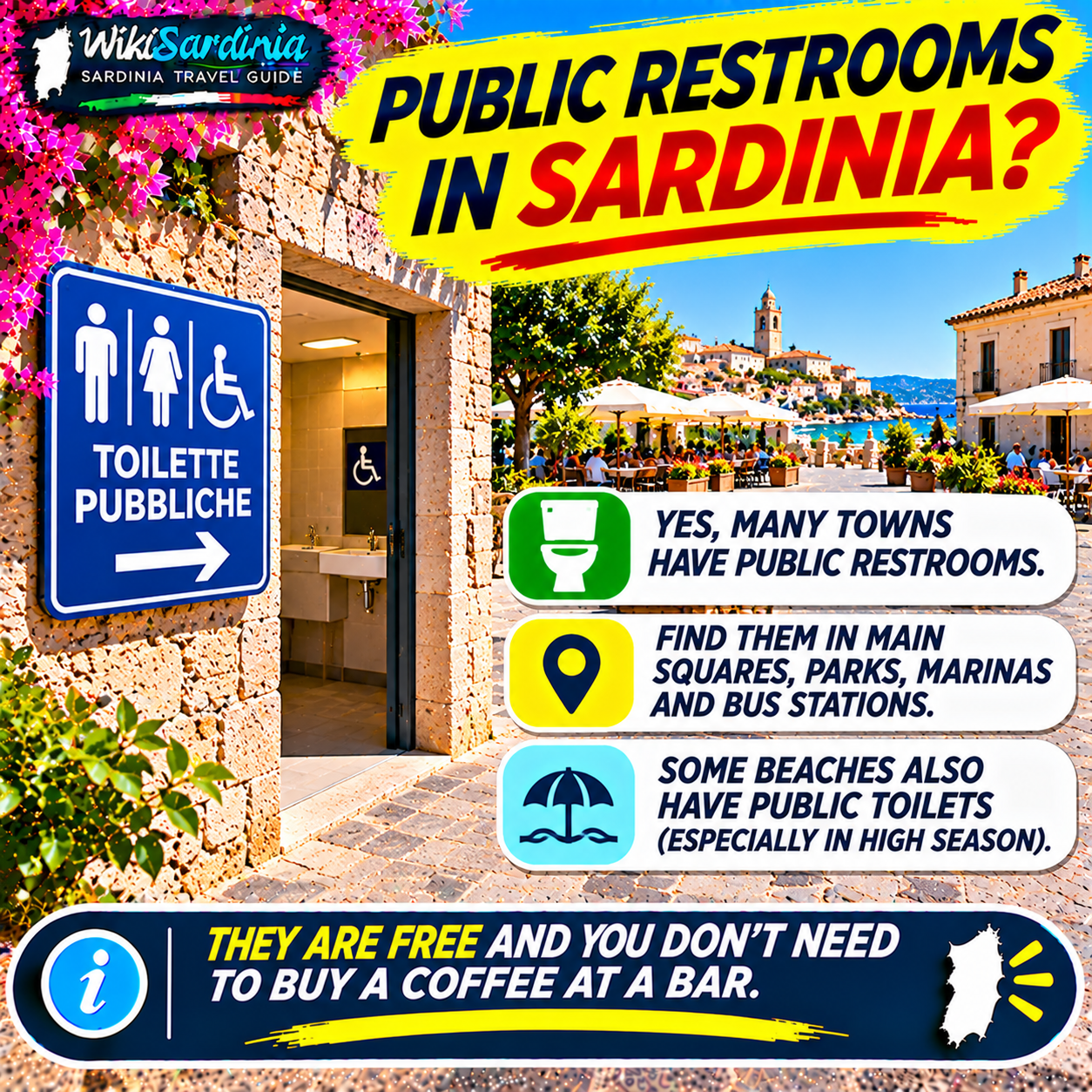
Yes, some towns in Sardinia have public restrooms that you can use without buying a coffee or becoming a customer at a bar. But availability is inconsistent: a large town, marina or busy tourist destination may have dedicated facilities, while a small inland village may have no clearly signed public toilet at all. Opening hours, charges, accessibility and seasonal operation vary by location. The safest approach is to identify a restroom before starting a long walk or heading to a remote beach.
Where can I find a public restroom in a Sardinian town?
Look for signs reading bagni pubblici, servizi igienici, WC or toilette pubbliche. Possible locations include municipal facilities near central squares, public parks, markets, tourist offices, larger transport terminals, ports and marinas. These are places worth checking, not a promise that every one contains a public restroom. Municipal tourist offices can tell you which facilities are currently open.
Do I have to buy a coffee to use the bathroom?
Not when you are using an independently operated public restroom. A municipal toilet is separate from the facilities provided by a café. In a bar or restaurant, however, the restroom is usually intended for customers, and a noncustomer should ask permission rather than assume access. Some businesses may kindly allow it without a purchase; others may refuse. Ordering a coffee is a common practical workaround, not a universal legal requirement for using any toilet in Sardinia.
Are public toilets free?
Some are free, while others may require a small fee, coin, payment terminal or access token. There is no verified island-wide tariff. Look for a posted price before entering and keep a few euro coins handy when visiting small towns. Do not assume a facility is free simply because it is municipally owned, or paid simply because it is beside a transport hub.
Are public restrooms open all day?
Not necessarily. Opening hours can follow the municipal office schedule, park opening times, tourist season or cleaning arrangements. Facilities may be closed for maintenance, in winter or during holidays. A map listing marked “public toilet” does not prove the door is open now. Ask the tourist office, check the municipality's official information or verify locally.
What about historic inland villages?
In small inland settlements, restroom facilities may be limited and poorly signposted. Before exploring narrow streets or walking to a viewpoint, ask at the ufficio turistico, museum, visitor center or municipal office. A museum or other attraction may have customer-only or ticket-holder facilities, so check access conditions. If no public restroom is available, politely ask a café whether you may use its toilet and whether a purchase is expected.
Can I find toilets at beaches?
Some equipped beaches have restrooms at beach clubs, public service areas, parking facilities or nearby businesses, especially in summer. But a beach bar's toilet is not automatically a public facility, and remote coves may have none. At seasonal sites, facilities can close outside the main visitor period. Before a long beach day, check the beach's official access information and ask whether restrooms are public, customer-only, accessible or fee-based.
What about train stations, bus stations and ferry ports?
Larger terminals may offer toilets, sometimes with restricted hours or a charge, while small bus stops and rural rail stations may have no facilities. Do not plan a long transfer around an assumed station bathroom. Where a terminal has a staffed information desk, ask about the nearest open restroom and any access restrictions.
Are accessible toilets available?
Some public and commercial facilities provide accessible toilets marked bagno accessibile or with the wheelchair symbol. However, the sign alone does not guarantee the toilet is open, unobstructed or suitable for every mobility need. Ask about step-free access, door width, assistance arrangements and opening hours before traveling. Do not assume every historic building or small village restroom is accessible.
Are baby-changing facilities common?
They are not guaranteed. Some shopping centers, larger visitor facilities and family-oriented venues may have a changing table, but many small public restrooms do not. Ask for a fasciatoio and carry your own changing supplies. Avoid assuming that the only available changing area is in a women's restroom; ask staff about family or accessible facilities where appropriate.
How do I search for a toilet on my phone?
Search maps for “bagni pubblici”, “toilette pubbliche” or “WC pubblico” plus the town name. Check recent reviews and photographs, but treat them as leads rather than proof of current availability. Municipal websites and tourist offices are better sources for official hours and any fee. In rural areas, download the map beforehand because mobile reception may be unreliable.
Can I use a restaurant bathroom without ordering?
You can ask politely: “Scusi, posso usare il bagno anche se non sono cliente?” (“Excuse me, may I use the bathroom even though I'm not a customer?”). The answer depends on the venue and circumstances. Do not present a general entitlement to use every private restaurant toilet. If the business says no, ask where the nearest public facility is instead.
What should I expect inside?
Cleanliness and supplies vary. Carry a small pack of tissues and hand sanitizer, particularly for long rural excursions. Some toilets have no paper, soap or functioning hand dryer at the moment you visit. Follow posted instructions and dispose of waste properly. If a facility is out of order, report it to staff rather than entering a closed area.
What if I urgently need a restroom?
Ask the nearest open public facility, café, hotel reception or tourist office for help, explaining that it is urgent. If you have a medical condition requiring reliable access, plan stops ahead and check accessibility and hours rather than relying on an unverified map pin. For a genuine medical emergency, seek appropriate assistance; an ordinary lack of restroom access is not itself a reason to call emergency services.
Useful Italian phrases
“Dove sono i bagni pubblici?” — “Where are the public toilets?” “Sono gratuiti?” — “Are they free?” “Sono aperti oggi?” — “Are they open today?” “Posso usare il bagno senza consumare?” — “Can I use the bathroom without buying anything?” “C'è un bagno accessibile?” — “Is there an accessible toilet?” “C'è un fasciatoio?” — “Is there a baby-changing table?”
Before heading out: restroom checklist
- Search for public toilets near your destination and check for recent, credible opening information.
- Ask the municipality or tourist office if the listing is unclear.
- Bring small euro coins, tissues and hand sanitizer.
- Check accessibility and baby-changing facilities in advance if needed.
- Use a confirmed restroom before long drives, hikes or visits to remote beaches.
- When asking to use a café restroom, be courteous and respect the business's policy.
The WikiSardinia takeaway
You do not need to buy a coffee just to use a genuine public restroom in Sardinia. The challenge is finding one that is actually open: facilities are unevenly distributed, some charge a fee and many smaller villages or beaches have limited provision. Plan ahead, ask locally and distinguish municipal public toilets from restrooms reserved for customers.