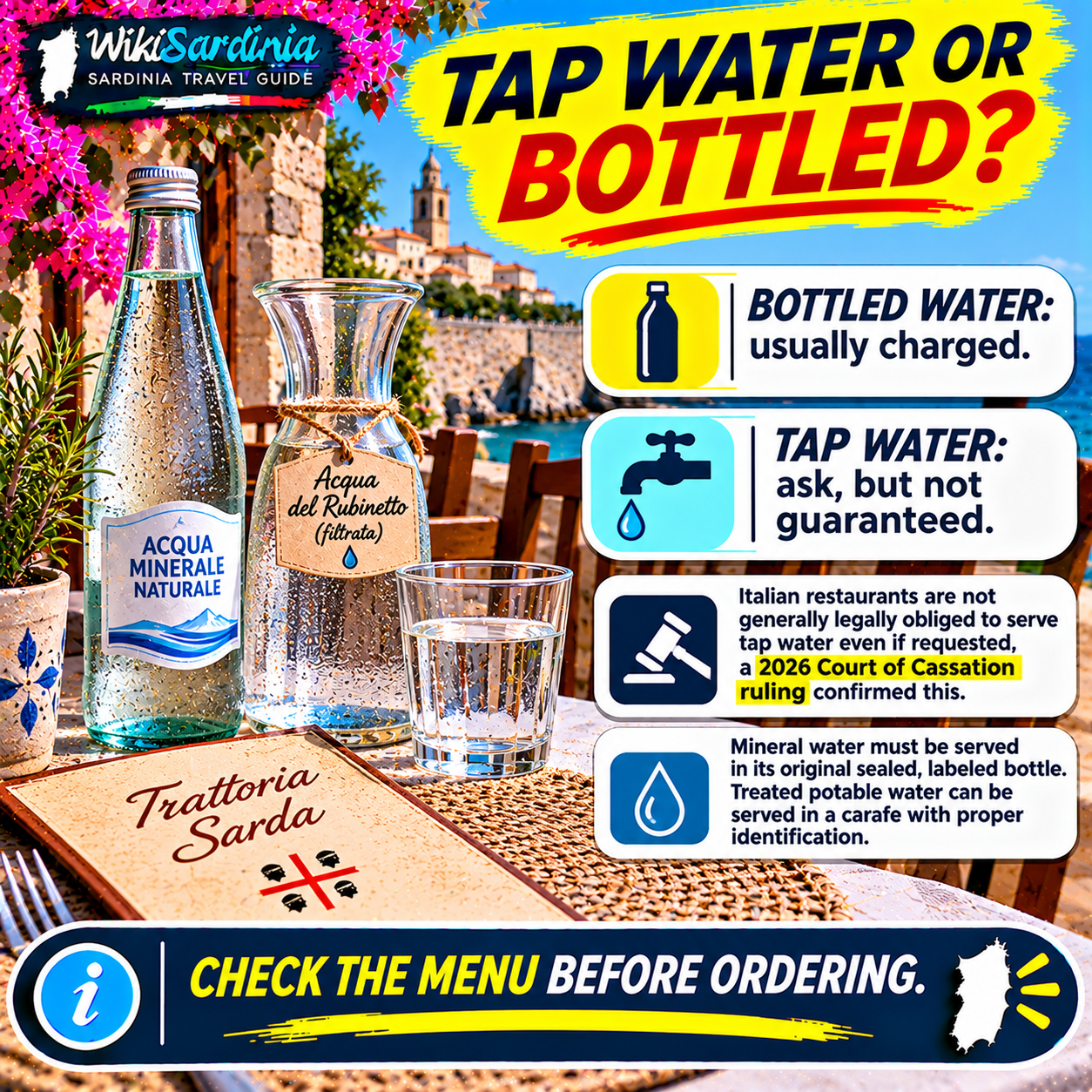
In Sardinian restaurants, it is customary to pay for bottled water, and you are welcome to ask for tap water—but the restaurant does not have to serve it. For travelers from the United States, this is an important difference: a free pitcher of tap water is not automatically brought to the table. Italian restaurants commonly ask whether you prefer acqua naturale (still) or acqua frizzante (sparkling), and then bring a bottle or another paid water service.
Can I ask for tap water in a Sardinian restaurant?
Yes. Politely ask “Posso avere dell'acqua del rubinetto, per favore?” (“May I have some tap water, please?”). Some restaurants may provide it, free or at a stated charge, while others offer only bottled or filtered water. Asking is normal; demanding it as a legal entitlement is not. The restaurant's actual policy matters more than assumptions based on dining customs in another country.
Is a restaurant legally required to give me tap water?
No, not as a general rule in Italy. The Italian Court of Cassation's order no. 11827 of April 29, 2026 confirmed that restaurants and hotels are not under a general legal obligation to serve tap water to guests. The Italian hospitality association FIPE explains that Article 17(2) of Legislative Decree 18/2023 encourages measures to promote tap-water availability, but does not impose a direct universal obligation on individual restaurants. See FIPE's September 2026 legal explanation. A venue can therefore decline a request even if the guest offers to pay.
Is bottled water normally charged?
Yes. Bottled mineral water is commonly listed as a paid menu item in Italian restaurants. The price depends on the venue, bottle size and type of water. Check the menu or ask before ordering. There is no single Sardinia-wide bottle price, and a premium waterfront restaurant may charge differently from a village trattoria. If a waiter asks “Naturale o frizzante?”, that question usually concerns your preference for still or sparkling water—not whether you want free tap water.
What about glass bottles?
Glass packaging does not determine whether the water is free. A sealed glass bottle may contain commercial natural mineral water and be charged like any other bottled product. A reusable glass bottle or carafe may contain tap water that has been filtered, chilled or carbonated by the restaurant. Ask “È acqua minerale in bottiglia o acqua filtrata?” to find out what is being served, and check its listed price.
How can I tell mineral water from filtered tap water?
Italy's National Institute of Health explains that natural mineral water must be served in its original sealed, labeled bottle in a public establishment. Treated drinking water served in a carafe or reusable container must be properly identified as acqua potabile trattata, or acqua potabile trattata e gassata when carbonated. See the Istituto Superiore di Sanità guidance. Do not assume that every carafe contains bottled mineral water.
Can restaurants charge for filtered or tap water?
They may charge for a water service according to their commercial policy, subject to applicable price-disclosure requirements. The relevant distinction is whether the price was made clear before ordering. If you specifically want free tap water, ask both whether it is available and whether it costs anything. A restaurant offering a paid filtered-water carafe is not necessarily offering free tap water.
Is tap water safe to drink in Sardinia?
Public drinking water in Italy is regulated and monitored under national drinking-water standards, including Legislative Decree 18/2023. However, safety at a specific address can depend on the local supply, building plumbing and any temporary restrictions. Do not claim that every tap on the island is always drinkable. Check current municipal notices, the local water operator and any acqua non potabile signs. If a temporary non-potability notice applies, follow its instructions rather than relying on general travel advice.
Can I refill my water bottle at a restaurant?
You can ask, but the restaurant is not automatically required to refill a personal bottle. A café or hotel may be willing to help, particularly if you are a customer, but hygiene and service policies vary. If a public fountain is labeled acqua potabile, it indicates drinking water; if it says acqua non potabile, do not drink from it. Check for local restrictions and use clean refillable bottles.
What if the waiter brings bottled water without asking?
Before opening it, politely clarify whether it was ordered and what it costs. If you do not want it, say so immediately rather than waiting until the end of the meal. When reviewing the bill, compare the water charge with the menu. Keep the discussion calm and ask for clarification if you believe an item was added by mistake.
Is water included in the coperto or service charge?
Not automatically. A coperto is a separately disclosed table or place-setting charge where applied; it should not be confused with the price of drinks. Water, bread, service and cover charges may be listed separately depending on the restaurant. Read the menu rather than assuming the cover charge includes a bottle of water.
What should families and budget travelers do?
Check the menu before ordering multiple bottles, particularly in a group. Ask whether a larger bottle or a house-filtered carafe is available and what it costs. For children, carry a suitable refillable bottle when exploring towns and beaches, and plan access to drinking water during hot weather. Do not compromise hydration simply to avoid a restaurant charge.
Is asking for tap water considered rude?
No. A courteous request is reasonable, although it may be less customary than ordering bottled water. A server may simply explain that the restaurant does not provide it. There is no need to argue or assume that a refusal is targeted at tourists; the policy can apply to all customers.
Useful Italian phrases
“Posso avere acqua del rubinetto?” — “Can I have tap water?” “È gratuita?” — “Is it free?” “Quanto costa una bottiglia d'acqua?” — “How much is a bottle of water?” “Acqua naturale, per favore.” — “Still water, please.” “Acqua frizzante, per favore.” — “Sparkling water, please.” “È acqua filtrata?” — “Is it filtered water?” “L'acqua del rubinetto è potabile?” — “Is the tap water safe to drink?”
Before ordering: a practical checklist
- Check the water section of the menu for bottle sizes and prices.
- Ask specifically for acqua del rubinetto if you want tap water.
- Confirm whether any tap-water or filtered-water service is free or paid.
- Distinguish sealed mineral-water bottles from refillable filtered-water carafes.
- Check local drinking-water notices if you plan to refill a bottle.
- Review the bill and ask promptly about any unexpected water charge.
The WikiSardinia takeaway
Expect to pay for bottled water in Sardinian restaurants, including glass bottles. You can always politely ask for tap water, but Italian restaurants are generally not obliged to provide it, free or otherwise. Confirm the price and whether the water is bottled mineral water or treated drinking water before ordering. This small bit of local dining knowledge can prevent confusion and make your meal more relaxed.