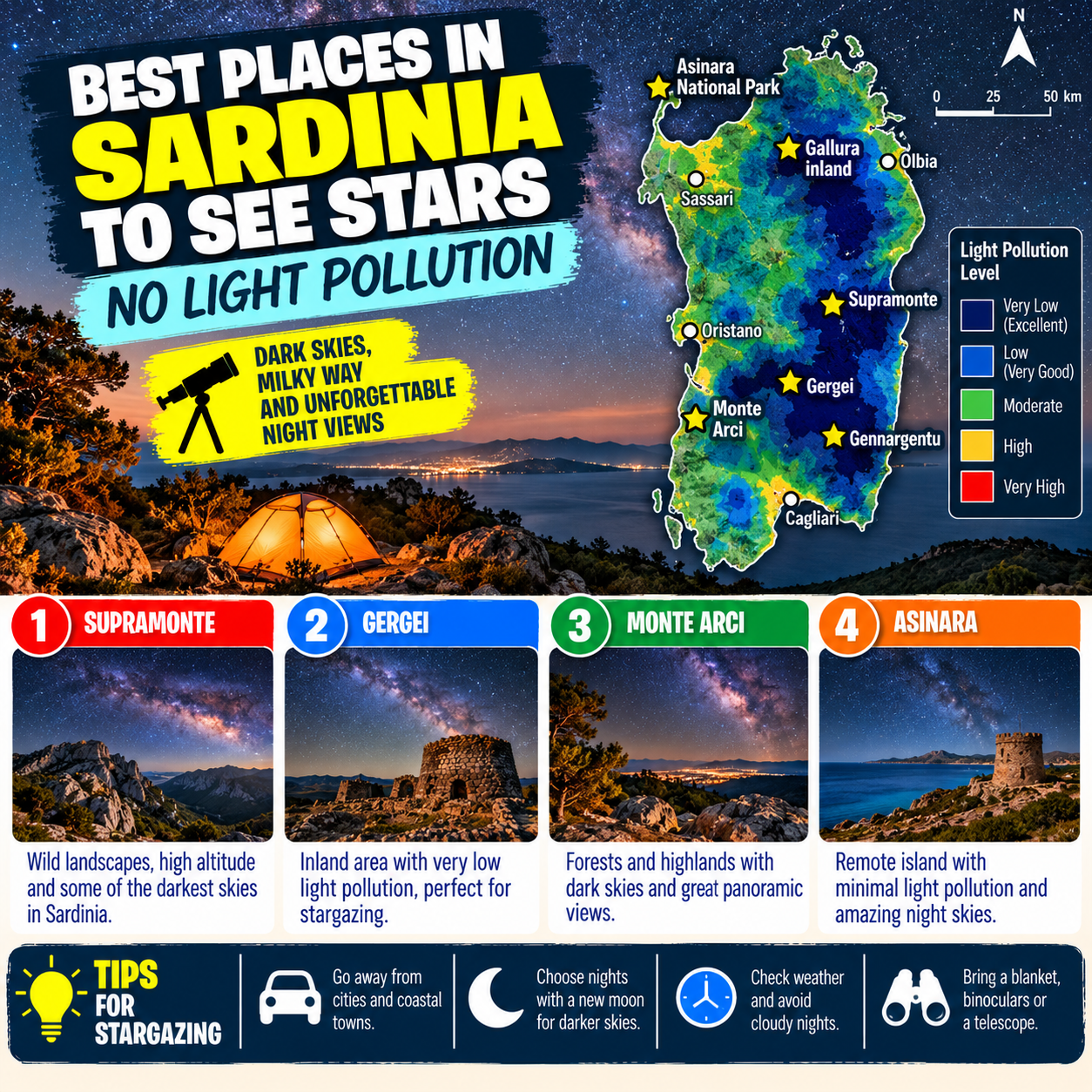
Sardinia has plenty of rural landscapes where the night sky can look spectacular, especially away from towns, resorts and main roads. For a stargazing trip, start by exploring the Supramonte or the countryside around Gergei in central-southern Sardinia. Neither place is guaranteed to have zero light pollution everywhere, so use a current light-pollution map to choose a specific, accessible viewpoint before setting off.
1. Supramonte: mountains and wide horizons
The Supramonte area is known for rugged limestone landscapes, remote countryside and relatively sparse settlement in many parts. Away from illuminated roads and villages, you may find darker skies and wide views of the stars. Conditions differ across this large area, however, and some trailheads, roads or visitor facilities may have lights nearby.
Choose a legal viewpoint or an established stopping place rather than pulling over on a narrow road. Mountain terrain can be difficult to navigate after dark, so avoid unfamiliar trails at night unless you are properly equipped and know the route.
2. Gergei and the central Sardinian countryside
The rural landscape around Gergei can be another good candidate for stargazing because you can look for open horizons away from larger urban areas. Use a light-pollution map to compare locations around the village and check for nearby streetlights, farm buildings and roads. A short drive into the countryside does not automatically guarantee a completely dark sky.
Before visiting private land or farm tracks, make sure access is permitted. Park without blocking gates or agricultural traffic, and keep headlights and torches pointed away from other people who may be observing the sky.
3. How to use a light-pollution map
A light-pollution map helps you compare the brightness of the night sky in different places. It is a planning tool, not a promise of what you will see on a particular night. Choose a location with low mapped light pollution, then check the actual horizon and nearby light sources when you arrive.
- Compare several spots: look beyond the nearest town and check whether a road, resort or industrial area is visible nearby.
- Check the moon phase: a bright Moon can wash out faint stars and the Milky Way even in a dark location.
- Check clouds and haze: clear, transparent skies matter as much as darkness.
- Look at the horizon: distant towns can create a glow even when the spot itself has no streetlights.
- Plan for the season: the Milky Way’s visibility changes through the year, and the best time depends on what you want to observe.
4. What to bring
- A phone with an offline map and your route saved in advance.
- A red-light torch or a torch with a low setting to preserve night vision.
- Warm layers, even after a hot day, because rural and mountain areas can cool down at night.
- Water and any essentials you need, since facilities may be closed or far away.
- A tripod and camera if you plan to photograph the Milky Way.
5. Stargazing safely and responsibly
Tell someone where you are going, check the weather and avoid cliff edges, ravines and unfamiliar tracks in darkness. Do not enter restricted areas or drive onto unpaved routes unless access is permitted and the vehicle is suitable. Keep noise low, take all rubbish away and avoid shining bright lights towards wildlife, homes or other observers.
Will you see the Milky Way?
Possibly, if the sky is clear, the Moon is not too bright and you choose a suitably dark location at the right time of year. A dark-sky map can help you find promising areas, but it cannot guarantee a Milky Way view. Check the Moon, weather and visibility forecast before travelling, and allow your eyes time to adapt to the dark.
The best approach to dark skies in Sardinia
Start with the Supramonte or the countryside around Gergei, compare exact spots on a current light-pollution map and confirm that you can reach the chosen viewpoint legally and safely. With a clear forecast, little moonlight and a little patience, Sardinia’s inland landscapes can offer a memorable night under the stars.