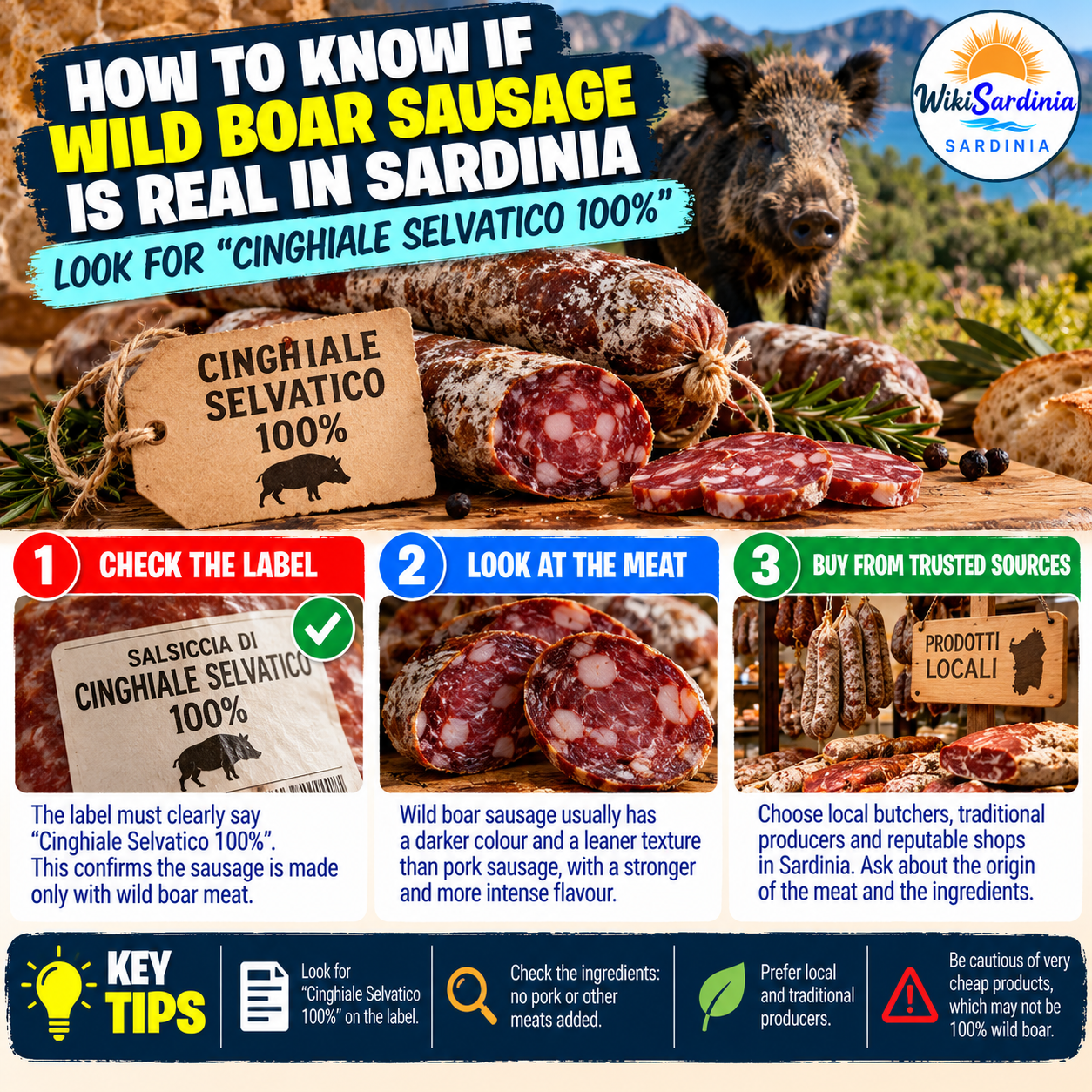
Wild boar sausage, or salsiccia di cinghiale, is a tempting Sardinian food souvenir—but the name alone does not tell you how much wild boar meat it contains. Some sausages are made with wild boar meat mixed with pork fat or pork, which can help give the product the desired texture. If you want to know what you are buying, check the label and ask the butcher or producer directly.
1. Read the ingredient list
Look for “carne di cinghiale” (wild boar meat) in the ingredients and check whether pork, pork fat or other meats are also listed. Ingredients are generally listed in descending order by weight, so the order can offer a clue, but it does not tell you the exact percentage unless that amount is declared.
2. Does the label have to say “100% wild boar”?
No—not as a universal rule for every product sold as wild boar sausage. The phrase “cinghiale selvatico 100%” may be a useful claim if it is accurate and supported by the product information, but its absence does not automatically mean the sausage is fake. The reliable approach is to check the full ingredients and ask the seller for the proportion of wild boar meat.
3. Ask the butcher a direct question
At a Sardinian market or butcher’s shop, ask: “È fatta solo con carne di cinghiale o è mista con maiale?” — “Is it made only with wild boar meat, or is it mixed with pork?” You can also ask what percentage is wild boar and where the meat comes from.
4. Don’t judge by colour or taste alone
Colour, texture, seasoning and flavour can vary with the recipe, curing process and fat content. A dark colour or strong gamey flavour does not prove that a sausage is 100% wild boar, and a milder flavour does not prove that it is fake. Use the label and the producer’s information instead of appearance alone.
5. Check who made it and how it is stored
- Look for producer details: packaging should identify the responsible food business and provide the required product information.
- Ask about the recipe: a reputable butcher should be able to explain whether pork is added and why.
- Check storage instructions: follow the label’s refrigeration and use-by guidance, especially for fresh sausage.
- Keep the receipt and label: these are useful if you need to check the product details later.
6. Buying loose sausage at a market
If the sausage is sold without its original package, ask the vendor to explain the ingredients and meat proportions and whether written product information is available. If the seller cannot clarify what meat is used, choose a product with clearer information rather than relying on a handwritten sign that simply says “cinghiale”.
Useful Italian phrases
- “Quanta carne di cinghiale contiene?” — How much wild boar meat does it contain?
- “È mista con carne o grasso di maiale?” — Is it mixed with pork meat or fat?
- “Posso leggere gli ingredienti?” — Can I read the ingredients?
- “Chi è il produttore?” — Who is the producer?
The simplest way to check
Do not rely on the words “wild boar” or on a claim such as “100%” without checking the product details. Read the ingredients, ask for the percentage of wild boar meat, and confirm whether pork or pork fat is included. Clear information from the producer is much more useful than judging a sausage by its colour or flavour.