If you want to buy a handmade Sardinian knife, Pattada gives you something a generic souvenir shop cannot: the opportunity to speak to a maker about the object itself. The town’s folding-knife tradition is a reason to visit an artisan workshop, compare materials and understand what you are paying for before choosing a piece to take home.
Two documented starting points are the Giagu atelier and Coltelli Artigianali Manca. They are useful leads for planning a visit, rather than a ranking of every maker in town. Current stock, prices and whether a commission can be finished before your flight need to be established directly with the workshop.
Begin with the maker, not just the name
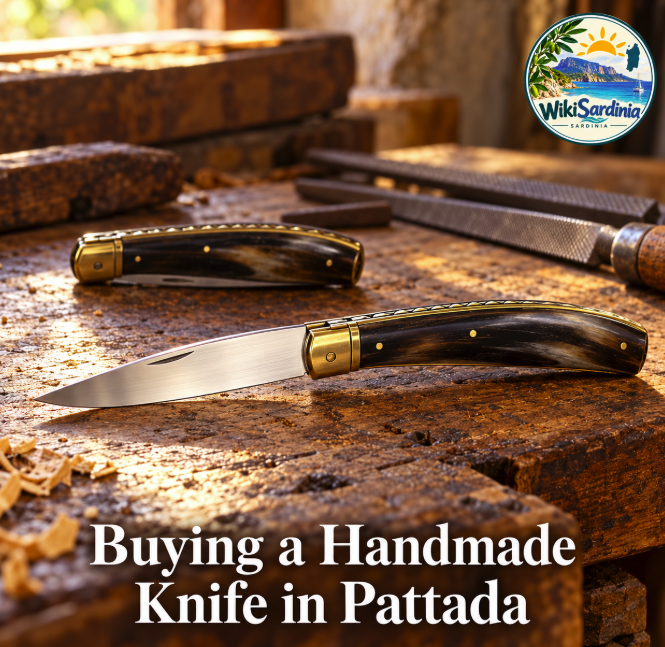
Sardinia’s official tourism portal associates Pattada with the resolza pattadesa, a folding knife with a steel blade and traditionally a horn handle. It also highlights the town’s artisan workshops. The attraction is the combination of local craft, shape and finishing, rather than an assumption that every knife sold under the word “Pattada” was handmade there.
Ask who made the particular piece, where it was produced and what work was done by hand. A maker’s signature and a clear receipt help preserve its provenance. For a gift, write down the maker’s name and the handle material; those details will mean more later than an unsupported claim that it is the “best” knife in Sardinia.
Two workshops to contact in Pattada
Giagu: Via Vittorio Emanuele 52A. The atelier’s own website describes a family workshop producing knives by hand, with a showroom and the Museo Culter in the same building. It says visitors can discuss the models with a member of the family. Contact the workshop through its website or the published landline, +39 079 755918, before making a special trip.
The site publishes opening information, but Sunday times differ between its homepage and atelier page. Confirm your intended arrival time rather than treating either listing as a guaranteed appointment. Also ask whether you can buy a finished piece during the visit or whether the model you like is made to order.
Coltelli Artigianali Manca: Via S’Ena 1. The maker’s official website presents original Pattada knives. The local Tancas Abertas tourism listing identifies Massimo Manca’s workshop at this address and publishes the contact number +39 351 8725650. It describes work with horn and fine woods, giving you useful materials to ask about when comparing individual pieces.
Call ahead with a simple question: “Vorrei acquistare una resolza artigianale. Avete pezzi disponibili e possiamo visitare il laboratorio?” You are asking whether handmade knives are available and whether you can visit the workshop. Add your travel dates if a custom order would interest you.
Choose a piece you understand
Set your budget before discussing decoration. Ask for the total price of the actual knife, including any case, personalisation or delivery, rather than assuming a displayed example represents the cost of every model. Different materials and finishing can make two similarly shaped pieces very different purchases.
Let the maker explain the opening mechanism, blade material and care requirements. Handle a demonstration piece only as instructed and ask how to store the knife safely. For a collector, a distinctive finish may be the priority; for someone buying a keepsake, a simpler traditional design with documented provenance may be more meaningful.
If the handle uses animal-derived material, ask for its exact identity and sourcing documentation. That information is also relevant when checking destination-country import requirements. A purchase receipt does not, by itself, answer every customs question.
Think about the return flight before buying
For US-bound travellers, keep baggage security and import rules separate. TSA guidance lists pocket knives as prohibited in carry-on baggage and allowed in checked baggage; sharp objects should be securely wrapped or sheathed. For departure from Italy, consult ENAC’s cabin restrictions and your airline. Plan checked transport rather than assuming a souvenir purchase can pass through a cabin checkpoint.
US Customs and Border Protection identifies switchblade knives as restricted, subject to limited exceptions. Do not decide a knife’s import classification from a loose English translation of serramanico: ask about the exact mechanism and verify the model with the relevant authority. Destination-state rules and any restrictions on handle materials also require their own check.
If you are travelling with cabin baggage only, settle a lawful shipping or transport arrangement before paying. The most satisfying Pattada souvenir is one whose maker, materials and journey home you have understood—not a last-minute purchase you have to abandon at the airport.