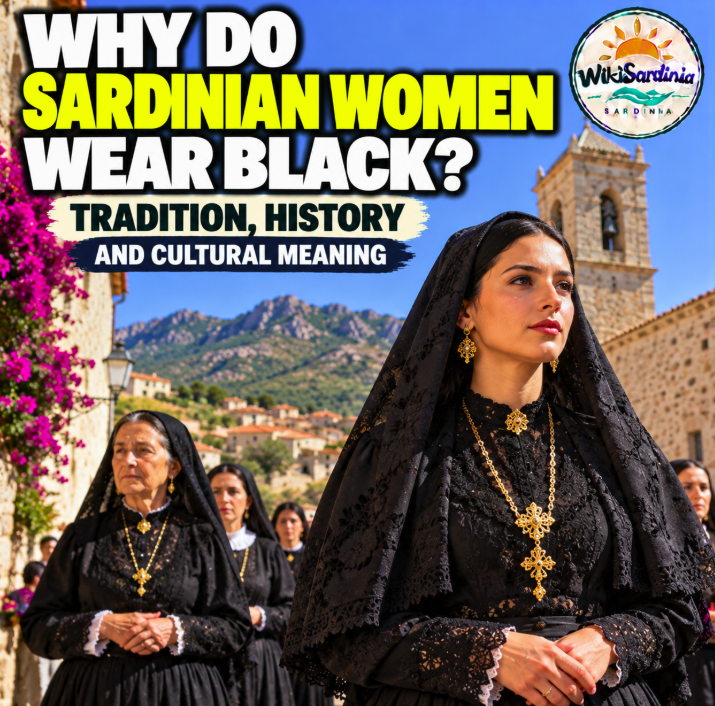
Why do Sardinian women wear black in traditional photographs and village festivals? Black clothing is often associated with mourning, widowhood, modesty and older local customs. Yet the familiar image of an elderly Sardinian woman dressed entirely in black tells only part of the story. Sardinia has a remarkably diverse tradition of women's dress, and many historic costumes are richly colored, embroidered and decorated with precious jewelry.
The important distinction is that not all Sardinian women traditionally wore black, and not every woman dressed in black was a widow. Clothing could communicate age, marital status, family circumstances, a religious occasion or local convention. Meanings varied between communities and changed over time.
Black clothing and mourning in Sardinia
In many European and Mediterranean societies, black became strongly associated with mourning. Sardinia developed its own local expressions of these customs, particularly in rural communities where family and village traditions remained influential.
Following the death of a spouse or close relative, a woman might adopt dark or black clothing for a period of mourning. In some families and communities, older widows continued wearing black for many years or even for the rest of their lives. This is one reason black dresses and headscarves became a recognizable image of Sardinian village life.
However, mourning customs were not uniform across the island. Their duration, the garments worn and the social expectations surrounding them depended on the place, generation and family.
Did Sardinian widows always wear black for life?
No universal rule applied to every Sardinian widow. Lifelong black clothing existed as a personal or customary practice in some settings, but it should not be presented as an island-wide obligation.
Some women chose to continue wearing dark clothing because it felt appropriate, familiar or respectful to a deceased spouse. Others followed a shorter period of mourning or adopted different styles as customs changed.
Today, wearing black after bereavement is a personal choice rather than a reliable indicator of a woman's marital status.
Why did older women often wear black even when they were not widows?
Black and other dark colors could also be associated with age, sobriety, practicality and everyday dress. In some communities, older women preferred dark garments even without a recent bereavement.
Photographs can amplify this impression. Historical images of rural Sardinia often focus on older generations, formal portraits or ceremonial occasions. They do not necessarily show the full range of colors worn by younger women or on festive days.
A black headscarf, long skirt or apron should therefore not automatically be interpreted as evidence of widowhood.
Were traditional Sardinian women's costumes always black?
Absolutely not. Traditional clothing in Sardinia is famous for its regional variety. Different towns developed distinctive combinations of skirts, bodices, blouses, aprons, shawls, head coverings, embroidery and jewelry.
Many festive costumes include brilliant reds, deep blues, greens, gold embroidery and patterned fabrics. In some villages, black forms part of an elaborate ceremonial outfit; elsewhere, brighter colors dominate.
There is no single “Sardinian national costume” worn identically throughout the island. A costume from Desulo can look very different from one associated with Orgosolo, Busachi, Oliena or another community.
Everyday clothing versus festive costume
One of the biggest sources of confusion is the difference between daily clothing and traditional festive dress.
Everyday garments needed to be practical for work, household tasks and the climate. They were often less elaborate than the costumes now displayed at folk festivals. Festive garments, by contrast, could include intricate embroidery, carefully arranged headwear and inherited jewelry.
A woman photographed in plain black clothing on an ordinary day may have owned a much more colorful outfit for weddings, religious celebrations or community events.
What did black clothing symbolize?
Depending on the context, dark clothing could express several meanings:
- Mourning: remembrance of a deceased spouse or family member.
- Restraint and modesty: a style regarded as appropriate in certain communities or situations.
- Age and life stage: older women's preferred or customary dress.
- Religious observance: clothing chosen for church, funerals or solemn occasions.
- Local identity: a particular garment or color combination associated with one village's traditions.
- Personal preference: comfort, habit or taste.
These interpretations can overlap. It is rarely possible to determine the reason for a woman's clothing from color alone.
What about the black headscarf?
Head coverings are an important part of many Sardinian clothing traditions. Depending on the village, women might wear scarves, shawls or more complex forms of traditional headwear.
A black scarf may be connected to mourning or an older everyday style, but head covering does not automatically mean widowhood. Its shape, fabric, arrangement and relationship to the rest of the outfit can be more revealing than the color alone.
In traditional costume studies, the correct local name and context of the garment matter. It is better to identify the specific village's dress than to apply a generic explanation to all Sardinian headwear.
Why does the image of the Sardinian woman in black remain so powerful?
Photographs, documentaries, literature and travel imagery have repeatedly portrayed elderly Sardinian women in dark dresses and headscarves. Such images can convey resilience, continuity and a connection to rural life.
But they can also create a misleading stereotype if presented as the whole of Sardinian womanhood. The island's history includes women with many different experiences, occupations, personal choices and styles of dress.
Respectful storytelling recognizes the emotional power of these portraits without reducing the women in them to symbols of grief.
Is wearing black linked to Sardinia's long-life traditions?
Some visitors associate elderly women in traditional dark clothing with Sardinia's reputation for longevity, particularly in inland communities. Yet there is no sound basis for claiming that wearing black causes longevity or is a defining feature of all long-lived Sardinian women.
Longevity is a complex topic involving many social, environmental and health-related factors. Clothing is a cultural detail, not a scientific explanation.
How did village customs differ?
Sardinia's mountains, valleys and coastal settlements historically supported distinct local identities. Dress varied according to the materials available, local artisans, family resources and community conventions.
In one town, mourning might be expressed through an entirely black ensemble. Elsewhere, particular garments or reduced ornamentation could communicate a similar message. Festive dress also differed dramatically from village to village.
For this reason, anyone researching a family photograph should try to establish the woman's hometown, approximate date and occasion before drawing conclusions.
Are these traditions still alive?
Yes, although everyday clothing has changed significantly. Most women in contemporary Sardinia dress in modern styles, just as women do elsewhere in Italy. Traditional garments are preserved and worn in specific contexts, including cultural festivals, religious celebrations and community events.
Some older residents may still prefer dark clothing as part of their personal style or family tradition. Others do not. Neither choice should be treated as a rule about Sardinian women today.
Where can visitors see traditional Sardinian women's clothing?
Folk festivals, ethnographic museums and local cultural associations are useful places to explore Sardinia's clothing heritage. The Museo del Costume in Nuoro, part of the regional ethnographic museum tradition, is a valuable starting point for learning about the island's diverse costumes.
During village celebrations, visitors may see carefully preserved traditional outfits. Ask local guides or costume groups about the specific community represented and whether a garment is intended for mourning, ordinary use or celebration.
Check museum opening hours and festival programs before traveling.
What should you ask when viewing a traditional costume?
Instead of asking only “Why is it black?”, try these questions:
- Which Sardinian town or village does this costume represent?
- Is it everyday, ceremonial or mourning dress?
- What period does the garment come from?
- Does the head covering have a particular local name?
- Which elements were handmade or inherited?
- How did younger and older women's clothing differ?
These questions lead to a more accurate and interesting story than assuming one meaning applies everywhere.
How to photograph traditional dress respectfully
If you see a woman wearing traditional clothing at a festival, ask permission before taking a close-up portrait. Do not assume that someone dressed in black wants to be photographed as an example of mourning.
When sharing images online, identify the village and occasion when known, and avoid captions that claim a person is a widow unless that information has been confirmed and shared appropriately.
Frequently asked questions
Why do Sardinian women traditionally wear black?
Black is often associated with mourning and widowhood, but it can also reflect age, modesty, local customs or personal preference.
Do all Sardinian widows wear black?
No. Customs vary, and wearing black is not a universal requirement.
Did widows wear black for the rest of their lives?
Some did, particularly in older generations and certain communities, but not all.
Are all Sardinian traditional dresses black?
No. Many traditional festive costumes are colorful and richly embroidered.
Does a black headscarf mean a woman is widowed?
Not necessarily. Headwear styles and meanings differ by village and occasion.
Why do old photos show so many women in black?
Historical photography often emphasizes older women, formal occasions and rural settings, which can create an incomplete picture of everyday clothing.
Do women still wear traditional black clothing in Sardinia?
Some do, but most contemporary Sardinian women wear modern clothing. Traditional dress also survives in festivals and cultural events.
Is black clothing a religious rule?
No single religious rule explains the practice across Sardinia. Local customs and personal beliefs have played different roles.
Where can I learn more about Sardinian costumes?
Ethnographic museums, including the Museo del Costume in Nuoro, and local cultural associations offer valuable context.
Is the tradition the same in every village?
No. Sardinia has many distinct local costume traditions, and their meanings can change across time and place.
The bottom line
The image of a Sardinian woman dressed in black is closely connected to traditions of mourning and widowhood, but it is not the whole story. Black could also be a matter of age, occasion, local identity or preference. Sardinia's women's clothing heritage is much richer than a single color, ranging from restrained everyday garments to extraordinary embroidered festive costumes.
Understanding the difference means seeing the women behind the clothes—not just a familiar image of the island.
Further reading
ISRE — Istituto Superiore Regionale Etnografico, a starting point for research into Sardinian ethnographic collections and traditional dress; SardegnaTurismo, official regional tourism and cultural information. For specific costume interpretations, consult local museum catalogues and community historians.