Where should you go to buy authentic Sardinian textiles? Busachi, a village in the historic Barigadu area of central-western Sardinia, is a rewarding place to explore the island's textile heritage. Its traditions of weaving, embroidery and ceremonial dress make it particularly interesting for travelers who want to understand the people and techniques behind Sardinian fabric—not simply pick up a mass-produced souvenir.
However, a useful distinction matters: Busachi is a culturally relevant destination, but we cannot confirm that a particular workshop or textile shop in the village is open and selling specific items today. The best approach is to contact local artisans or visitor organizations in advance and ask what can actually be seen and purchased.
Why visit Busachi for Sardinian textiles?
Busachi is associated with traditional Sardinian clothing and textile craftsmanship. Like many inland communities, it has preserved distinctive elements of local dress and domestic fabric culture. This makes the village a compelling destination for anyone curious about how Sardinian textiles were worn, woven, decorated and passed between generations.
Busachi is not the only important weaving center on the island. Samugheo, also in the Oristano area, is especially renowned for textile production and its regional textile museum. If your priority is a wide selection of woven rugs and home textiles to buy, consider combining Busachi with Samugheo rather than assuming Busachi has the island's largest concentration of active shops.
What kinds of Sardinian textiles should you look for?
Handwoven rugs and runners
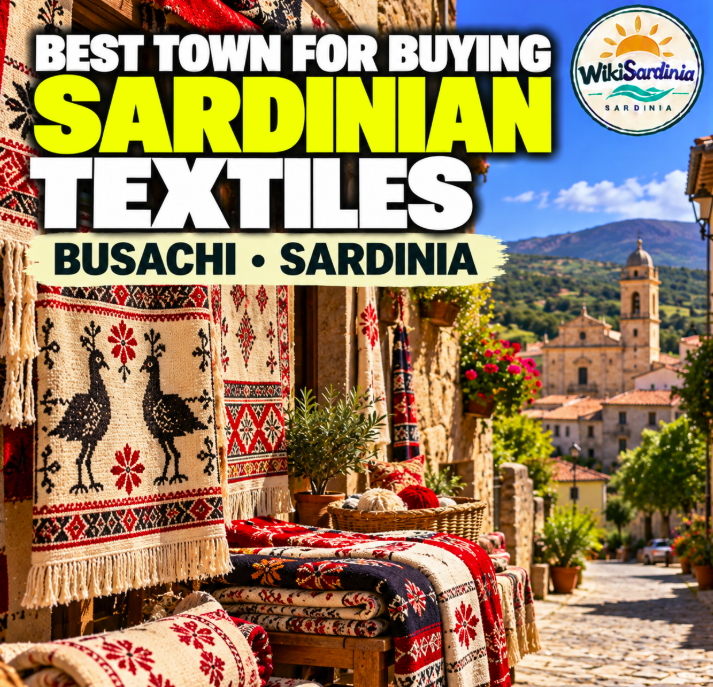
Traditional Sardinian rugs can feature geometric motifs, stylized animals, floral patterns and repeated borders. Techniques, materials and designs vary by locality and workshop. Ask whether a piece was woven by hand, on what kind of loom and where it was produced.
Table runners and placemats
Smaller woven pieces can be easier to pack than a large rug. They also let you bring traditional textile craftsmanship into everyday use. Check whether the fabric is intended for decorative or frequent practical use and follow the maker's care instructions.
Cushion covers and household fabrics
Contemporary Sardinian artisans sometimes adapt traditional patterns for cushions and home furnishings. Such pieces can be authentic expressions of local craft even if they are modern designs rather than exact reproductions of historical textiles.
Embroidered cloth and costume details
Busachi's traditional clothing heritage offers an additional reason to visit. Embroidery, decorative fabric details and ceremonial garments can reveal local techniques and cultural identity. Some items are primarily for display or preservation, not ordinary retail sale; ask before assuming that historic costume pieces are available to purchase.
What makes a Sardinian textile authentic?
There is no single label that guarantees authenticity. Instead, ask clear questions about the maker, place of production, technique and materials. A genuine artisan piece should have a traceable story.
- Who made it? Ask for the artisan's name or workshop.
- Where was it made? A Sardinian motif does not prove an item was manufactured on the island.
- How was it made? Handloom weaving, machine weaving and hand embroidery are different processes.
- What materials were used? Wool, cotton, linen and blended fibers have different textures and care requirements.
- Can the maker explain the pattern? Traditional motifs may have local associations, but avoid assuming every symbol has one universal ancient meaning.
- Is there a label or receipt? Written provenance is useful, especially for larger purchases.
Small variations can be part of handmade work, but irregularity alone is not proof of authenticity. Likewise, a clean modern finish does not make an artisan textile less genuine.
How is traditional Sardinian weaving done?
Many Sardinian textile traditions use looms to interlace warp and weft threads. The precise structure depends on the technique and intended object. Some textiles feature raised or textured decorative motifs, while others rely on color contrasts and geometric arrangements.
Producing a large woven piece can require substantial planning and labor: preparing threads, setting up the loom, following the pattern and finishing the edges. This helps explain why handmade textiles often cost more than factory-made alternatives.
Are Busachi textiles different from Samugheo textiles?
Busachi is particularly interesting for its broader heritage of traditional clothing and textile arts. Samugheo has a strong reputation as a center of contemporary and traditional textile production, especially woven home furnishings.
Both places belong to Sardinia's rich craft landscape, but they are not interchangeable. A visitor looking to learn about costume heritage may be especially drawn to Busachi; someone seeking several active rug producers may find Samugheo a useful additional stop.
Where to buy textiles in Busachi
Start by contacting local cultural associations, tourism information services or artisan networks. Ask whether there are currently active weavers or embroidery workshops offering visits or sales. Some craftspeople work by appointment or through regional exhibitions rather than maintaining a walk-in storefront.
Useful Italian question: “Buongiorno, cerco tessuti sardi artigianali realizzati a Busachi. Ci sono laboratori di tessitura visitabili o artigiani che vendono direttamente?”
In English: “Hello, I'm looking for handmade Sardinian textiles produced in Busachi. Are there weaving workshops I can visit or artisans who sell directly?”
Ask for opening hours, whether an appointment is required and whether the pieces are made locally. Do not drive to a supposed workshop based only on an old social-media post.
Can you watch a weaver at work?
Possibly, if a local artisan offers demonstrations or scheduled visits. Such experiences are not guaranteed. Weaving can be slow and detailed work, so be respectful of the craftsperson's time. If a demonstration is offered, ask whether there is a visit fee or an expectation to book in advance.
Photography and video may be welcome in some workshops and restricted in others. Always ask permission before filming people, designs or private working spaces.
What should a handmade Sardinian textile cost?
Prices vary enormously with size, fiber, technique, design complexity and hours of labor. A small runner and a large handwoven rug are not directly comparable. Without current quotes from verified producers, publishing a universal price range would be misleading.
When comparing products, ask for dimensions, materials, production method and provenance. If an item is advertised as handmade but priced like a mass-produced souvenir, ask for clarification rather than assuming it is a bargain.
How to avoid mass-produced souvenirs
Look beyond decorative motifs. A pattern that resembles Sardinian weaving can be printed onto industrial fabric or reproduced by a machine. These items may still be attractive, but they are different from an artisan-made textile.
Read product labels and ask whether the item was woven, embroidered or printed. Be cautious of vague claims such as “traditional Sardinian style” when no maker or production location is identified.
Can you order a custom textile?
Some artisans accept commissions, depending on their workload and equipment. You may be able to discuss size, colors, motifs and intended use. Ask about the estimated completion time, deposit, shipping, returns and whether the design is original or based on a traditional pattern.
Custom orders can take time. If you're visiting Sardinia for only a few days, arrange the conversation well before arrival.
Can you take Sardinian textiles home on a flight?
Usually, ordinary clean textiles can be packed as personal purchases, but baggage allowances and destination-country import rules vary. Protect delicate fabrics from moisture, sharp objects and crushing. Keep purchase receipts, especially for valuable handmade pieces.
For large rugs, ask whether the artisan can arrange shipping with suitable packaging and insurance.
How to care for handmade Sardinian textiles
Care depends on fiber and construction. Wool may need different handling from cotton or linen. Some textiles are best cleaned professionally, especially if they contain delicate embroidery, unstable dyes or intricate raised patterns.
Ask the maker for written cleaning instructions. Do not automatically machine-wash a handmade rug or historic-style textile just because it feels sturdy.
Planning a craft-focused trip through central Sardinia
Busachi and Samugheo can form part of a wider inland itinerary that combines craft traditions, villages and local food. Allow time for appointments and rural driving rather than trying to visit multiple workshops at fixed times without confirmation.
Roads in the interior can be winding. Check travel times and opening arrangements, especially on Sundays, public holidays and outside the main tourist season.
Why buying directly from artisans matters
Buying from a maker helps you understand what you are paying for and supports the continuation of specialized skills. It also gives you a chance to learn how traditional designs are interpreted by today's craftspeople.
Respect the artisan's pricing and avoid expecting factory-level discounts for labor-intensive work. A thoughtful purchase can become a lasting reminder of the village and its people.
FAQ
Is Busachi a good town for Sardinian textiles?
Yes. Busachi has a meaningful heritage of traditional dress and textile arts, making it a worthwhile destination for craft-minded travelers. Verify active workshops and shops before visiting.
Where can I buy handmade textiles in Busachi?
Contact local artisan networks or cultural organizations to identify currently active producers. We cannot verify a specific walk-in shop or today's stock.
Is Samugheo better for buying Sardinian rugs?
Samugheo is especially well known for textile production and is a strong additional destination for visitors looking for woven rugs and home textiles.
What are traditional Sardinian textiles made from?
Materials vary and may include wool, cotton, linen or blends, depending on the piece and the maker.
How can I tell whether a rug is handmade?
Ask who made it, where it was produced, what loom or technique was used and whether provenance can be documented.
Can I buy a custom Sardinian rug?
Some artisans may accept commissions. Contact them directly about design, price, production time and shipping.
Are traditional Sardinian textiles expensive?
Handmade pieces can cost more because of labor, materials and complexity. Ask for individual quotes rather than relying on generic price estimates.
Can I visit a weaving workshop in October?
Possibly, but availability varies. Arrange an appointment in advance rather than assuming a workshop is open to visitors.
Are all Sardinian-pattern fabrics made in Sardinia?
No. A decorative motif does not establish provenance. Verify the manufacturer and place of production.
The bottom line
Busachi is a fascinating place to discover the heritage behind Sardinian textiles, while nearby Samugheo is a valuable complement for anyone focused on purchasing woven rugs and home furnishings. To find the right piece, contact artisans before your visit, ask about provenance and technique, and choose something whose maker and story you genuinely know.
Further reading
SardegnaTurismo — Official Sardinia travel portal. Confirm current artisan locations, workshop access and opening hours directly before travel.