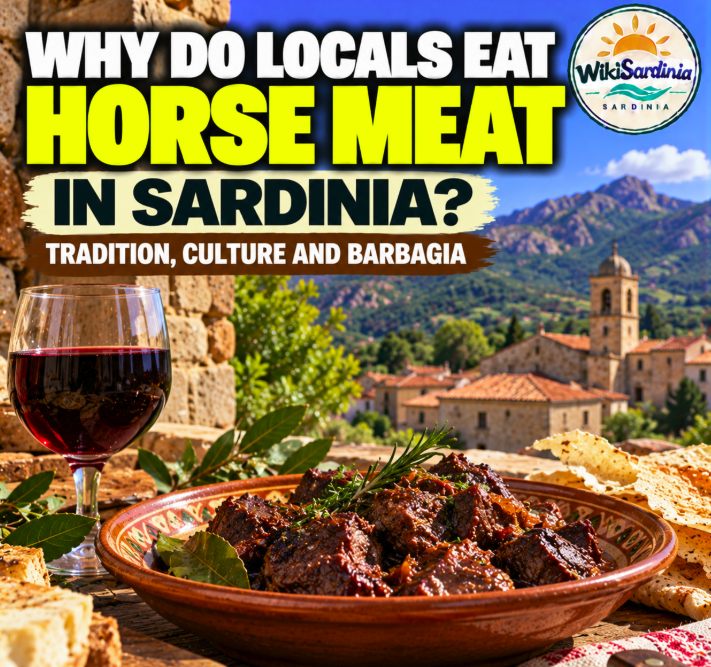
Why do some people in Sardinia eat horse meat? The short answer is that carne di cavallo belongs to certain Italian and Sardinian food traditions, where it is treated as a culinary ingredient rather than as something inherently unusual. But it would be wrong to say that all Sardinians eat horse meat or that it is the defining dish of Barbagia. Food habits vary greatly between families, generations and communities.
For visitors, this tradition can raise an especially interesting question: how can an island famous for its free-roaming Giara horses also have a history of eating horse meat? The answer is that these are different cultural and practical contexts. The protected, free-ranging Giara horses should not be confused with horses raised and processed through regulated food-production channels.
Is horse meat traditional in Sardinia?
Horse meat has a place in parts of Sardinian food culture, as it does in several other Italian regions. It can be sold through authorized butchers and served in some restaurants, depending on local demand. However, it is not an everyday staple for everyone, and its popularity differs by area and personal preference.
Sardinia is better known internationally for foods such as porceddu, sheep's milk cheeses, handmade pasta and breads, but the island's culinary history includes a much broader range of meats and rural dishes.
Why did people begin eating horse meat?
The reasons behind traditional food habits are rarely explained by one event. Across parts of Europe, horses have held different roles over time: transport, agriculture, work, companionship and, in some contexts, food production. Local availability, economic conditions and inherited tastes have all shaped what communities eat.
It would be an oversimplification to claim that horse meat became popular in Sardinia solely because of poverty, one historical crisis or a single Barbagia custom. The better explanation is that it developed within a wider regional food culture in which the use of different livestock species has varied over generations.
What does horse meat taste like?
People who eat it often describe horse meat as relatively lean, with a pronounced flavor and sometimes a slightly sweet note. Taste depends on the cut, the animal, storage and cooking method. Like other meats, it can become dry or tough if cooked without regard to the cut.
These descriptions are subjective: someone accustomed to beef may find it familiar in some preparations and noticeably different in others.
How is horse meat prepared in Sardinia?
Preparations vary between households and restaurants. Horse meat may be grilled, cooked as a steak, sliced thinly or simmered in a sauce. A menu might describe it simply as carne di cavallo, bistecca di cavallo or another preparation rather than using a special regional dish name.
Do not assume that every Sardinian restaurant serves it or that any single recipe is unique to Barbagia. If you are interested in trying it, ask a restaurant whether it is on the current menu and how it is prepared.
Is horse meat especially associated with Barbagia?
Barbagia, Sardinia's mountainous central region, has a rich pastoral and rural food heritage. That makes it a natural setting for discussing livestock and traditional cooking. Yet the evidence does not support treating horse meat as an exclusive or universal Barbagia specialty. The practice is part of a broader and more varied Sardinian and Italian context.
Visitors exploring villages in Barbagia may encounter many other local foods, from sheep and goat cheeses to handmade pasta, seasonal dishes and distinctive breads. Those traditions deserve attention alongside any discussion of horse meat.
Are the famous Giara horses eaten?
Do not confuse the free-roaming Giara horses with animals entering the regulated meat supply chain. The cavallini della Giara are an iconic population living on the Giara plateau. Their conservation, management and legal status are separate from ordinary livestock production.
Seeing the Giara horses in their natural landscape is a wildlife experience, not a visit to a meat-producing farm. It would be misleading to imply that a restaurant serving horse meat is serving a Giara horse, or that local cuisine depends on taking animals from the plateau.
Is eating horse meat legal in Italy?
Yes. Horse meat can be legally sold for human consumption in Italy when it comes from animals eligible for the food chain and complies with applicable identification, veterinary, slaughter, hygiene and traceability rules.
Not every horse is eligible to enter the food chain. Equine identification and medicine records are relevant to determining whether an animal may be slaughtered for human consumption. Meat sold through legitimate channels must meet the applicable food-safety requirements.
Is horse meat safe to eat?
As with other meats, safety depends on lawful sourcing, veterinary controls, hygienic handling, storage and suitable preparation. Buy from authorized food businesses and follow official food-safety guidance.
Never assume that meat is safe because it is described as traditional or locally produced. If you have dietary restrictions or questions about a particular product, ask the seller or restaurant.
Is horse meat healthier than beef?
Horse meat is often described as lean and a source of protein and iron, but its nutritional profile depends on the cut and preparation. It is not automatically healthier for every person or diet. A balanced nutritional comparison would need to account for serving size, fat content, cooking method and individual health needs.
For personal dietary advice, consult a qualified health professional rather than relying on broad claims about one type of meat.
Why is eating horse meat controversial?
Attitudes toward horses differ across cultures and individuals. Some people primarily see horses as companion or sporting animals and find the idea of eating them unacceptable. Others regard horse meat as part of established culinary heritage, provided animal welfare and food-safety rules are respected.
Both reactions are part of the social context. Visitors do not need to adopt a local food habit to appreciate or understand it, and declining a dish politely is perfectly acceptable.
Do all Sardinians eat horse meat?
No. Sardinians have diverse diets and personal views. Some families may prepare horse meat, others may never buy it, and some people avoid it for ethical, cultural or personal reasons. Generalizations such as “Sardinians eat horses” are inaccurate.
Where can tourists try horse meat in Sardinia?
If you wish to try it, look for a restaurant or authorized butcher that clearly lists carne di cavallo. Menus and availability change, so contact the business before making a special trip. We cannot verify a specific restaurant in Barbagia currently serving horse meat and will not invent a recommendation.
Ask whether the meat is sourced through regulated channels, which cut is being served and how it is cooked. Staff should be able to explain the dish without requiring visitors to know local terminology.
Useful Italian phrases
- Avete carne di cavallo? — Do you serve or sell horse meat?
- Come viene cucinata? — How is it cooked?
- È una specialità della casa? — Is it a house specialty?
- Preferisco un altro piatto, grazie. — I'd prefer another dish, thank you.
What should you eat instead if you don't want horse meat?
Sardinia offers countless alternatives. Depending on the restaurant and season, you might find culurgiones, malloreddus, sheep's milk cheeses, grilled vegetables, legumes, seafood, traditional breads and many other local dishes. Ask about ingredients if you follow a vegetarian or other restricted diet.
How to explore Sardinian food culture respectfully
Food traditions are a useful way to learn about a place, but they are not a test of cultural authenticity. You can be curious about a dish without eating it. Ask thoughtful questions, avoid assuming that one family's habits represent an entire island, and respect the choices of both locals and visitors.
FAQ
Why do Sardinians eat horse meat?
Some Sardinians eat it because it is part of certain regional and Italian culinary traditions. Habits vary widely, and there is no single explanation shared by everyone.
Is horse meat common in Barbagia?
It may be encountered, but it should not be described as a universal or exclusive Barbagia dish without stronger local evidence.
Do Sardinians eat the wild horses of the Giara?
Do not equate the protected, free-roaming Giara horses with horses raised for regulated food production. There is no basis for claiming that local restaurants routinely serve Giara horses.
Is horse meat legal in Sardinia?
Yes, when sold and prepared through legally compliant food-production channels.
What is horse meat called in Italian?
Carne di cavallo.
What does horse meat taste like?
It is often described as lean and flavorful, sometimes with a slightly sweet note, though taste varies by cut and cooking.
Is horse meat served in every Sardinian restaurant?
No. Availability depends on the restaurant and local demand.
Can tourists decline horse meat?
Of course. There is no obligation to try it, and Sardinia has many other traditional dishes.
Is horse meat healthier than beef?
Nutritional differences depend on the specific cuts and preparation. Neither is universally the healthier choice.
Can I buy horse meat from any butcher?
Not necessarily. Ask an authorized butcher whether it stocks horse meat and follow applicable food-safety advice.
The bottom line
Horse meat is one strand of Sardinia's diverse food culture, not a habit shared by every Sardinian or a tradition exclusive to Barbagia. Understanding it means recognizing how regional diets evolve—and distinguishing legally regulated food production from the island's celebrated free-roaming Giara horses. Whether you choose to try it or not, curiosity and respect are the best ways to approach the subject.
Further reading
Italian Ministry of Health — food safety and veterinary information; European Commission — animal identification; SardegnaTurismo — official regional travel and food information. Specific regional historical claims and current restaurant menus should be independently verified before publication.