Sardinia's turquoise coves and granite islands make it one of the Mediterranean's most appealing destinations for private boats, sailing yachts and charter holidays. But a beautiful, sheltered bay is not necessarily a legal place to drop anchor. No: you cannot anchor a private boat or yacht just anywhere in Sardinia. Several stretches of coastline fall within marine protected areas, national parks or locally regulated waters, and the rules can be strict.
Whether you can anchor depends on the exact location, the area's protection zone, seabed type, vessel category, current regulations and any required permits. The key is to plan an anchorage, not simply choose a pretty spot on a map.
What is a marine protected area?
Italy's aree marine protette (AMPs) are designated sea areas managed to conserve habitats, species and coastal ecosystems. They commonly use zones with different protection levels. Some also have seasonal restrictions, designated mooring fields and rules governing navigation speed, diving, fishing or access.
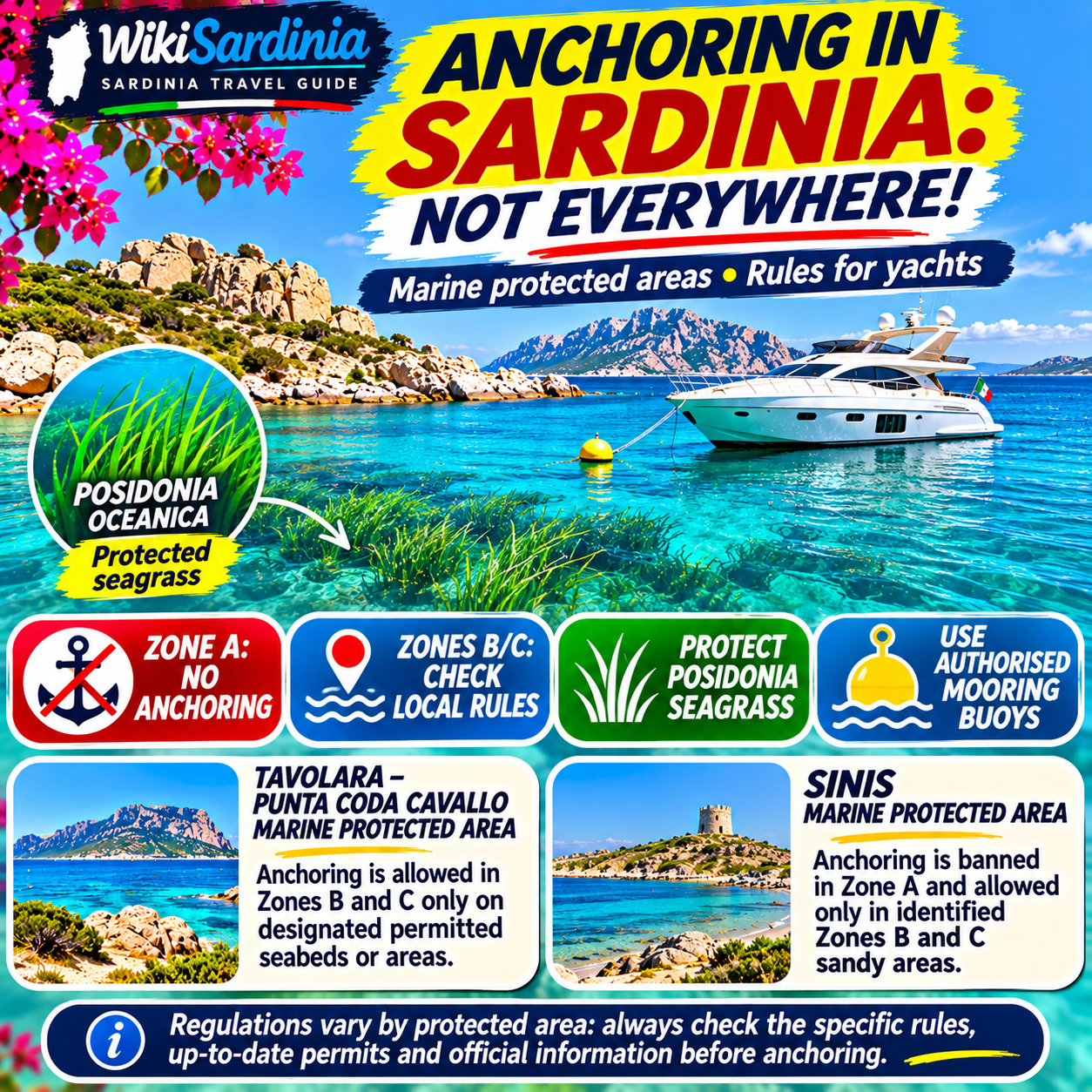
Many protected areas distinguish Zone A, Zone B and Zone C. In general, Zone A is the most strictly protected, while Zones B and C allow certain activities under conditions. But these letters do not create one universal anchoring rule for all Sardinian MPAs. Each managing authority's regulations and current notices govern what is allowed.
Can you anchor in Zone A?
Normally no. Zone A is an integral reserve, where anchoring is prohibited and ordinary recreational navigation may also be forbidden. Exceptions, if any, are tightly limited and specifically authorised—for example for management, research or emergency operations.
Do not assume that passing through, stopping to swim or using a buoy is permitted just because no patrol boat is visible. Check the official boundary map before entering.
What about Zones B and C?
These zones are not automatically open to anchoring. A managing authority may allow it only over designated sandy or pebbly seabeds, within marked areas, subject to capacity limits or on approved mooring buoys. Other sites may require a permit, fee or reservation.
Rules can differ even between two nearby bays within the same protected area. If you cannot confirm that anchoring is authorised at a specific point, choose an official marina or a clearly permitted mooring location instead.
Why is Posidonia oceanica so important?
Posidonia oceanica is a Mediterranean seagrass, not an ordinary seaweed. Its underwater meadows shelter marine life, help stabilise sediment and support healthy coastal ecosystems. An anchor and dragging chain can tear up plants and scar the seabed, with damage that may persist for years.
Protected-area rules frequently prohibit anchoring over Posidonia and other sensitive habitats, including Cymodocea nodosa meadows and coralligenous formations. Do not treat a patch of pale sand between seagrass beds as automatically legal: the surrounding chain sweep and the area's zoning matter too.
Anchoring near Tavolara and Punta Coda Cavallo
The Tavolara–Punta Coda Cavallo Marine Protected Area, near Olbia and San Teodoro, publishes official zoning and navigation rules. It states that anchoring in Zones B and C is prohibited except on permitted sandy or pebbly seabeds and in specifically identified, equipped areas.
Zone A is subject to integral protection and is not an ordinary recreational anchorage. Before sailing near Tavolara, Molara or Molarotto, consult the authority's official map and the most recent implementing rules. Conditions for anchoring and for using mooring buoys may differ.
Anchoring in the Sinis–Mal di Ventre Marine Protected Area
On Sardinia's western coast, the Penisola del Sinis–Isola di Mal di Ventre Marine Protected Area provides unusually clear public guidance. It expressly prohibits anchoring in Zone A.
In Zones B and C, anchoring is barred over ecologically valuable seabeds and allowed only in sandy areas specifically identified by the managing authority. The official guidance distinguishes free anchoring areas from regulated anchoring areas, the latter operating from 1 May to 31 October under its published arrangements. Its page references a supplementary discipline approved in June 2026, illustrating why skippers should consult the latest rules rather than old cruising blogs.
Do not confuse the absence of an authorisation requirement for a particular activity with permission to anchor anywhere in the AMP. The location restrictions still apply.
What about Capo Testa–Punta Falcone?
The Capo Testa–Punta Falcone Marine Protected Area near Santa Teresa Gallura states that Zone A anchoring is prohibited. Its published guidance for Zones B, Bs and C allows anchoring only over designated inert or pebbly seabeds, and refers to administrative fees under the applicable annual rules.
Because permits and fees can change, confirm the current season's requirements before visiting. Do not rely on an old price table as a guarantee of today's cost.
Can you anchor around La Maddalena?
The La Maddalena Archipelago National Park is a particularly popular yachting destination, but its islands and bays are not an unrestricted anchoring playground. The park has marine zoning, navigation and access rules, and in some areas authorised mooring fields or permits are relevant.
Before sailing around Caprera, Budelli, Spargi or the other islands, obtain the current official park map and any required navigation or mooring authorisation. Avoid assuming that rules for a normal coastal bay apply within the national park.
What about Asinara, Capo Caccia and other protected coasts?
The waters around Asinara, Capo Caccia–Isola Piana and Capo Carbonara–Villasimius also require careful attention to protected-area boundaries and activity-specific rules. In the Asinara Marine Protected Area, the official park website describes the zoning and restrictions on access and marine activities.
Protected-area status is not limited to places that look remote. A popular beach, harbour approach or picturesque headland can sit beside restricted waters. Always consult nautical charts and the relevant authority's current documents.
Is using a mooring buoy the same as anchoring?
No. Ancoraggio means deploying your own anchor. Ormeggio means securing the vessel to a mooring, such as an authorised buoy or berth. In some protected areas, the latter may be allowed where dropping an anchor is prohibited.
Not every buoy is available to every yacht. Some are reserved for authorised operators, particular vessel sizes or paid reservations. Check the buoy field's management rules, vessel limits and availability before using it. Never tie up to navigation markers or conservation equipment.
Are permits or fees required?
They may be. Depending on the area, permission can relate to entering or navigating a park, anchoring in a regulated sector, or using a managed buoy field. Vessel length, duration, residency status and season may affect the requirements.
Some activities may be permitted without an individual authorisation but only in clearly mapped locations. Conversely, holding a navigation permit does not necessarily grant the right to anchor wherever you want. Keep digital and offline copies of relevant authorisations aboard.
What about anchoring outside protected areas?
Outside an AMP, anchoring is not automatically unrestricted. Harbour-master ordinances, bathing zones, navigation channels, port approaches, submarine cables, military areas, safety restrictions and local environmental protections can all limit where vessels may stop.
In summer, swimming areas near beaches require particular caution. Do not navigate or anchor within restricted bathing zones unless a specifically authorised corridor or activity applies. Consult the local Capitaneria di Porto ordinances and official nautical information.
How can you check whether an anchorage is legal?
Start with the official map and regulations of the protected area or national park. Then check current nautical charts, notices to mariners and harbour-master ordinances. Confirm whether the intended point is in Zone A, B, C or another special category; whether anchoring is allowed there; whether the seabed is suitable and authorised; and whether a permit or buoy reservation is needed.
Do not rely solely on crowd-sourced anchorage apps or photos of other boats at anchor. An app may show a popular location without reflecting its legal status or a recent rule change.
What if the weather changes?
Safety comes first. Plan legal alternatives before departure, including marinas and sheltered authorised moorings. If conditions become dangerous, follow maritime emergency guidance and contact the Coast Guard as appropriate. Emergency necessity should not be treated as a routine way to bypass conservation rules.
Never put your crew at risk to avoid a minor administrative inconvenience. If you must take emergency action, document the circumstances and follow instructions from the competent maritime authority.
Can you be fined for anchoring illegally?
Yes. Unauthorised anchoring or access in protected waters can lead to sanctions, and environmental damage may carry further consequences. The applicable amount depends on the legal provision and the circumstances, so generic internet fine figures are unreliable.
Authorities may also require a vessel to leave an area. The safest way to avoid penalties is to verify the location and permissions before deploying the anchor.
Frequently asked questions
Can I anchor my yacht anywhere in Sardinia?
No. Protected-area zoning, seabed restrictions, harbour-master ordinances and other rules apply. Always check the exact location.
Can I anchor on sand inside an MPA?
Only if that specific sandy area is authorised for anchoring under the relevant MPA rules. Sand alone does not guarantee permission.
Is anchoring on Posidonia seagrass allowed?
Protected-area rules commonly prohibit it, and it can cause serious environmental damage. Avoid anchoring on seagrass and use authorised sandy areas or managed buoys.
Does a mooring buoy mean I can use it for free?
No. Buoys may require permission, payment or reservation and may have vessel-size limits.
Can I anchor in Zone A for a quick swim?
Generally no. Zone A is the highest protection level and ordinary recreational anchoring is prohibited.
Do I need a permit to sail around La Maddalena?
Park access and navigation rules may require authorisations depending on your vessel and itinerary. Check the national park's current official procedures.
Can I trust a boating app's anchorage suggestions?
Use apps as planning aids, not legal authority. Verify the point against current official zoning and maritime notices.
The bottom line
Sardinia welcomes boaters, but its most beautiful waters are also among its most carefully protected. The difference between a legal anchorage and a prohibited one may be only a short distance—or a patch of Posidonia below the hull. Check the official rules, choose authorised anchorages or mooring buoys, and leave the seabed as you found it.