You're planning a beach holiday in Sardinia and wondering whether to pack your own umbrella. Perhaps you've heard stories about the Maestrale, the strong northwesterly wind that can sweep across the island, and you're worried that a cheap beach umbrella will snap, flip inside out or fly across the sand.
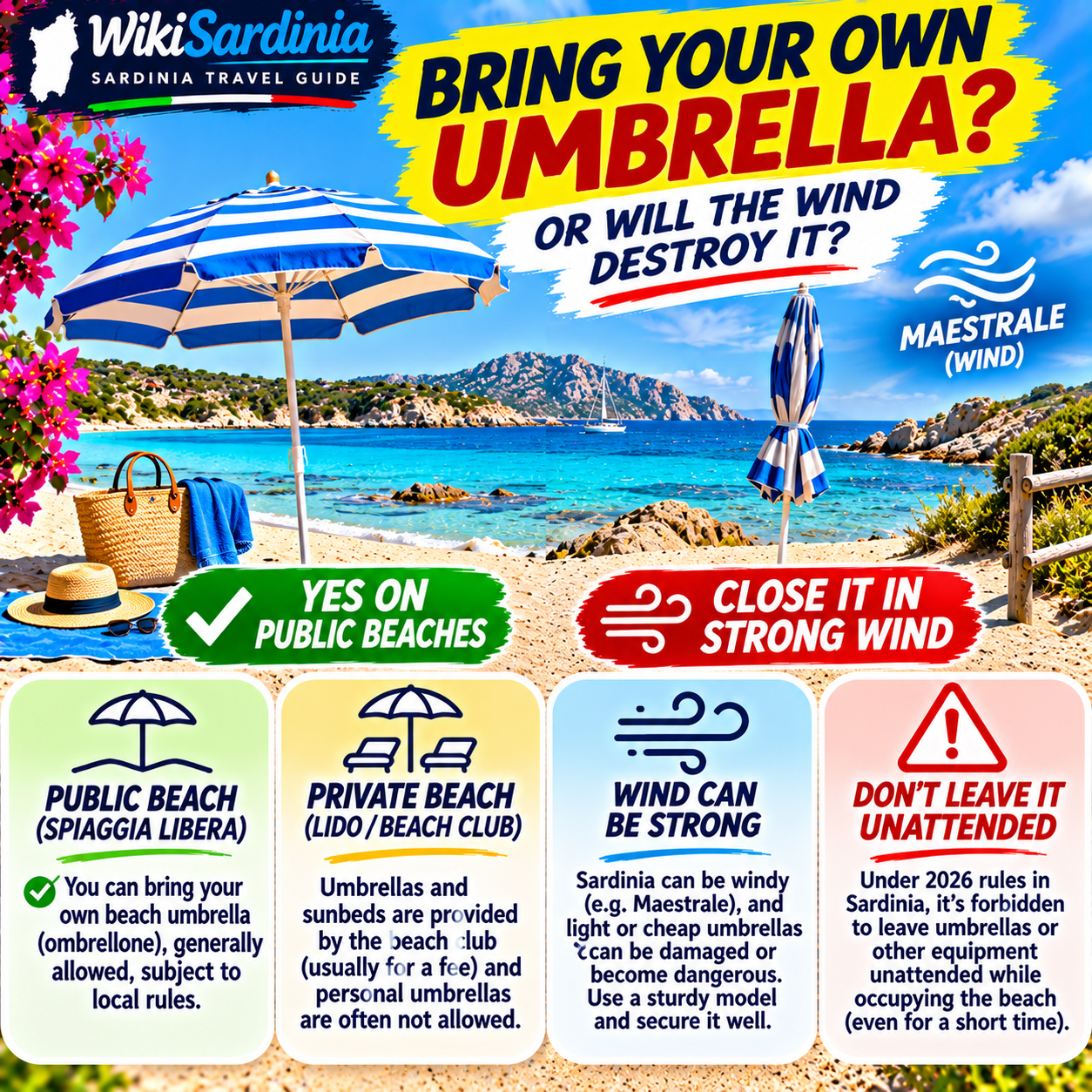
Yes, you can generally bring your own portable umbrella to Sardinia's public beaches, subject to local rules. But windy conditions are a genuine safety consideration. A lightweight umbrella that works perfectly on a calm beach may become unstable in strong gusts. The most important skill is knowing when to take it down.
Can I use my own umbrella on a Sardinian public beach?
On a spiaggia libera—a public, freely accessible stretch of beach—visitors can generally use normal portable beach equipment, including umbrellas and chairs, provided they respect applicable regulations and do not obstruct other people or access routes.
That does not give you a right to occupy any spot you choose. Sardinia's regional bathing ordinance regulates beach use, and municipalities can introduce additional restrictions. Some protected areas have special rules to preserve dunes, vegetation and fragile coastal habitats. Check notices at the entrance and any current municipal ordinance.
What about beach clubs and private lidos?
A managed concession area, often called a stabilimento balneare or lido, may provide umbrellas and sunbeds as part of a paid service and impose rules on bringing your own equipment into its designated area. For example, some establishments expressly prohibit guests from setting up personal umbrellas inside the managed section.
If you prefer to use your own gear, look for an adjoining public-beach area where it is allowed. Public access rights and concession boundaries must still be respected; do not assume the whole beach belongs to the beach club, or that every area is open for setting up equipment.
Why is the Maestrale such a big deal?
The Maestrale is a northwesterly wind that can bring refreshing air to Sardinia in summer, but sometimes also strong gusts, blowing sand and rough seas. Conditions can change substantially from one beach to another depending on the coast's orientation, surrounding cliffs and local topography.
On an exposed beach, an umbrella behaves like a sail. Gusts place force on the fabric, ribs and central pole. If the anchoring fails, the umbrella can tip over or become airborne, creating a danger for people nearby. This is not just about protecting a cheap purchase from damage.
Will a cheap umbrella get destroyed?
Not necessarily. An inexpensive umbrella may be perfectly adequate on a calm day. But very light poles, weak hinges, flimsy ribs and large canopies with poor ventilation tend to be less forgiving when the wind rises. Even an expensive umbrella can fail or become dangerous if poorly anchored or used beyond its safe conditions.
Rather than looking for a product described as 'windproof', prioritise sturdy construction, a reliable locking mechanism, a manageable canopy size and a secure method of installation. No ordinary beach umbrella should be treated as safe in all wind conditions.
What kind of umbrella is practical for Sardinia?
For typical summer beach visits, look for a portable umbrella with a robust pole, durable joints, an easy-to-operate closing mechanism and a secure sand anchor compatible with the pole. A vented canopy may help relieve some wind pressure, but it does not make the umbrella storm-safe.
Size matters. An oversized canopy catches more wind and can be harder to manage. A compact, well-built umbrella that you can close quickly is often more practical than a huge model that is awkward to carry across a long beach.
How should I secure it in the sand?
Choose an appropriate spot away from pedestrian routes and other beachgoers. Use a suitable screw-style sand anchor or other approved anchoring method, following the manufacturer's instructions. Ensure the pole is seated firmly, the locking mechanism is engaged and the umbrella does not wobble.
Do not dig large holes, damage vegetation or dunes, use prohibited fixed structures, or leave dangerous exposed anchors in the sand. Never assume that a stronger anchor alone makes it safe to keep an umbrella open during severe gusts. If the wind becomes strong or erratic, close and remove the umbrella.
When should you close the umbrella?
Close it immediately if the pole starts shifting, the canopy repeatedly flips, sand is blowing strongly, or gusts make the umbrella difficult to control. If an official weather warning or dangerous wind conditions are expected, consider changing your beach plans altogether.
Italy's Civil Protection Department specifically warns that mobile outdoor structures and fabric coverings are vulnerable to strong winds. It also advises particular caution along exposed coasts when strong winds are accompanied by rough seas. The safest response is not to stand beneath an unstable umbrella or attempt to hold it open against a powerful gust.
Can you avoid the wind by choosing a different beach?
Sometimes. Sardinia has coastlines facing different directions, and beaches sheltered from a particular wind may feel much calmer than exposed ones. On Maestrale days, visitors often investigate more sheltered locations, but there is no universal rule that guarantees a safe beach: local gusts, swell, access and sea conditions still matter.
Check the current weather forecast, official warnings and local beach conditions before travelling. Do not assume that calm-looking water means there are no dangerous offshore winds or currents.
Are there rules about where you can place an umbrella?
Yes. Sardinia's bathing regulations protect the strip near the shoreline for free passage and safety. The traditional regional rule keeps the first five metres from the waterline clear of umbrellas, sunbeds and similar obstructions; check the current ordinance and local signage for the precise application.
Never set up an umbrella on protected dunes or among coastal vegetation. Access restrictions are designed to protect fragile ecosystems as well as beach safety.
Can you leave an umbrella on the beach to reserve your spot?
No. Sardinia's 2026 bathing rules prohibit occupying public beach space with equipment left unused and unattended, including umbrellas, chairs and tents. This is not simply a theoretical rule.
In August 2026, Sardinia's Forestry and Environmental Surveillance Corps reported removing numerous umbrellas and other items left on the beach at Baia delle Mimose near Badesi to reserve places. Local authorities can remove equipment and issue penalties. Pack your belongings when you leave; do not try to claim a spot overnight or while you are away.
What if you're travelling with children?
Shade is important, especially in the hottest hours, but an unstable umbrella can pose a serious injury risk. Keep children away from the pole and anchoring point, and never leave an open umbrella unattended. If the wind is too strong for safe shade equipment, choose a safer sheltered location or leave the beach rather than improvising with a poorly secured canopy.
Bring hats, protective clothing, drinking water and appropriate sunscreen. An umbrella alone does not eliminate ultraviolet exposure, particularly when sunlight reflects off sand and water.
Should you bring an umbrella on the plane or buy one locally?
That depends on your luggage allowance, the umbrella's packed length and the airline's restrictions. Many visitors buy a portable umbrella after arriving in Sardinia, especially if travelling with only cabin baggage. If you do, check its build quality rather than selecting solely on price.
If you plan to visit several beaches by rental car, consider how easily the umbrella fits in the boot and whether you can carry it comfortably over sandy paths. Renting an umbrella and sunbed from a beach club is another option for travellers who prefer not to transport equipment.
What can you use instead when it is windy?
A sunhat, UV-protective clothing and shorter beach visits during cooler hours can reduce your reliance on an umbrella. On windy days, a properly managed beach club may offer a more convenient option, but its umbrellas can also be closed by staff when conditions are unsafe.
Be cautious with beach tents, large pop-up shelters and tarps. They can catch even more wind than a small umbrella, and some beaches restrict or prohibit certain structures. Always check local rules before setting one up.
Frequently asked questions
Are personal umbrellas allowed on Sardinia's free beaches?
Generally yes, if they are portable, safely placed and compliant with regional and local beach rules.
Can I bring my own umbrella into a beach club?
Not necessarily. Managed establishments may have rules restricting personal beach equipment within their concession area. Ask the operator or use a permitted public section.
Is the Maestrale dangerous for beach umbrellas?
It can be. Strong gusts can overturn or lift umbrellas, particularly lightweight or poorly anchored ones. Close the umbrella when conditions become unsafe.
Will a windproof umbrella always be safe?
No. Marketing claims do not override weather conditions. Every umbrella has practical limits, and no anchor guarantees safety in strong gusts.
Can I leave my umbrella overnight to save a spot?
No. Leaving equipment unattended to occupy public beach space is prohibited under Sardinia's 2026 bathing rules.
Can I put my umbrella right next to the water?
Do not obstruct the protected shoreline passage. Check the current regional and local rules, which commonly require a clear strip near the waterline.
Are beach tents better than umbrellas on windy days?
Not automatically. Tents and large shelters can also catch the wind, and some locations restrict them. Use only permitted equipment and pack it away if gusts increase.
The bottom line: bring it, but respect the wind
You do not need to rent a sunbed and umbrella every day to enjoy Sardinia's beaches. Your own umbrella is usually welcome on public stretches, and a sturdy, easy-to-close model can be useful on calm days. But the Maestrale deserves respect: if the wind starts to overpower your equipment, take it down. A safe day at the beach is worth far more than keeping your favourite shady spot.