You've booked a hotel in Sardinia, paid online and arrived ready for your holiday. At check-out, the receptionist asks for a few extra euros for the tassa di soggiorno—Italy's local tourist tax. Is that normal? Wasn't everything already included in the room price? And do you really have to pay in cash?
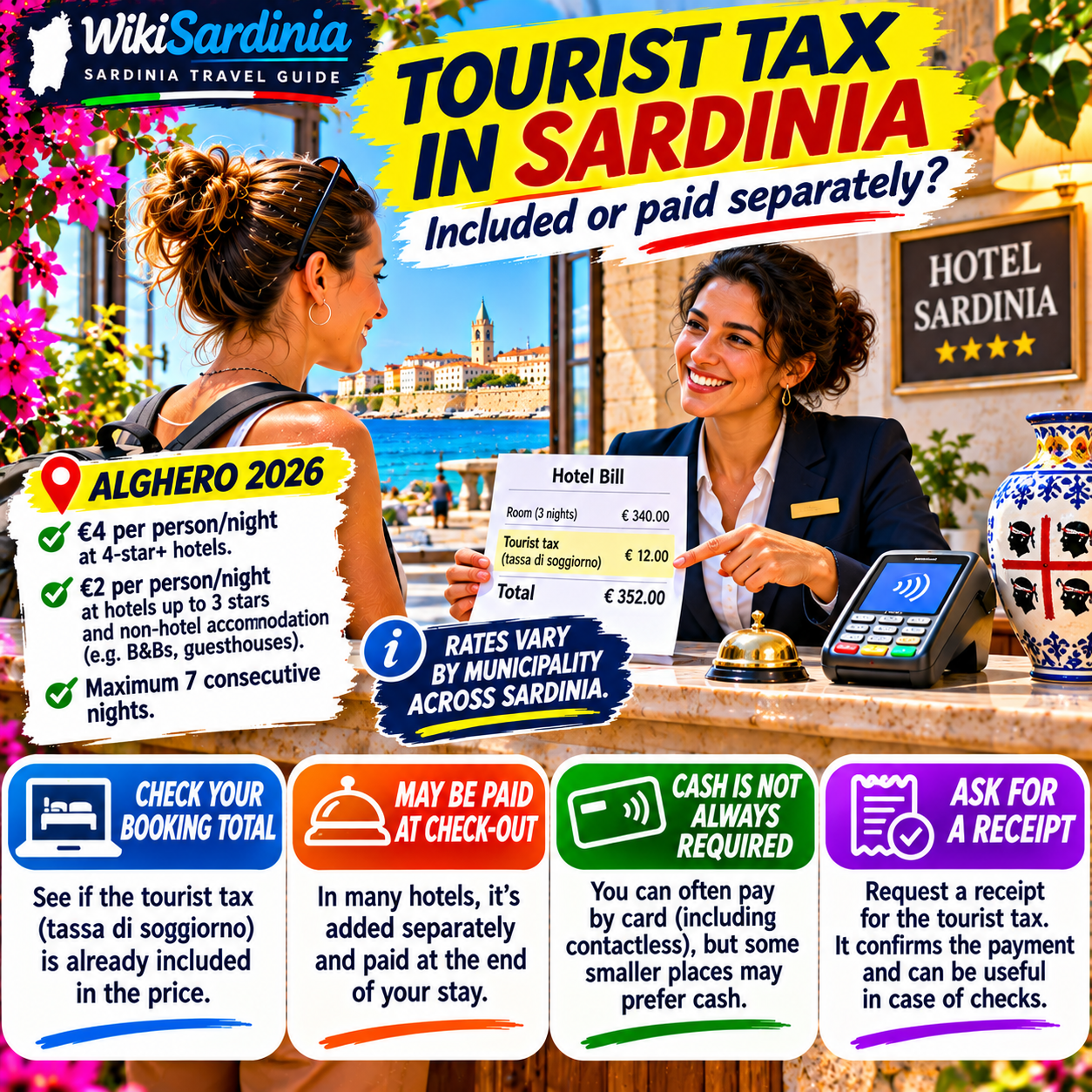
The tourist tax is not automatically included in every advertised hotel price. Depending on the booking channel and accommodation, it may already have been collected when you paid online, or it may be payable separately during your stay. Cash is not a universal legal requirement for guests: ask the accommodation which payment methods it accepts, and always request proof of payment.
What is the tassa di soggiorno?
The imposta di soggiorno, commonly called the tourist tax or city tax, is a municipal levy that some Italian towns and cities impose on overnight visitors. It is not a single Sardinia-wide tax with one price for the entire island. Each municipality that has introduced the tax applies its own local rules, rates, exemptions and limits.
The tax can apply to hotels, B&Bs, guesthouses, holiday apartments, agriturismi, campsites and other accommodation types, depending on the local regulation. Its proceeds are intended to support tourism-related services and the upkeep of local cultural and environmental assets.
Is tourist tax included in the room price?
Sometimes, but not always. An accommodation listing might show a nightly rate and then display the tourist tax separately in the price breakdown. Another platform may collect the tax in advance as part of the booking. Some hotels collect it on arrival or at check-out.
Before confirming a reservation, check the full price summary for phrases such as city tax, tourist tax, local tax, imposta di soggiorno or tassa di soggiorno. The fact that you prepaid the room does not, by itself, prove that the local tax was paid.
If the amount is unclear, message the accommodation: “Is the tourist tax included in my booking total, or will it be collected separately?” A written answer can prevent misunderstandings later.
How much is the tourist tax in Alghero in 2026?
Alghero's municipal government approved new tourist-tax rates effective 1 January 2026. The amount is calculated per person, per night, with a maximum of seven consecutive nights for the same stay.
- €4 per person per night: hotels rated four stars or above.
- €2 per person per night: hotels up to three stars.
- €2 per person per night: non-hotel accommodation, such as many B&Bs, holiday rentals and agriturismi.
- €2 per person per night: outdoor accommodation where guests do not use their own sleeping equipment.
- €1 per person per night: specified outdoor accommodation and camper areas when guests use their own overnight equipment.
Alghero also removed the previous distinction between high and low season for 2026, so the same approved rates apply throughout the calendar year. These figures come from the municipality's official tourist-tax information page and its 2026 tariff resolution.
Example: a couple staying in Alghero for three nights
Imagine two adults booking a four-star hotel for three nights in 2026. At €4 per adult per night, the tourist tax would be €24 in total (2 people × 3 nights × €4), unless a specific exemption applies. The hotel room price and any other services are separate from this calculation.
If the same couple stays for eight consecutive nights in the same accommodation, the Alghero tax is normally charged for only the first seven nights under the municipal cap. Always verify the applicable rules for the actual stay.
How does the tourist tax work in Cagliari?
Cagliari also applies a municipal tourist tax to non-residents staying in hotels and other eligible accommodation, including short-term rentals and agriturismi. Its rates depend on the accommodation category and municipal tariff decisions.
The city updated its tariff framework for 2026. Unlike Alghero's seven-night cap, Cagliari's published regulation generally limits the tax to the first five consecutive nights in the same accommodation within the relevant stay conditions. The current amount should be checked against the official tariff table for your accommodation category and travel dates, rather than assuming Alghero's figures apply.
The Municipality of Cagliari's tourist-tax service publishes the applicable rules, tariff documents and information about exemptions.
Do all Sardinian towns charge tourist tax?
No. The tax depends on the municipality. Some destinations impose it and others may not. Even neighbouring towns can have different rates, age exemptions or limits on the number of taxable nights.
Do not assume that a rate paid in Alghero will be the same in Olbia, Cagliari or a small inland village. Ask the host for the name of the municipality and the applicable local tariff if you are uncertain.
Must tourist tax be paid in cash?
No general rule says that tourists throughout Sardinia must pay the tax exclusively in cash. Some accommodations accept a card payment together with the room balance, while others may request cash as their usual collection method. A platform might already have collected the amount online.
Because collection procedures vary, check the booking terms or ask the property in advance. If you prefer paying by card, ask whether that is possible. A small cash reserve can be convenient, but you should not assume a separate cash request is automatically suspicious.
Should the hotel give you a receipt?
Yes, you should ask for documentation showing that the tourist tax was collected. Alghero's official rules require the accommodation manager to collect the tax and issue a receipt or acknowledgement. Cagliari likewise requires the responsible operator to issue a receipt for the amount paid.
If the tax was collected through a booking platform, keep the booking confirmation or payment breakdown showing the amount. This helps prevent accidental duplicate payment.
Who is exempt from the tax?
Exemptions are established locally, so they vary. In Alghero, the municipal rules exempt children up to the twelfth year of age and certain other categories, including specified carers, service personnel and people with qualifying severe disabilities and an accompanying person, subject to documentation and the regulation's conditions.
Other towns may apply different age thresholds or additional exemptions. Do not assume that all children, business travellers or people with disabilities are automatically exempt everywhere in Sardinia. Ask the accommodation which documents are needed.
Do Airbnb and holiday apartments charge tourist tax?
They can. A short-term rental is not automatically exempt merely because it is not a hotel. In municipalities that apply the tax to holiday rentals, the host or an authorised booking intermediary may be responsible for collection and reporting.
Read the booking's tax section carefully. If the platform indicates that the local tax has already been collected, show that record to the host before paying it again. If the platform states that the tax is due at the property, ask for the exact amount and how it is calculated.
Why might a hotel ask for tax only at check-out?
The accommodation may collect the amount after confirming the actual number of guests and nights, including any exemptions. This is common enough that it should not automatically be treated as a hidden charge, provided the tax is correctly disclosed and calculated.
Nevertheless, the accommodation should be able to explain the rate, the municipality that levies it and the basis for the calculation. If the amount seems too high, ask for a breakdown rather than paying without clarification.
How can you avoid unexpected charges?
Check the total price before booking, including taxes and fees. Ask the accommodation whether the tourist tax has already been collected. Confirm the number of taxable guests and nights. Keep payment records and request a receipt for any amount collected separately.
For families or long stays, verify age exemptions and nightly caps. For multi-stop itineraries, remember that changing municipality—or accommodation—may change the applicable tax calculation.
Frequently asked questions
Is Sardinia's tourist tax included in Booking.com or Airbnb prices?
It depends on the listing and booking arrangements. Check the final price breakdown and any message saying that local taxes are payable at the property.
Can a hotel ask for tourist tax after I prepaid my room?
Yes, if the tax was not already collected and is due under the local rules. The accommodation should explain the amount and provide proof of payment.
Is cash the only way to pay the tassa di soggiorno?
No. Payment methods vary by accommodation and booking platform. Ask whether card payment is accepted and keep a receipt.
How much is tourist tax in Alghero in 2026?
It ranges from €1 to €4 per person per night depending on accommodation type. A four-star hotel generally costs €4 per person per night, while many B&Bs and holiday rentals are €2, subject to exemptions and a seven-night cap.
Does Cagliari have the same tourist tax as Alghero?
No. Cagliari has its own tariffs and rules, including a generally applicable five-consecutive-night limit in the same accommodation under the municipal regulation.
Do children pay tourist tax in Sardinia?
That depends on the municipality and the child's age. Alghero provides an exemption for children up to the twelfth year of age; other destinations may differ.
Do I need to pay the tourist tax twice if I change hotels?
Each stay may be assessed under the relevant municipality's rules. The applicable maximum-night rule does not automatically mean you are exempt from tax at every subsequent property.
The bottom line
The tassa di soggiorno is a normal part of travelling in many Italian destinations, including Alghero and Cagliari. It may be included in your prepaid booking or collected separately, and cash is not universally required. Check the price breakdown, confirm the current municipal rate, ask about exemptions and keep a receipt. That way, the only surprise at check-out should be how quickly your Sardinian holiday went by.