You're driving your rental car toward a charming Sardinian old town. The navigation app tells you to turn down a narrow street, but a sign ahead says Zona a Traffico Limitato—ZTL. Can you enter? Will a camera record your number plate? And what happens if your hotel is inside the historic centre?
The safest rule is simple: never drive past a ZTL sign unless you have checked that your vehicle is allowed to enter at that time. Sardinia's historic towns use restricted traffic zones to protect narrow streets, residents and pedestrians. Alghero and Cagliari both have ZTLs, but their rules, boundaries and schedules differ.
What is a ZTL in Italy?
ZTL stands for Zona a Traffico Limitato, meaning restricted traffic zone. Municipalities can limit vehicle access to designated streets or neighbourhoods, often in historic centres. Access may depend on the time, vehicle category or a specific authorisation, such as a resident permit.
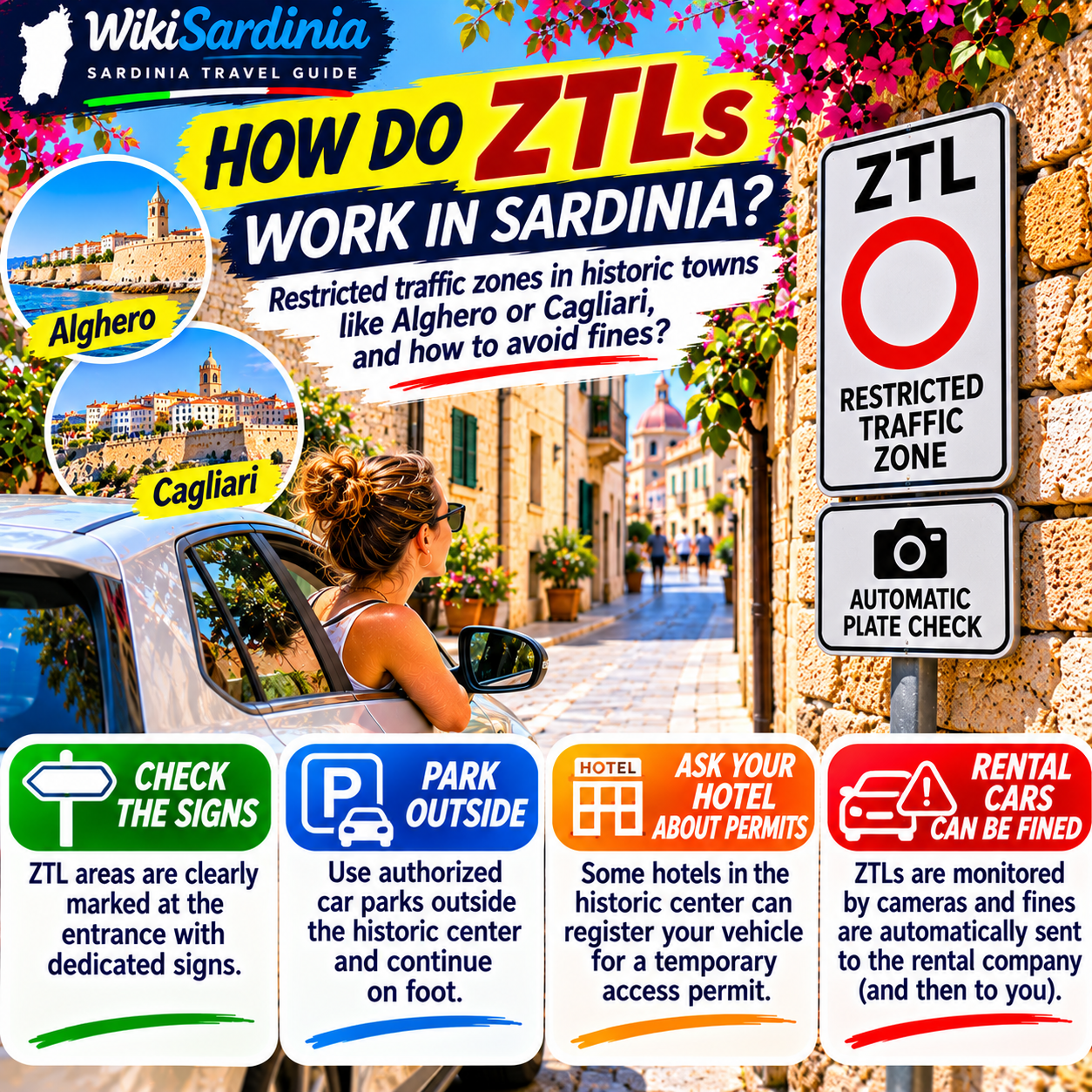
Italian ZTL entrances typically display a white circular sign with a red border, often accompanied by text stating the zone, operating hours and exceptions. Camera-controlled entrances—called varchi elettronici—can record vehicle registration plates and allow authorities to check whether a vehicle had permission to enter.
Do not confuse a ZTL with an ordinary parking restriction. Driving through a restricted entrance can be an offence even if you do not stop or park.
How does the ZTL work in Alghero?
Alghero's historic walled centre has controlled access, including electronic gates associated with the Piazza Sulis and Via Simon/Porta Terra approaches. The restrictions are designed to limit unnecessary car traffic in the compact old town, where many streets are narrow or pedestrian-oriented.
A 2026 published summary of Alghero's municipal rules describes general restricted periods from midnight to 8:00 a.m., 10:30 a.m. to 2:30 p.m., and 4:30 p.m. to midnight, leaving limited access windows around 8:00–10:30 a.m. and 2:30–4:30 p.m. Do not treat these as a guarantee of access: individual streets, pedestrian zones, temporary orders and vehicle restrictions can differ. Check the official municipal rules and the sign at the exact entrance before driving through.
Alghero's municipal website maintains a dedicated ZTL information section, including permit-related notices. It is the appropriate starting point for checking changes.
How does the ZTL work in Cagliari?
Cagliari's municipal administration identifies six ZTL areas: Poetto, Castello, Marina, Stampace Basso, Stampace Alto and Villanova. These are separate zones with their own rules, not one uniform restriction covering the entire city.
Some of Cagliari's most appealing historic districts—especially Castello, Marina, Stampace and Villanova—contain streets where visitors should pay close attention to access restrictions. The city provides an official ZTL permit and information service linking to maps, operating hours and authorisation procedures.
The municipal ZTL regulation was amended in December 2025, a reminder that rules can change. Because the six zones do not share a single universal timetable, verify the current map and hours for the exact district and entrance rather than relying on an old travel blog.
How do camera-controlled ZTL entrances work?
At an electronic gate, a camera can photograph the registration plate of a vehicle entering the zone. The municipal system checks whether that plate is authorised under the applicable rules. If the entry was not permitted, the municipality may issue a fine.
You do not need to be stopped by a police officer for a camera-recorded violation. A tourist may only learn about the incident later, especially when driving a rental car.
Can I enter a ZTL to reach my hotel or B&B?
Do not assume that having a hotel booking automatically gives you permission. Some accommodation providers can help arrange authorised access, temporary registration of a number plate or specific loading and unloading arrangements, but eligibility and procedures depend on local rules.
Before arrival, contact your accommodation and ask three things: whether the property is inside a ZTL, whether you may drive in to unload luggage, and exactly how your rental car's number plate must be registered—if authorisation is available. Ask for written confirmation of the permitted route and time window.
Importantly, a hotel telling you “you can drive here” is not the same as proof that your vehicle has been properly authorised. If the host cannot confirm the procedure, park outside the restricted area.
Does a rental car make any difference?
No. Rental cars are subject to ZTL rules just like privately owned cars. When a violation is detected, the rental company may be contacted to identify the driver. The driver may receive the fine later, including after returning home.
Rental companies may also charge a separate administrative fee for processing a traffic violation under their rental agreement. That fee is distinct from the municipal fine and does not necessarily mean the fine itself has been paid.
How much is a ZTL fine?
The amount depends on the applicable provisions of Italy's Highway Code and can change with statutory updates and administrative costs. Article 7 governs many urban traffic restrictions. Rather than relying on a fixed figure quoted in an old article, consult the current legal text and the actual notice if you receive one.
A fine may also include notification expenses. If you believe the notice is wrong—for example, because your number plate was correctly authorised—follow the appeal instructions and deadlines on the notice. Do not ignore a foreign-address notification simply because you are no longer in Italy.
How can you recognise a ZTL sign?
Look for a red-bordered white circle, the words Zona a Traffico Limitato, and smaller panels specifying hours, categories or exceptions. At some camera gates, an electronic sign may indicate whether access is currently restricted. Read the complete signage rather than focusing on one word.
Signs may appear immediately before a narrow street or intersection. Slow down early enough to choose a legal alternative route without making an unsafe manoeuvre. Never reverse suddenly or stop in traffic to inspect a sign.
Will Google Maps or another navigation app warn me?
Navigation tools can help, but they are not legal authority. Maps may contain outdated access information, and a route can still lead toward a restricted street. The road sign and current municipal rules take priority over your phone.
Set your destination to a car park outside the historic centre rather than the accommodation's front door. From there, walk or use permitted local transport to reach the property.
Where should you park in Alghero?
For a visit to Alghero's old town, the simplest strategy is to use a legal parking area outside the walled centre and explore on foot. Check the current parking rules, prices and any resident-only restrictions at the chosen location. Avoid treating every open space near the seafront as a free public car park.
If you are staying in the historic centre with heavy luggage, ask your host for the nearest practical drop-off point that does not require unauthorised ZTL entry.
Where should you park in Cagliari?
Cagliari is a larger city, so choose parking based on the neighbourhood you want to explore. Parking outside Castello, Marina, Stampace or Villanova and continuing on foot is often easier than navigating the narrow streets. Check whether your selected car park is itself reached by a restricted route and whether parking charges or time limits apply.
Do electric cars, disabled parking permits or hotel guests have automatic access?
Never assume an automatic exemption. Municipal rules may provide access rights or registration procedures for certain vehicle types and permit holders, but these can involve advance communication of the registration plate and supporting documents. A rental electric car is not automatically entitled to enter every ZTL, and a disability permit does not remove the need to follow the municipality's applicable notification process.
Contact the local authority before travelling if you need an accessibility-related authorisation. The official municipal office can explain how to register a foreign or rental plate.
What if you accidentally enter a ZTL?
Do not panic or perform an illegal U-turn. Continue safely and follow permitted road signs to exit. If you had a valid authorisation that was not correctly recorded, contact the relevant municipal office and your accommodation promptly with the vehicle plate, date and time.
There is no general guarantee that an accidental entry will be excused simply because you were following GPS or did not notice the sign. If a notice arrives, verify its details and follow the stated payment or appeal procedures.
Frequently asked questions
Can I drive through Alghero's historic centre?
Only when access is allowed for your vehicle under the current rules. Check the precise entrance sign, any operating window and pedestrian restrictions.
Is the whole of Cagliari a ZTL?
No. Cagliari has six designated ZTL areas, including Castello, Marina, Stampace Alto, Stampace Basso, Villanova and Poetto.
Can my hotel register my rental car for access?
Some accommodation providers may be able to assist with authorised access, but procedures vary. Confirm your vehicle's eligibility and registration in writing before entering.
Will a ZTL camera fine me if I just drive through without parking?
Yes, an unauthorised entry can be recorded even if you never park or stop.
Will I receive a ZTL fine after returning home?
Possibly. Rental companies can provide driver information to the authorities, and notices may be sent later to travellers abroad.
Can I rely on Google Maps to avoid ZTLs?
No. Use navigation as a planning tool, but obey current road signs and municipal access rules.
Is an electric rental car always exempt?
No. Any exemption may depend on local rules and registration of the number plate.
Seven practical ways to avoid ZTL fines in Sardinia
- Check the municipality's official ZTL page before driving into a historic town.
- Read every entrance sign and its operating hours.
- Park outside the old town whenever practical.
- Ask your hotel whether access requires a permit or plate registration.
- Keep written confirmation of any authorisation.
- Do not assume a rental car, electric car or GPS route gives you special access.
- If a fine arrives, check the notice, deadlines and rental-company charges carefully.
The bottom line
Sardinia's old towns are often best enjoyed on foot. The simplest way to avoid a ZTL fine is to leave the car outside the historic centre and walk in. If you truly need to drive through a restricted entrance, verify the local rules and any required authorisation before crossing the camera gate. A little planning can save money and let you enjoy Alghero's bastions or Cagliari's historic districts without worrying about a letter arriving months later.