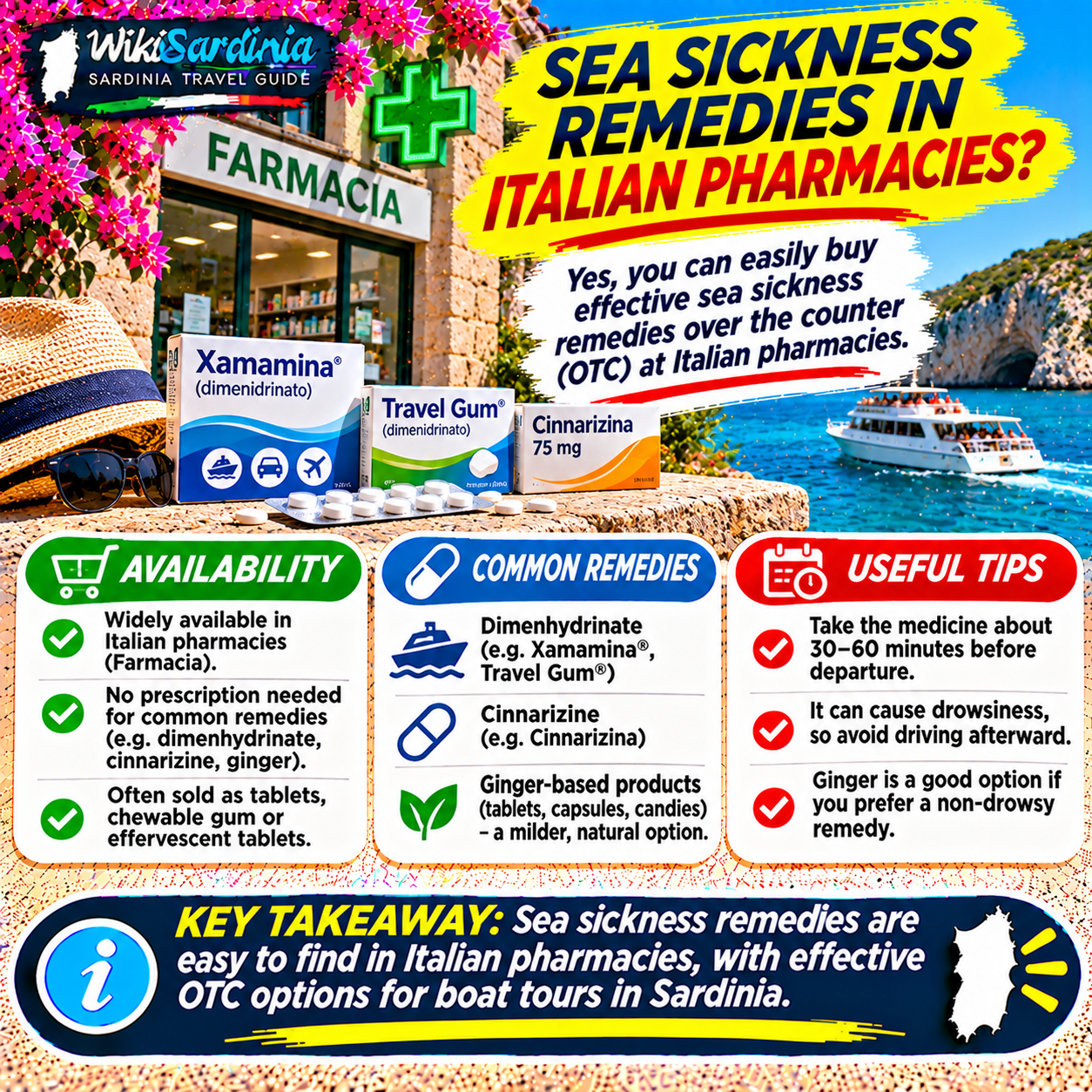
Yes. Italian pharmacies generally sell some remedies for seasickness (mal di mare) without a prescription. That makes it possible to prepare for a boat excursion from Cala Gonone, Palau, Alghero or another Sardinian harbor without bringing medication from home. However, not every product is available at every pharmacy, not every anti-nausea medicine is sold over the counter, and the best choice depends on age, medical conditions and other medicines.
What should I ask for at an Italian pharmacy?
Ask for “un rimedio per il mal di mare” or “un medicinale per la cinetosi”. Cinetosi is motion sickness, which can affect people on boats, buses and winding roads. A pharmacist can help identify an appropriate product and check whether it requires a prescription, whether it causes drowsiness and when it should be taken.
Which seasickness medicines can be bought without a prescription?
In Italy, certain dimenhydrinate products are marketed as non-prescription medicines for motion sickness. Availability, formulation, age limits and legal supply classification should be confirmed for the exact product with the pharmacist. Familiar Italian brand names may include Xamamina and Travelgum, but formulations and pack instructions differ. Do not substitute one product for another based on the brand alone or assume that a medicine available without prescription in another country has the same status in Italy.
What about cinnarizine, scopolamine patches or stronger anti-nausea medicines?
Do not assume these are freely available as over-the-counter seasickness treatments in Italy. Prescription status, approved indications and availability depend on the exact product and formulation. Ask a pharmacist or doctor to verify the current Italian classification. Do not borrow someone else's prescription patch or take a medicine that has not been prescribed to you when a prescription is required.
When should I take a motion-sickness medicine?
Many motion-sickness medicines work best when taken before symptoms start, but timing varies by active ingredient and formulation. Read the Italian package leaflet and follow the pharmacist's instructions for the product you actually purchase. Do not apply a universal “30–60 minutes before departure” rule to every tablet, gum or patch. If you are already vomiting or unable to keep medicines down, seek professional advice rather than repeatedly taking extra doses.
Will it make me sleepy?
Some effective motion-sickness medicines, including sedating antihistamines, can cause drowsiness, slower reaction times, blurred vision or dizziness. Avoid alcohol and check interactions with sleep aids, anxiety medicines and other sedating products. Do not drive a car or operate a rental gommone if a medicine makes you drowsy or impairs your alertness. This is especially important for visitors who plan to pilot their own boat rather than join a skippered tour.
Are ginger, wristbands and other non-drug remedies useful?
Ginger products and acupressure wristbands are available in various shops and pharmacies, but evidence of benefit for motion sickness is mixed and generally less established than for some medicines. They may appeal to travelers who prefer to avoid sedating drugs, but they should not be advertised as guaranteed or equally effective alternatives. Ask a healthcare professional before using herbal products if you are pregnant, have a medical condition or take medicines that could interact.
What can I do on the boat without medicine?
Choose a position with a clear view of the horizon and, where possible, sit near the center of the boat where motion may feel less pronounced. Look at a stable point in the distance, breathe fresh air, avoid reading or staring at a phone, drink water and eat a light meal if tolerated. Limit alcohol and heavy meals before departure. These strategies may help, but they do not guarantee that you will avoid nausea in rough seas.
Is seasickness worse on a gommone or a large tour boat?
The experience depends on sea conditions, vessel design, speed, route and individual sensitivity. A small RIB can be exposed to sharp movement in choppy water; larger sightseeing boats may feel different but are not automatically motion-sickness-free. Ask the operator about the expected conditions and seating, especially during strong Maestrale winds. If you are prone to severe seasickness, consider a shorter trip or postponing in rough weather.
Can children take the same remedies as adults?
No. Age restrictions and doses differ between products. Some medicines are unsuitable for younger children, and adult tablets or gums must not be split or used without appropriate guidance. Tell the pharmacist the child's age and, where relevant, weight. If a child becomes persistently unwell or dehydrated, seek medical advice.
What if I am pregnant, breastfeeding or taking other medication?
Ask a pharmacist or doctor before taking motion-sickness medicines or herbal supplements. Pregnancy, breastfeeding, glaucoma, urinary problems and certain other conditions may affect which treatments are appropriate. Bring the names of your medicines and active ingredients, as US and Italian brand names may differ. A product being sold without a prescription does not mean it is safe for everyone.
Where can I find a pharmacy before an early boat departure?
Look for the green cross and the word Farmacia. Opening hours vary, and smaller coastal towns may have pharmacies that close during part of the afternoon. A farmacia di turno is a pharmacy assigned to provide out-of-hours service according to a local rotation. Check the local pharmacy notice, official pharmacy directory or ask your accommodation. For a morning departure, buying a suitable product the previous day is usually more practical than searching at the harbor just before boarding.
How much do seasickness remedies cost?
Prices vary by product, formulation, package size and pharmacy. There is no reliable single price for all remedies, and availability may change. Ask the pharmacist for the current price and whether a less expensive equivalent with the same active ingredient is appropriate. Avoid buying unfamiliar medicines from unverified sellers.
What if I become severely ill at sea?
Tell the skipper or boat operator immediately. Persistent vomiting, dehydration, confusion, fainting or symptoms that do not resemble ordinary motion sickness need medical assessment. In a serious emergency, ask the crew to contact maritime rescue or call Italy's emergency number 112 when a connection is available. Do not take repeated doses beyond the package instructions.
Useful Italian phrases
“Avete qualcosa per il mal di mare senza ricetta?” means “Do you have something for seasickness without a prescription?” “Questo medicinale provoca sonnolenza?” means “Does this medicine cause drowsiness?” “Quanto tempo prima della partenza devo prenderlo?” means “How long before departure should I take it?” “È adatto ai bambini?” means “Is it suitable for children?” “Qual è la farmacia di turno?” means “Which pharmacy is on duty?”
Before your Sardinia boat tour: a simple checklist
- Ask the pharmacist for a product suitable for your age and medical situation.
- Check the active ingredient, package instructions and possible drowsiness.
- Buy it before departure day if pharmacies near the harbor may be closed.
- Check whether it is safe to drive or operate a boat after taking it.
- Ask the tour operator about wind and sea conditions.
- Bring water, avoid heavy meals and tell the crew if you begin feeling unwell.
The WikiSardinia takeaway
Seasickness remedies are generally accessible at Italian pharmacies, and some medicines are sold without a prescription. Ask for a treatment for mal di mare or cinetosi, confirm the exact product's availability and instructions, and take drowsiness warnings seriously. For a Sardinia boat excursion, preparation the day before is usually better than trying to find a pharmacy at the last minute.