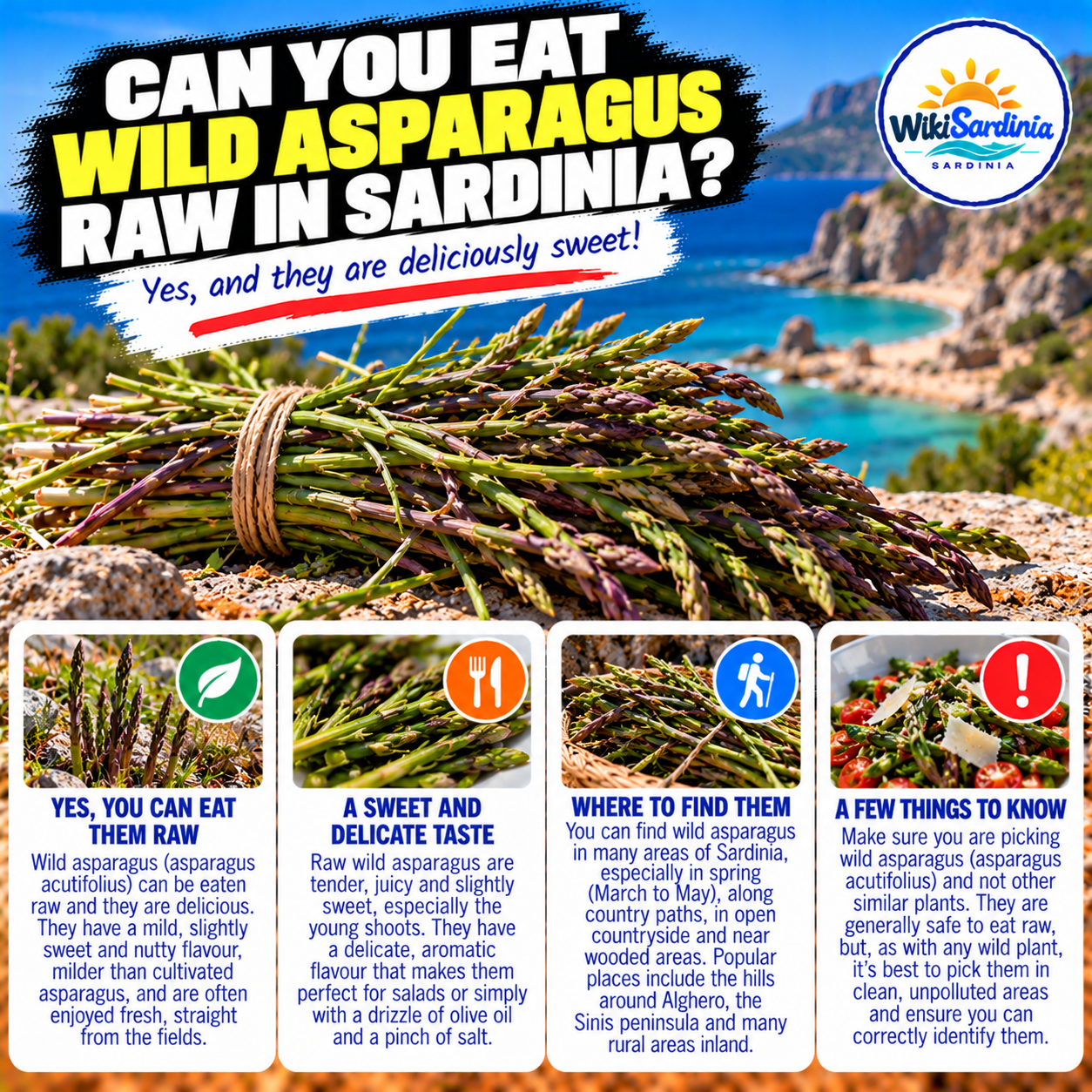
In spring, Sardinia's countryside offers a seasonal delicacy: slender shoots of wild asparagus emerging from the Mediterranean scrub. Locals often gather them for omelettes, pasta and simple home cooking. But can you eat Sardinian wild asparagus raw straight from the countryside?
Yes, properly identified, fresh young shoots of edible wild asparagus can be eaten raw. However, they are not necessarily sweet. Compared with cultivated asparagus, the flavour of Sardinia's common wild species is often stronger, more aromatic and distinctly bitter. Accurate plant identification, careful washing and respect for local collecting rules matter much more than any promise of sweetness.
What is Sardinian wild asparagus?
One of the best-known species is Asparagus acutifolius, a perennial Mediterranean plant commonly called wild asparagus or prickly asparagus. It grows in scrubland, hedgerows and woodland edges. The mature plant has tough, branching stems and short, pointed, needle-like structures. Its edible young shoots are gathered before they become woody.
The slender spears can range from green to purplish, depending on growth conditions. Their appearance differs from the thick, uniform asparagus commonly sold in supermarkets.
Can you safely eat the shoots without cooking?
When the species has been positively identified and the shoot is young and tender, it can be consumed raw. Cooking is not inherently necessary to make ordinary edible asparagus safe. Nevertheless, raw foraged plants carry practical risks: soil, animal contamination, dirty water, pesticides and incorrect identification. Wash the shoots thoroughly with safe water, discard damaged or dirty portions and do not eat plants gathered near busy roads, sprayed farmland or contaminated sites.
Anyone who cannot confidently identify the plant should not taste it to find out what it is. Ask an experienced local botanist or qualified foraging guide instead.
Are Sardinian wild asparagus sweet?
The claim that wild asparagus is always deliciously sweet is misleading. Young tips can have a fresh, green flavour and may seem milder than older stems, but Asparagus acutifolius is frequently prized for its intense, slightly bitter character. Some people love that sharpness; others prefer the flavour softened by cooking. Taste varies with the individual plant, age and growing conditions.
When is wild asparagus season in Sardinia?
The main gathering period is generally late winter through spring, depending on rainfall, temperature, altitude and the year. March and April are often associated with the season, but there is no guaranteed island-wide calendar. Early shoots may appear sooner in mild areas, while cooler or higher locations can develop later.
Where does it grow?
Wild asparagus can occur in many parts of Sardinia where suitable Mediterranean vegetation survives, including scrubby hillsides, field margins and the edges of woodland. It is not restricted to one famous beach or tourist destination. The important considerations are permission to access the land, any protected-area restrictions and whether the habitat is clean and undisturbed.
Do not uproot the plant or strip an area of every emerging shoot. Sustainable harvesting leaves enough growth for the plant and surrounding ecosystem.
How do Sardinians eat wild asparagus?
A traditional favourite is frittata di asparagi selvatici, an omelette in which the shoots are sautéed briefly before being mixed with eggs. Wild asparagus also works in risotto, pasta and simple vegetable dishes. To enjoy a small amount raw, finely slice only clean, tender, confidently identified tips and combine them with olive oil and lemon. Their bitter note can balance rich ingredients, but raw consumption is a matter of preference rather than a traditional requirement.
Are there lookalikes or poisonous parts?
Wild plants can be misidentified, especially when only young shoots are visible. Do not rely on one photograph or a description such as “thin green spear.” Mature asparagus plants also produce berries, which should not be eaten. Edibility of the shoots does not mean every part of the plant is suitable for food.
Some people may experience digestive discomfort from raw asparagus, and individuals with relevant food allergies should avoid it. Children should never be encouraged to sample unidentified wild plants.
Can you collect it anywhere?
No. Collection may be restricted in nature reserves, protected habitats, private land or under local regulations. Rules can vary, so check the relevant municipality, park authority or landowner before gathering. Never damage plants or vegetation in a protected area simply to collect a few shoots.
The answer
Yes: Sardinian wild asparagus shoots can be eaten raw if the edible species is correctly identified, the shoots are young, and they are cleaned properly. But do not assume they are sweet or safe to pick everywhere. Their characteristic flavour is often pleasantly bitter, and cooking remains one of the most popular ways to enjoy this seasonal Sardinian ingredient.
Further reading
- Royal Botanic Gardens, Kew — Plants of the World Online (botanical identification and distribution of Asparagus acutifolius)
- Sardegna Turismo (Sardinian food traditions and rural landscapes)
- European Food Safety Authority (general food safety information)