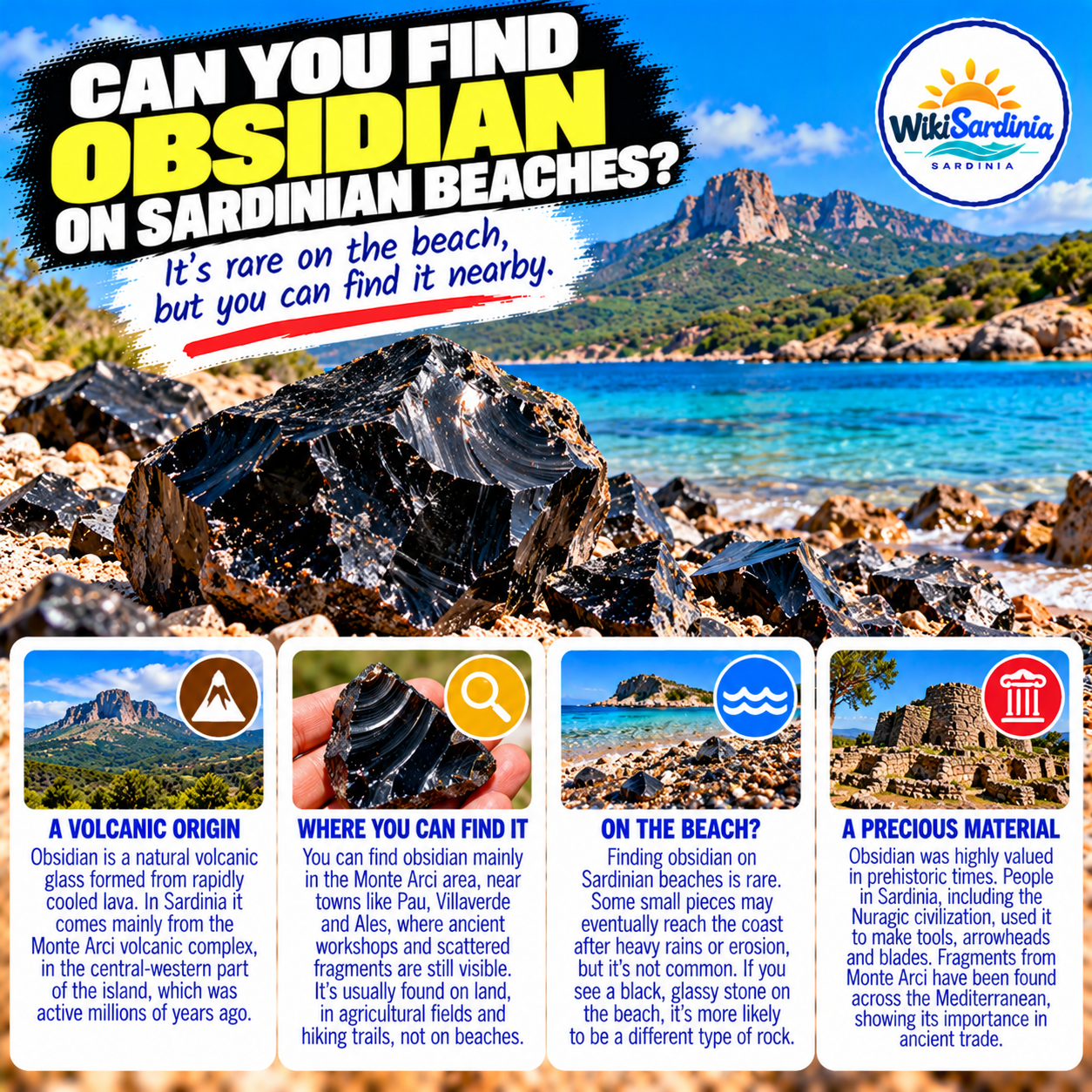
Imagine walking along a Sardinian beach and spotting a shiny black stone that looks almost like glass. Could it be obsidian, the volcanic material that prehistoric communities once valued for making razor-sharp tools? It is possible to encounter transported pieces of obsidian in unexpected places, but Sardinia’s beaches are not the main place to look. The island’s most famous source is inland, around the ancient volcanic complex of Monte Arci in west-central Sardinia.
What is obsidian?
Obsidian is a natural volcanic glass formed when silica-rich molten rock cools so rapidly that crystals have little time to develop. Fresh obsidian typically has a glossy surface and a characteristic curved, shell-like or conchoidal fracture. It is often black, but some pieces show brownish, grey or translucent tones depending on their composition and thickness. Because broken edges can be extremely sharp, prehistoric people used obsidian for blades, scrapers, cutting implements and projectile points.
Where does Sardinian obsidian come from?
The most celebrated source is Monte Arci, a volcanic massif in the Oristano area, close to communities such as Pau, Ales and Villaverde. Geological processes millions of years ago created deposits of high-quality obsidian. The mountain is now famous not just for its geology but also for its prehistoric mining and toolmaking heritage. The village of Pau hosts the Museo dell’Ossidiana, which explores this history through archaeological and geological displays.
Can you actually find obsidian on a Sardinian beach?
It is uncommon. Obsidian is not a typical component of Sardinia’s sandy beaches, and a shiny black pebble is not automatically volcanic glass. Fragments could in principle be transported from inland deposits by erosion, rivers or human activity, but finding them on a particular beach cannot be predicted. The strongest concentrations of naturally occurring Monte Arci obsidian are associated with inland geological outcrops and surrounding landscapes rather than the coastline.
Some beaches contain dark minerals or other rock fragments that may look glassy when wet. Without examining the material, it is easy to confuse them with obsidian, industrial glass or other dark stones.
How can you recognize obsidian?
Look for a glass-like shine and curved fracture surfaces rather than the grainy texture of most ordinary rocks. Thin edges may allow some light through, and the colour can change slightly with thickness. However, these features are not definitive proof: manufactured glass can look very similar. Avoid breaking a stone to test it, as obsidian and glass can produce dangerously sharp splinters. A museum or qualified geologist can help with identification.
Why was Monte Arci obsidian so important in prehistory?
During the Neolithic period, obsidian from Monte Arci was transported across Sardinia and beyond the island. Archaeologists have identified Sardinian obsidian at prehistoric sites in other parts of the western Mediterranean, including Corsica and the Italian mainland. Chemical analyses can distinguish different geological sources, allowing researchers to reconstruct ancient exchange networks. These finds demonstrate that Sardinia participated in far-reaching maritime contacts long before the Nuragic period.
Obsidian was valuable because it could be shaped into efficient cutting tools. Its distribution reveals both practical technology and the movement of people, materials and knowledge across the sea.
What about the obsidian workshops near Pau?
Monte Arci’s archaeological landscape includes areas where prehistoric communities collected and worked the raw glass. Researchers have found flakes, cores and other evidence of stone-tool production. These traces can be scientifically important even when they appear to be ordinary chips of rock. Do not pick up archaeological fragments as souvenirs. Objects found at protected or archaeological sites may be cultural heritage, and removing them can damage the evidence researchers need to understand the past.
Can tourists collect obsidian in Sardinia?
Do not assume that finding a loose piece means you may legally take it. Restrictions depend on whether a location is a protected natural area, an archaeological site or other regulated land. Italian cultural-heritage law protects archaeological finds, and local rules may also prohibit removal of geological materials. Beaches are particularly sensitive environments, and removing sand, pebbles or shells can be prohibited or penalised. The safest approach is simple: photograph what you find, leave it in place and ask the relevant local authority or museum if you believe it is significant.
Best way to discover Sardinia’s obsidian heritage
For a meaningful visit, begin at the Museo dell’Ossidiana in Pau, then explore authorised walking routes and interpretive sites in the Monte Arci area. Museum staff and local guides can explain the differences between natural deposits and prehistoric workshop debris. This approach gives you the chance to understand the stone without disturbing fragile archaeological evidence. Check opening hours and trail access before travelling.
Why Monte Arci matters beyond Sardinia
Obsidian is sometimes described as the “black gold” of prehistory, although it was not a currency in the modern sense. Monte Arci is one of the key western Mediterranean sources that help archaeologists trace early navigation and long-distance exchange. The presence of its volcanic glass far from Sardinia tells a remarkable story: prehistoric islanders were connected to wider networks of trade and contact thousands of years before written history.
The answer: beach or mountain?
So, can you find obsidian on a Sardinian beach? Possibly, but it is rare and not something to count on. For Sardinia’s authentic obsidian story, head inland to Monte Arci and Pau. There you can learn why this glossy volcanic glass was so prized, how it was worked into tools and how it travelled across the prehistoric Mediterranean—without removing stones from beaches or archaeological sites.