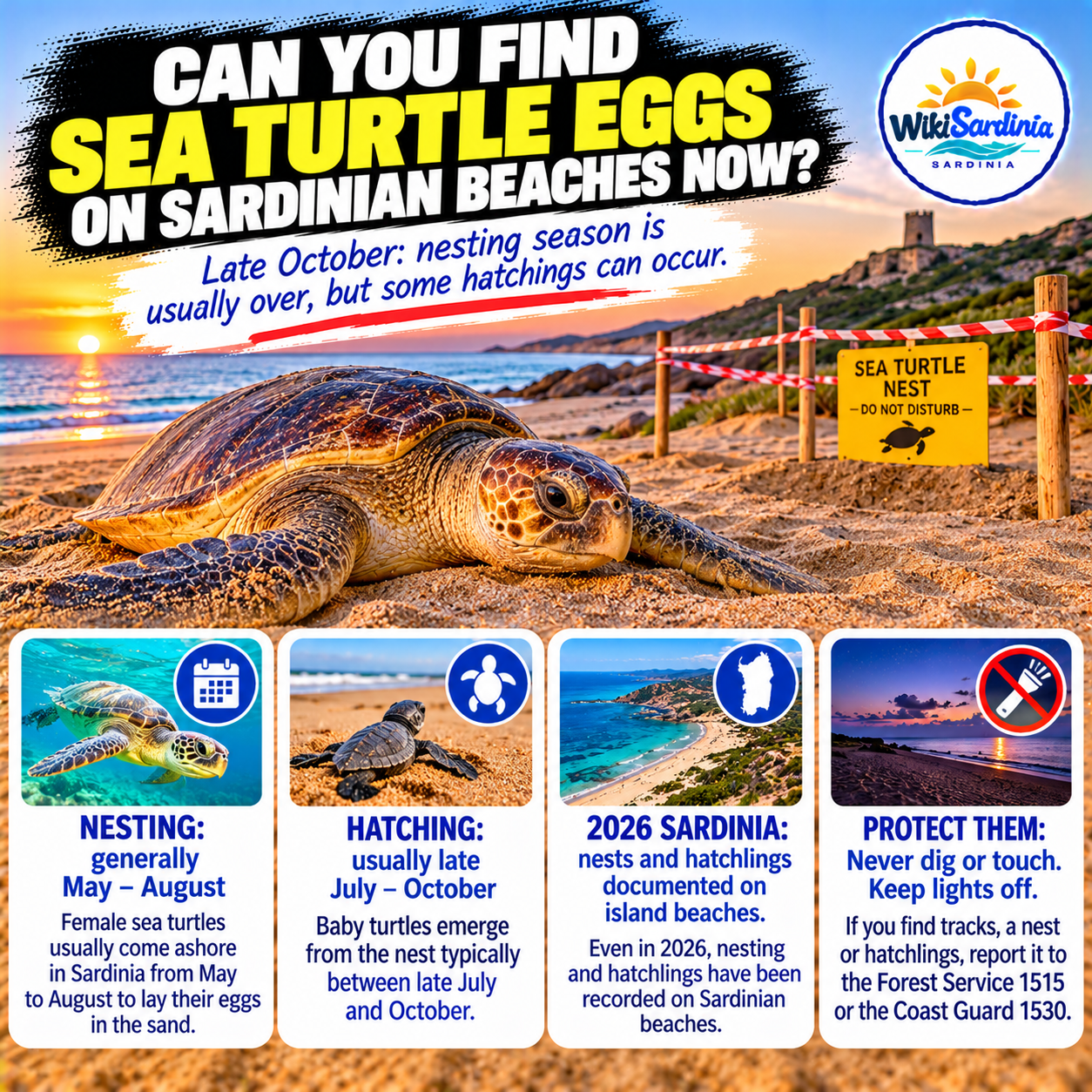
Can you find sea turtle eggs on a Sardinian beach right now? As of 30 October 2026, the main nesting season is normally over, but the answer is not simply “no.” Loggerhead sea turtles usually lay their eggs in late spring and summer, while some nests can continue hatching into October. Any remaining nest is a protected wildlife site, not something visitors should try to uncover.
When do sea turtles lay eggs in Sardinia?
The species most commonly associated with nesting on Italian beaches is the loggerhead sea turtle, Caretta caretta. Female turtles usually come ashore at night to dig a chamber in the sand and lay their eggs. According to WWF Italy, egg-laying generally takes place between May and August. The precise dates depend on conditions and can vary between years.
A turtle nest is usually buried below the sand, so there may be no visible eggs at all. Visitors might instead notice tracks leading from the water or a fenced-off section of beach monitored by conservation specialists.
Is late October too late for turtle eggs?
Late October is generally too late for a new nesting event to be expected, but it can still fall within the end of the hatching season. A scientific analysis of Italian loggerhead nesting records found that hatchlings generally emerge from late July through October, with occasional exceptional timing outside that period. Eggs usually incubate for several weeks, and temperature strongly influences the process.
Therefore, on 30 October 2026 it would be misleading to claim that absolutely no turtle eggs or active nests could remain anywhere in Sardinia. It is equally misleading to suggest that visitors are likely to find them. The responsible answer is that the season is winding down and any suspected nest should be left undisturbed.
Were sea turtle nests recorded in Sardinia in 2026?
Yes. On 4 August 2026, Sardinia's Forest Service reported a loggerhead turtle laying eggs at Foxi Manna in Tertenia. The authorities secured the area with the support of the Coast Guard and the regional marine-wildlife conservation network. Other reports documented nesting at Solanas and Colostrai in southeastern Sardinia.
In September 2026, small loggerhead turtles emerged on the beach at Museddu in Cardedu. Some became disoriented by artificial lights, prompting intervention by the Forest Service. These events show that nesting and hatching are real parts of Sardinia's coastal wildlife story, rather than a phenomenon limited to more distant Mediterranean shores.
What do turtle eggs look like?
Loggerhead eggs are generally rounded and have a flexible, leathery shell rather than the hard shell of a chicken egg. They are deposited in a buried chamber. But visitors should never dig into the sand to inspect eggs or try to identify a nest by disturbing the ground. Even well-intentioned handling can harm developing embryos or emerging hatchlings.
What should you do if you spot a nest or turtle tracks?
Do not touch, uncover, move or mark the eggs yourself. Keep people and pets at a safe distance, avoid walking over tracks and contact the authorities. The Laguna di Nora sea turtle recovery centre advises reporting nests or turtle tracks to the Forest Service on 1515 or the Coast Guard on 1530. Provide the beach name, a precise location and a description of what you observed, without interfering with the site.
If you encounter an adult turtle coming ashore, remain quiet, do not approach or stand in front of it, and do not use flash photography. Bright lights can disturb nesting females and misdirect newly hatched turtles away from the sea.
What if you see baby turtles heading for the water?
Watching hatchlings reach the sea is extraordinary, but they should not be picked up for photographs or carried to the water by untrained visitors. Contact the relevant wildlife authorities and follow their instructions. In a 2024 incident at Foxi Manna, Sardinia's Forest Service criticised visitors who dug into a nest and handled hatchlings, warning that such actions could harm the animals.
Can you visit a protected nest?
Some beaches may have temporary barriers or signs around nests. These are conservation measures, not tourist attractions to enter. Viewing from an appropriate distance may be possible where authorities allow it, but a nest should never be disturbed for a closer look. Specific sites and their status can change quickly; old social-media posts do not confirm that a nest remains active today.
Why is protecting nests so important?
Loggerhead turtles face hazards throughout their lives, including fishing interactions, marine debris, coastal development and artificial lighting. The eggs and hatchlings are especially vulnerable. WWF Italy's September 2026 update highlighted the role of volunteers and conservation teams in protecting nesting sites and helping thousands of hatchlings reach the sea around Italy.
Successful conservation depends partly on beachgoers understanding that doing less is often the best help: give turtles space, keep lights low and alert trained responders.
Can sea turtles nest on any Sardinian beach?
Not every beach is suitable, and nesting events are unevenly distributed. Females select sites according to a combination of environmental factors, including beach characteristics and local conditions. Reports from one summer do not mean that the same stretch of sand will host a nest every year. Nor should visitors search for nests in protected dunes or remote beaches.
The answer for late October 2026
Sea turtle nesting season in Sardinia is usually over by late October, but late hatching events can still occur. Eggs are buried and protected, so finding or digging them up is neither a realistic wildlife activity nor an acceptable one. If you see turtle tracks, a suspected nest or hatchlings, keep your distance and call 1515 or 1530. The best way to enjoy Sardinia's sea turtles is to help ensure they survive.