Can you get by speaking Spanish in Sardinia? If you know Spanish but little Italian, Sardinia's history may make you hopeful. The island spent centuries under rulers connected with the Crown of Aragon and the Spanish monarchy, and the coastal town of Alghero still preserves a historic Catalan-speaking tradition. But there is an important distinction: Spanish is not the everyday language of Sardinia, and Alghero's historic language is Catalan, not Castilian Spanish.
Spanish can occasionally help you recognise words or communicate with someone who understands it. For reliable everyday travel, however, Italian is the better language to learn.
What language should tourists use in Sardinia?
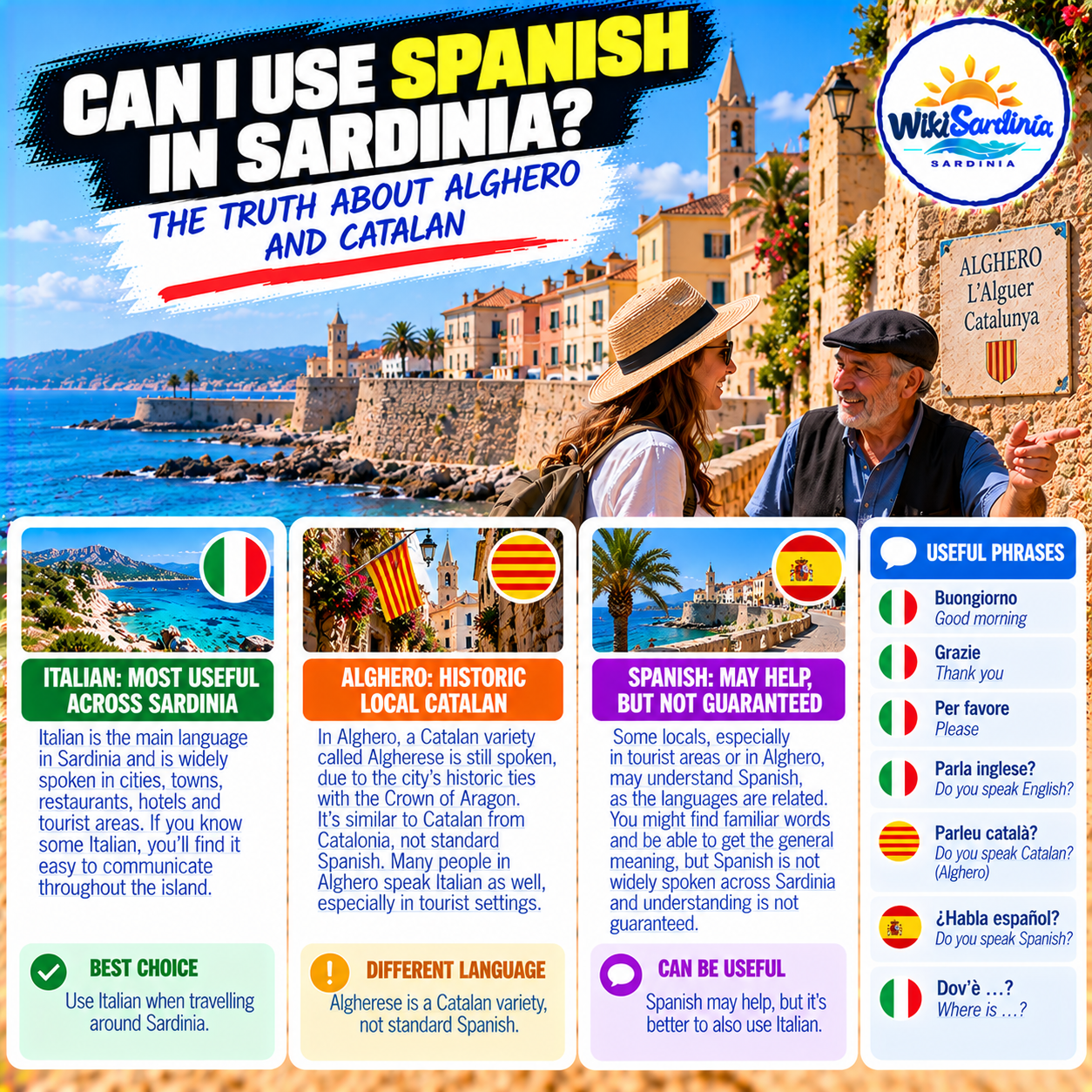
Italian is the most useful language across the island. It is used widely in shops, hotels, restaurants, transport, administration and everyday conversation. Sardinia also has its own language, Sardinian, along with several other local linguistic traditions. English is available in some tourist-facing businesses, but you should not assume every resident speaks it.
If you speak Spanish, you may notice similarities with Italian because both are Romance languages descended from Latin. That can make written menus or simple signs easier to guess. It does not guarantee that a person speaking Italian will understand a full sentence spoken quickly in Spanish.
Why does Sardinia have historical ties to Spain?
During the medieval and early modern periods, Sardinia was linked to the Crown of Aragon and later to the Spanish monarchy. Those centuries left traces in institutions, architecture, religious traditions, place names and vocabulary. Catalan and Castilian Spanish both had historical roles, but their influence varied across time and place.
These historical connections are real. They do not mean that modern Sardinians generally use Spanish in daily life. Political rule in the past and everyday language use today are different questions.
Does everyone in Alghero speak Spanish?
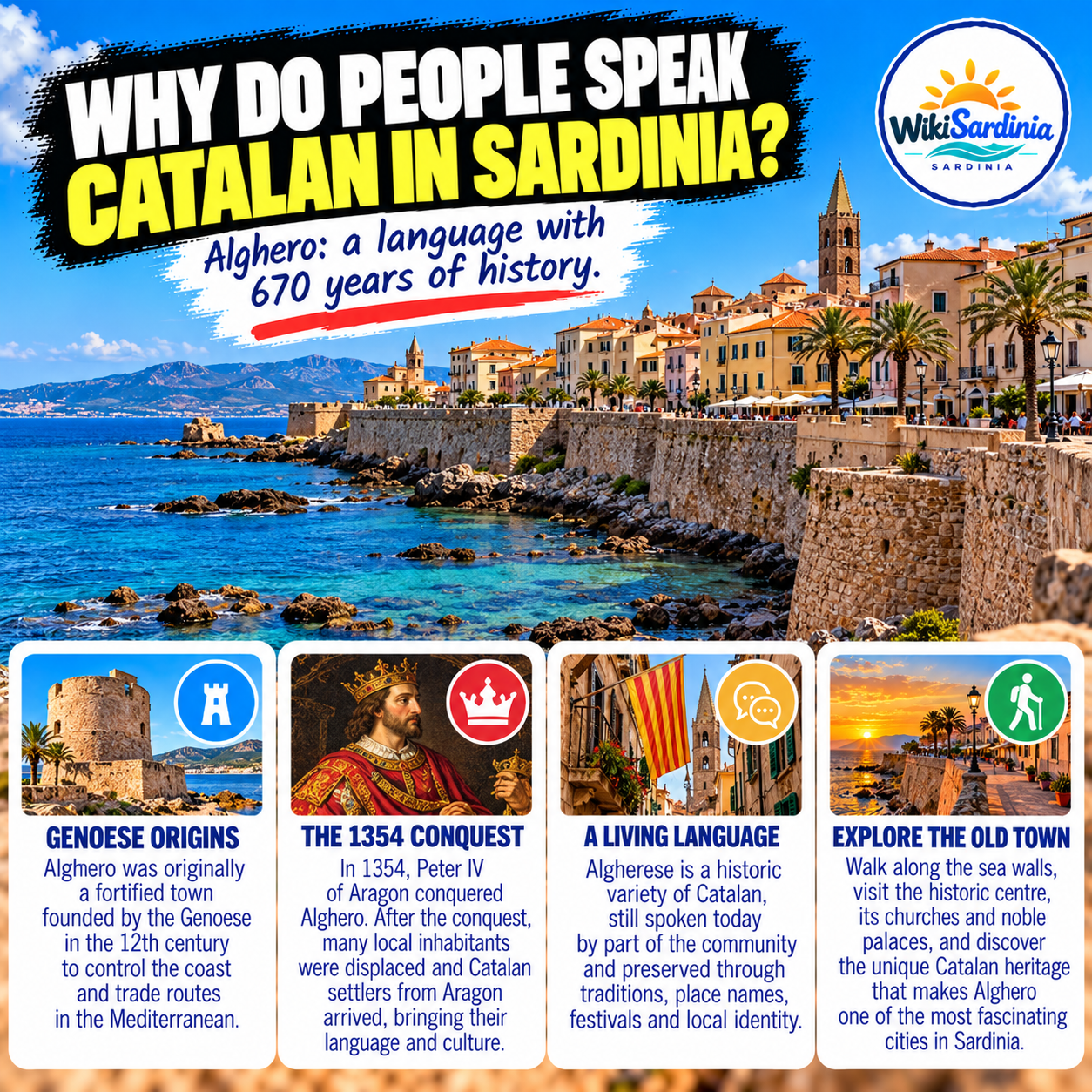
No. Alghero is known for its historic local variety of Catalan, called Algherese. Its presence is connected with medieval Aragonese rule and the settlement of Catalan-speaking people. The city's official tourism website describes Alghero as a bilingual city associated with Italian and Algherese Catalan, while the municipality maintains initiatives to protect and promote its linguistic heritage.
That does not mean every person you meet in Alghero speaks Algherese fluently. As in other multilingual communities, knowledge and use vary between individuals, families and generations. Italian remains a practical choice for visitors.
Is Catalan the same as Spanish?
No. Catalan and Castilian Spanish are separate Romance languages. They share some vocabulary and grammatical features because of their common Latin roots and centuries of contact, but they are not interchangeable. Someone who speaks Catalan may also know Spanish, particularly in Spain, yet that is an individual bilingual ability rather than proof that the two languages are identical.
Algherese belongs to the Catalan linguistic tradition. A Spanish-speaking traveller might recognise some words or understand fragments, but should not expect a complete conversation in Algherese to be easy.
Is Sardinian similar to Spanish?
Sardinian, often called sardu, is itself a distinct Romance language that developed from Latin on the island. It is not a dialect of Spanish or Italian. Historical contact introduced influences from Catalan, Castilian and other languages, but Sardinian retains its own linguistic structures and regional varieties.
A visitor who speaks Spanish may recognise certain Sardinian words, just as they might recognise some Italian or Portuguese vocabulary. Still, familiarity with a few shared roots is not the same as mutual intelligibility.
Where might Spanish be useful?
Spanish may help in occasional tourist interactions, especially if you happen to meet someone who studied or speaks the language. It may also make some written Italian easier to interpret. In Alghero, the historical connection with Catalan provides an additional cultural reason to be interested in the region's languages.
But you should not plan a trip assuming that Spanish will work at every restaurant, pharmacy, ticket office or rural guesthouse. If communication matters, begin with simple Italian, ask whether the person speaks Spanish or English, and use a translation tool if needed.
What language will you see on signs in Alghero?
Visitors can encounter Italian and Catalan-language elements in Alghero's cultural life, place names and local initiatives. The historic centre reflects its Catalan heritage in more than language alone. However, ordinary tourist services and national road information are generally accessible through Italian, so Spanish-speaking visitors should not expect Castilian-language signage throughout the town.
For the most accurate explanation of Alghero's linguistic identity, consult the city's official visitor information and municipal language services rather than assuming that any sign associated with Catalonia is written in Spanish.
Useful phrases if you speak Spanish but not Italian
These basic Italian expressions can help you travel more confidently:
- Buongiorno — Hello / good morning.
- Buonasera — Good evening.
- Per favore — Please.
- Grazie — Thank you.
- Scusi — Excuse me.
- Parla spagnolo? — Do you speak Spanish?
- Parla inglese? — Do you speak English?
- Non parlo bene italiano — I don't speak Italian well.
- Quanto costa? — How much does it cost?
- Dov'è la stazione? — Where is the station?
- Il conto, per favore — The bill, please.
In a Catalan-language context, Parleu català? means “Do you speak Catalan?” But you do not need to learn Catalan to visit Alghero, and you should not assume that a local resident wants to speak it simply because of the city's heritage.
Can Spanish speakers understand Italian without studying it?
Sometimes they can understand parts of a conversation, especially if it is slow, simple and supported by context. However, pronunciation, unfamiliar vocabulary and false friends can cause misunderstandings. For important matters such as allergies, medical care, transport changes or rental agreements, use a clear translation and confirm that the message was understood.
Downloading an offline Italian language pack before your trip is useful, particularly if you plan to visit rural areas with limited mobile coverage.
What about Spanish influence on Sardinian food and traditions?
Sardinia's historical connections with Iberian cultures are visible in aspects of its heritage, but it is best to explore these influences through specific, documented examples rather than claim that everything traditional on the island is Spanish in origin. Alghero's Catalan linguistic and cultural identity is particularly distinctive. Local festivals, architecture and food traditions also reflect multiple historical influences.
The island's culture is not simply an extension of Spain or mainland Italy. Sardinia has its own long history, shaped by Mediterranean exchange and local traditions.
How should you approach locals in Alghero?
Start with a friendly Italian greeting and speak clearly. If you prefer Spanish, politely ask whether the other person speaks it. If not, a translation app or a few Italian words usually make things easier. Showing interest in Algherese Catalan can be a wonderful way to learn about the city, but avoid treating Catalan as merely a form of Spanish.
Respect for linguistic identity is especially meaningful in places where communities work to preserve a minority language.
The verdict: can you travel around Sardinia speaking Spanish?
Spanish may occasionally help, but it is not a dependable substitute for Italian in Sardinia. The island's ties to Aragon and Spain are historically important, and Alghero still preserves a variety of Catalan. Yet Catalan is not Castilian Spanish, Sardinian is a separate language, and Italian is the most practical choice for day-to-day travel.
If you already speak Spanish, use your knowledge of Romance languages as a helpful starting point—then add a handful of Italian phrases. You'll be better prepared and better able to appreciate the island's linguistic diversity.