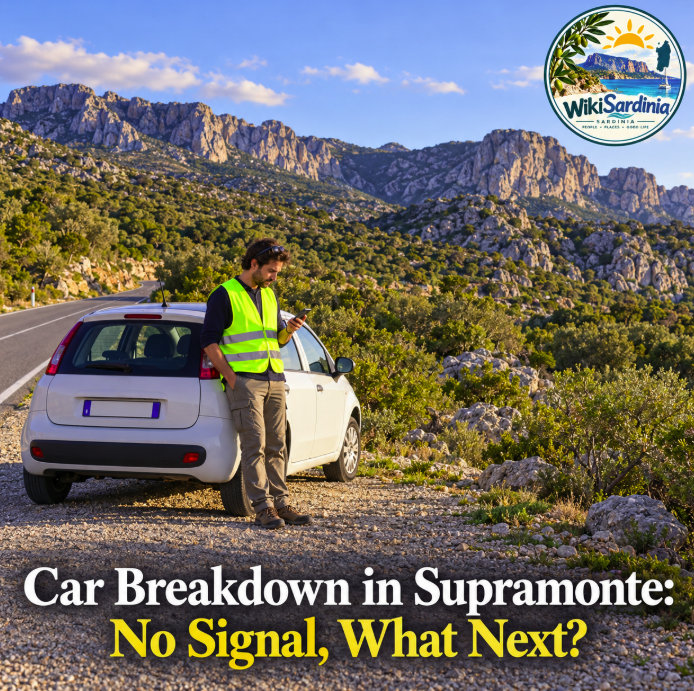
If your car breaks down without a phone signal in Sardinia’s Supramonte, first deal with your immediate safety, then work out how to contact help. A mechanical problem while safely parked is different from an emergency involving injury, fire or danger from traffic or the surrounding terrain. That distinction determines whom to contact and how urgently.
Do not assume a navigation app can summon assistance offline, or that walking uphill will necessarily restore reception. Keep your location clear, avoid turning a vehicle problem into an unfamiliar mountain walk and use the following steps to organise help.
Make the stop safe and record your position
If the vehicle can still be controlled safely, move fully out of the traffic flow into a suitable stopping place. Switch on hazard lights. Before stepping out, assess approaching vehicles, bends and the available space. Use the reflective vest and warning equipment supplied with the car when safe and appropriate; do not expose yourself to traffic simply to place equipment.
Choose a waiting position that protects everyone from traffic and other immediate hazards. Do not stand in front of or behind a stopped car where another vehicle could strike it. If there is smoke, fire or another immediate threat, move away to a safer place and seek emergency assistance. Do not attempt repairs that require working beside moving traffic or going underneath the vehicle.
Save your location before the phone battery runs down. If your device can obtain a GPS position, record the coordinates and take a screenshot. Satellite positioning and mobile communication are different functions: a phone may show where you are without being able to send that information. Offline maps must already be downloaded to provide useful map detail without data.
Also note the road number, any kilometre marker, your last junction and the direction you were travelling. Photograph a nearby sign only if you can do so safely. “Somewhere in Supramonte” is much less useful to an assistance operator than coordinates and a description of the access road.
For an emergency, try 112
Call 112 if somebody is injured or there is a real or developing danger requiring emergency services. Sardinia’s AREUS emergency service identifies 112 as the region’s single emergency number.
No service from your own mobile provider does not necessarily mean every network is unavailable. A compatible phone may route an emergency call through another available network. Apple’s emergency-call guidance explains this behaviour. But if there is no reachable mobile network at all, an ordinary cellular call cannot connect. Do not rely on claims that 112 works everywhere regardless of coverage.
If your phone offers a supported satellite emergency function, follow its on-screen instructions for a genuine emergency. Apple lists Emergency SOS via satellite as available in Italy on supported devices, with device, software and regional restrictions. A clear view of the sky may be needed, and surrounding terrain or vegetation can affect connection. Check your device’s capabilities before travelling; an emergency satellite service is not automatically a routine tow-truck booking service.
For a mechanical breakdown, contact roadside assistance
Once a normal call is possible, use your rental company’s emergency number or the assistance provider named in your insurance documents. For a rental vehicle, seek instructions before arranging an independent repair or tow. Ask what is authorised, where the car should be taken and how the passengers will travel.
ACI’s current official telephone page lists 803 116 for its services in Italy, available 24 hours a day throughout the year to members and customers. A free telephone number does not make recovery free: payment and coverage depend on your arrangements. Check before departure that you have a contact number reachable from your foreign mobile or travel SIM.
If no connection is available and you are safely stopped, conserve battery and remain near the vehicle where it is safe to do so. You can ask a passing road user to relay your coordinates, registration and assistance request when they regain coverage. Keep children and passengers together. Do not set out along an unknown trail or scramble onto rocks to look for a signal; any move away from the car needs a clearly known, safe route and a plan that does not leave vulnerable people stranded.
When contact is established, give the operator your exact position, vehicle registration, number of passengers, problem and road conditions. Explain if access is narrow or unpaved. If you later change your location, update them so assistance is not sent to an empty stopping place.
Before driving into remote country, save the assistance number offline, charge your phone, carry a power bank and water, download maps and tell someone your route and expected return. Ask the rental company which roads the vehicle and cover permit. Preparation cannot prevent every fault, but it gives you useful options when the engine and the signal both disappear.