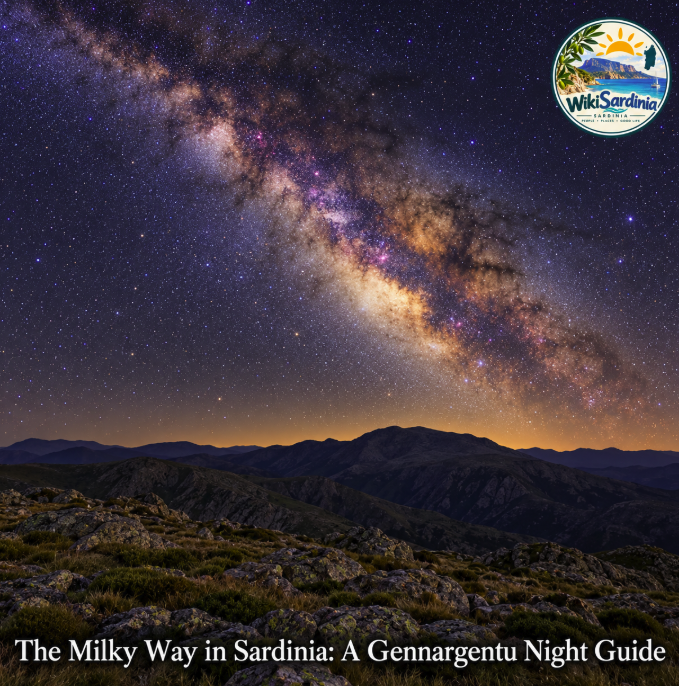
For a Milky Way trip in Sardinia, the Gennargentu gives you a mountain landscape to build an evening around, with Fonni and the Bruncu Spina area as practical planning references. The useful goal is a clear, moonless sky and an accessible foreground, rather than the highest possible summit. No comparative sky measurements were identified for this guide, so it does not rank Gennargentu as Sardinia’s darkest location or promise a sky entirely free of artificial light.
Choose your date before choosing your photograph. Moonlight, cloud, your viewing direction and nearby lamps can matter more than a dramatic place name. A mountain silhouette under the stars can make a memorable image without a night ascent to Punta La Marmora.
Start with Bruncu Spina, then check the access
The official Sardegna Sentieri description of route T 702 identifies its starting point at the paved area below the Bruncu Spina ski station. This gives you a concrete landmark for discussing an outing with a local guide or accommodation host. It is not confirmation of unrestricted overnight parking, current road conditions or permission to camp.
The same route is classified as a hiking trail and lists mountain hazards including wind, fog, slippery rock, snow and lightning. Its published hiking time should not be treated as a nighttime photography schedule. Walking with a tripod, stopping for exposures and returning in darkness changes the outing substantially.
For a first visit, ask a local professional to suggest a permitted viewing position with a short, straightforward return. Visit it in daylight: check the footing, the horizon, parking arrangements and any gates or restrictions. A viewpoint near your confirmed access point may serve the photograph better than an unfamiliar ridge reached after dark.
Plan around the Moon, especially in October
The National Park Service’s night-sky guidance describes summer and autumn evenings as useful seasons for seeing the Milky Way and explains that a bright Moon makes it harder to see. For your chosen Sardinian location, check astronomical darkness, the Moon’s rise and set times, and the galaxy’s position together. A dark date alone does not guarantee the composition you want.
For an October 2026 visit, the Cagliari lunar calendar places the new Moon on 10 October. Use that as a planning reference, then calculate the viewing window for your actual mountain coordinates. Cagliari’s rise and set times are not a substitute for a Gennargentu calculation, and a ridge may obstruct the part of the sky you intend to photograph.
Check the mountain forecast shortly before leaving, particularly cloud cover and wind. Keep an alternative evening available where possible. Do not interpret a new-Moon weekend as a promise of clear weather, nor a coastal forecast as a reliable description of conditions at your chosen elevation.
Photograph the sky without turning it into a summit challenge
Pack a sturdy tripod and practise operating your camera in darkness before the trip. The National Park Service’s photography advice recommends manual settings, a wide aperture and experimentation with sensitivity and exposure time. These are starting principles rather than a preset that works for every lens.
Take a test frame and enlarge a star on the screen to check focus and movement. Adjust the exposure if stars stretch into trails, and judge noise on your own camera. If your phone has an astrophotography mode, learn its support and timing requirements beforehand; do not assume handheld night mode will produce the same result.
Allow your eyes time to adapt and keep screen brightness low. Long-exposure photographs can reveal detail and colour that are less obvious to your unaided eyes, so enjoy the view without expecting it to match a processed image.
Bring warm layers, suitable footwear, a headlamp, spare power and an offline route back. Tell someone your plan and agreed return time. Keep light away from other observers, avoid trampling vegetation and stay within confirmed access arrangements. The best photograph for this trip is one made from a position you can reach, use and leave confidently.