If you want to buy a real Mamuthones mask in Sardinia, there is one destination that makes far more sense than a generic souvenir shop: Mamoiada.
This Barbagia village is the home of the Mamuthones and Issohadores tradition. Here the mask is not simply decorative merchandise. It belongs to a living ritual, a local craft tradition and one of Sardinia's most recognizable cultural identities.
Why Mamoiada is the best place to buy one
Mamoiada's tourism project explicitly connects the traditional masks of the Mamuthones and Issohadores with local craftsmanship and other identity products made in the village.
Buying here gives you the chance to understand who made the mask, how it was carved and how closely it follows the local tradition before you spend money on it.
That is very different from picking up a mass-produced imitation in a coastal souvenir shop.
Start at the Museum of Mediterranean Masks
Before shopping, visit the Museo delle Maschere Mediterranee in Mamoiada.
The museum places the Mamuthones and Issohadores within a broader Mediterranean world of ritual masking and gives visitors the cultural background needed to understand what they are looking at.
Official local tourism material describes the museum as one of the central elements of Mamoiada's cultural identity and tourism experience.
After seeing genuine ceremonial masks and learning about the tradition, it becomes much easier to recognize why an artisan-made object is not the same thing as a cheap souvenir.
What does a Mamuthone mask look like?
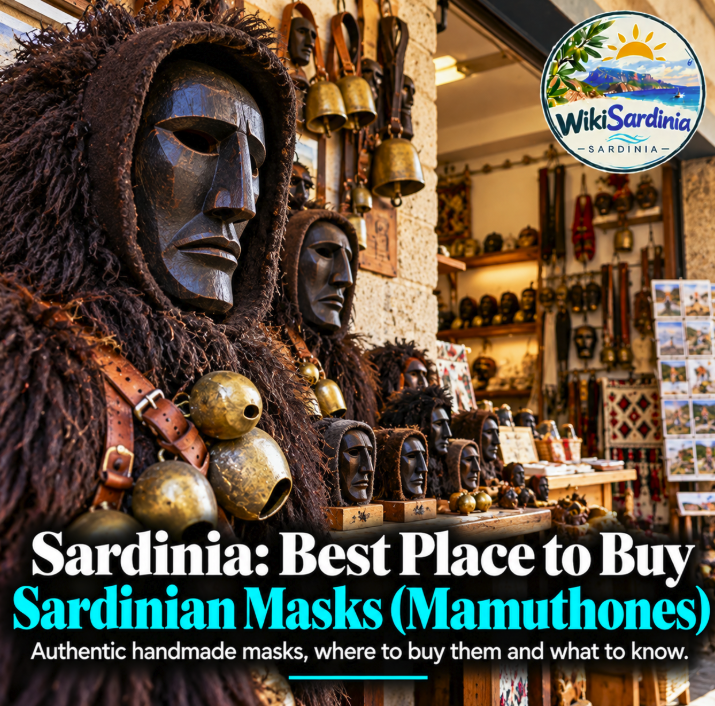
The traditional Mamuthone wears a dark wooden face mask known locally as a visera, combined with dark sheepskins and a heavy set of bells strapped across the back.
The expression is deliberately severe and elemental.
Individual masks vary because they are carved by hand. Small differences in the nose, mouth, brow, surface and finish are part of their character rather than defects.
Look for carved wood, not molded imitation
If authenticity matters, ask what material the mask is made from and who carved it.
A handmade wooden mask should show evidence of the maker's work. Perfectly identical masks stacked in large numbers deserve more questions.
Machine-made or molded souvenirs are not inherently wrong if all you want is an inexpensive decorative object. The important thing is that they should not be confused with a locally carved artisan mask.
Ask the artisan directly
Useful questions are simple:
Chi l'ha scolpita? — Who carved it?
È fatta a mano? — Is it handmade?
Che legno è? — What wood is it?
È una maschera tradizionale di Mamoiada? — Is it a traditional Mamoiada mask?
A genuine craft purchase becomes much more meaningful when you know the answer.
Do not expect every mask to look identical
There is no reason for handmade masks from different carvers to be clones.
Artisans interpret proportions and expressions while working within a recognizable Mamoiada tradition.
That individuality is one of the pleasures of choosing a mask in person rather than ordering a generic reproduction.
How much does a Mamuthones mask cost?
Prices vary enormously according to size, wood, artisan, complexity and whether you are buying a small decorative piece or a substantial hand-carved mask.
Rather than publishing a price that may be obsolete within months, WikiSardinia recommends comparing several pieces in Mamoiada and asking whether the mask is entirely handmade.
A very cheap item should be evaluated as a souvenir, not automatically assumed to be equivalent to an artisan carving.
Can you buy a small version?
Yes. For travelers with limited luggage, miniature masks and smaller craft pieces are much easier to transport.
They can still be locally made, so small does not necessarily mean inauthentic.
Ask the same questions about maker and material that you would ask for a full-size piece.
The bells are part of the story too
The Mamuthones are famous not only for their masks but also for the heavy bells carried across their backs.
The synchronized movement and sound of the group are fundamental to the ritual effect.
Decorative bells and miniature representations therefore appear frequently among Mamoiada craft products, but a complete ceremonial set is very different from an ordinary souvenir.
Mamuthones and Issohadores are not the same
Visitors sometimes use “Mamuthones” as a generic name for every masked figure they see from Mamoiada.
The tradition actually involves two distinct groups: Mamuthones and Issohadores, with different clothing, roles and appearance.
Learning that distinction before buying makes the souvenir more meaningful.
When can you see the real Mamuthones?
The most important traditional appearances are connected to Mamoiada's ritual calendar.
The celebrations of Sant'Antonio Abate on January 17 mark the beginning of the local Carnival cycle, with bonfires and the famous masked figures.
Mamuthones and Issohadores also appear during Carnival and at selected cultural events, including Autunno in Barbagia.
Do not buy the mask without learning the tradition
A Mamuthones mask looks powerful enough to work as wall decoration even without context.
But reducing it to “a scary Sardinian mask” misses almost everything interesting about it.
The procession, bells, sheepskins, rhythm, movements and relationship between Mamuthones and Issohadores form a cultural whole.
The object becomes far more valuable once you know what it represents.
Is it okay to display one at home?
Yes. Artisan masks are sold as cultural and decorative objects, and buying directly from local makers helps support the craft tradition.
Treat it as a piece of Sardinian craftsmanship rather than a novelty costume prop and, ideally, keep the artisan's name with it.
How to transport a wooden mask
A solid carved mask can be heavier than it appears.
If flying, wrap it carefully and protect projecting parts such as the nose from pressure inside luggage.
For an expensive piece, ask the artisan whether shipping is available rather than forcing it into a crowded suitcase.
Make Mamoiada a full cultural stop
Do not drive into the village, buy a mask and leave immediately.
Mamoiada is also known for Cannonau wine, archaeological sites and a landscape shaped by pastoral traditions.
The local MyMAMOIADA project was specifically created to connect masks, craftsmanship, food and wine, archaeology and the people of the village into a broader visitor experience.
Combine the museum and artisan shopping
The best sequence is simple: visit the museum first, walk through Mamoiada, then look at artisan work with fresh eyes.
You will notice details in the carved faces that would have meant little an hour earlier.
And when you finally choose one, you are buying a memory of a place rather than just an object.
WikiSardinia's verdict
For an authentic Mamuthones mask, go to Mamoiada.
Start at the Museo delle Maschere Mediterranee, learn what the mask actually means and then buy directly from a local artisan or a local outlet that can identify the maker.
Ask who carved it, what wood was used and whether it was handmade.
You may pay more than you would for a mass-produced souvenir on the coast. But years later, the dark wooden face on your wall will still have a name, a village and a story behind it — and that is the souvenir worth bringing home from Sardinia.