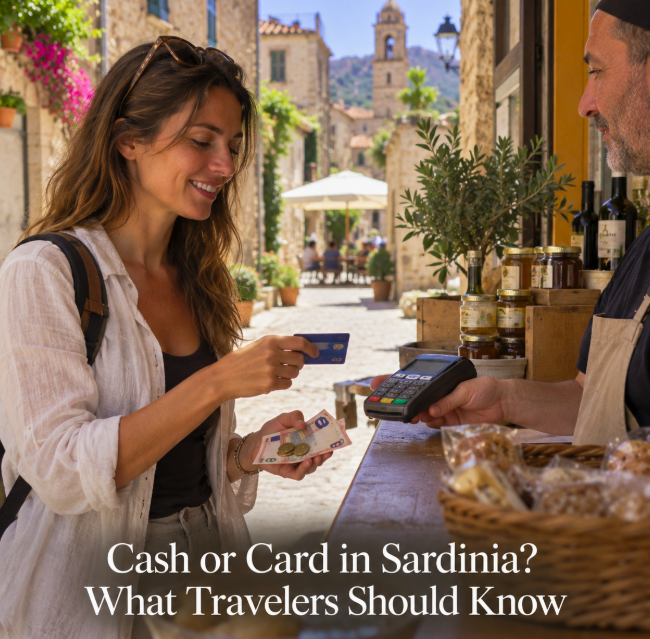
You can pay by card for much of a trip around Sardinia, especially in hotels, restaurants, supermarkets, shops and larger tourist destinations. But going completely cashless is not the most practical plan if your itinerary includes small inland villages, rural stops or minor purchases. Sardinia’s official tourism website specifically recommends carrying a small amount of cash because card payments may not always be available in smaller towns.
That advice is useful even though electronic payments are deeply established in Italy. Italian rules require businesses and professionals covered by the electronic-payment legislation to accept card payments, and the legal framework for electronic acceptance has been in place for years. In everyday travel, however, a card being legally accepted in principle does not eliminate practical issues such as temporary connection problems, a terminal that is not working, or a very small local business where cash remains convenient.
Where cards are usually easy to use
For a typical visitor, cards are a normal way to pay in Sardinia. The island’s official tourism portal says credit-card payments are possible in shops, hotels and restaurants. In cities and busy coastal destinations such as Cagliari, Olbia and Alghero, travelers can generally expect electronic payment to be part of everyday life.
Contactless payment is also common, so a physical card or a compatible phone wallet can be convenient for routine purchases. Travelers from the United States should still carry a physical card as a backup rather than relying entirely on a phone, especially if the phone battery fails or a particular terminal does not cooperate with a digital wallet.
If a terminal offers an American traveler a choice between paying in euros or US dollars, euros are generally the more sensible currency to select. Choosing dollars can trigger dynamic currency conversion, where the merchant or payment provider performs the conversion using its own displayed rate and mark-up. Travelers should also check whether their US card charges a foreign transaction fee.
Why cash is still useful in Sardinia’s smaller towns
The official SardegnaTurismo guidance makes an important distinction: cards are widely usable, but in smaller centers they may not always be accepted, and visitors are advised to keep a small sum of cash for minor expenses. That is particularly relevant if your holiday leaves the main coastal circuit and heads into the island’s interior.
A day exploring villages, countryside roads or local events can involve small cafés, market stalls, kiosks and other situations where having euros in your wallet saves time. The point is not that inland Sardinia operates on cash alone. Many village businesses have card terminals. Rather, the smaller and more remote the stop, the less sensible it is to make a working card terminal your only way to pay.
Cash can also be useful for low-cost purchases such as a coffee, a bottle of water, a small bakery order or an incidental expense. Carrying a modest amount avoids having to search for an ATM at the exact moment it is needed.
Are ATMs easy to find?
SardegnaTurismo says ATMs are widespread and operate 24 hours a day. They are known locally as bancomat, a word visitors will see frequently on bank signs and in everyday conversation.
Even so, travelers driving through remote areas should not assume that every tiny village will have a convenient ATM beside the main square. Withdrawing some euros before a full day in the countryside is easier than changing an itinerary to find cash later.
US visitors should check their bank’s international ATM fees before traveling. The ATM itself may also disclose an operator charge. If a machine offers to convert the withdrawal into US dollars, read the exchange-rate information carefully; declining the machine’s currency conversion and proceeding in euros can allow the card issuer or network to handle the conversion instead.
How much cash should you carry?
There is no special amount required for Sardinia. The best approach is a modest backup rather than a large envelope of euros. If accommodation, car rental and major meals are being paid by card, cash is mainly there for small purchases and situations where electronic payment is temporarily inconvenient.
Keeping smaller euro notes can be more practical than carrying only high denominations. It is also unnecessary and less secure to withdraw enough cash for an entire holiday at once when ATMs are available across the island.
Italy also limits large cash transactions. Current official information from Italy’s revenue-collection authority states a €5,000 cash threshold under the applicable legislation, meaning large travel expenses should not be planned around cash payments anyway.
The easiest payment setup for a Sardinia trip
A simple combination works well: one main card, a second card kept separately as backup, and a small amount of euro cash. For American travelers, a card with no foreign transaction fee can reduce unnecessary costs, while checking ATM fees in advance makes occasional cash withdrawals more predictable.
In Cagliari, Olbia, Alghero and major resorts, the card will probably do most of the work. When driving into Barbagia, Logudoro, Planargia or other rural parts of the island, having cash becomes more useful — not because Sardinian villages are disconnected from electronic payments, but because a little redundancy makes travel easier.
So, do you need cash in Sardinia? Not for every purchase, and certainly not as your main payment method. But a completely cashless trip can create avoidable inconvenience. Use cards for most expenses and keep a few euros ready for the moments when Sardinia’s smaller, quieter places remind you why a backup payment method is still worth carrying.