In Sardinia, traffic already inside a roundabout usually has priority—but only when the entrance is controlled by a Give Way (Dare precedenza) sign or equivalent priority instruction. Without such signage, Italy's ordinary give-way-to-the-right rule applies. The difference matters to tourists driving rental cars in Cagliari, Olbia, Alghero and elsewhere on the island.
Who has priority in an Italian roundabout?
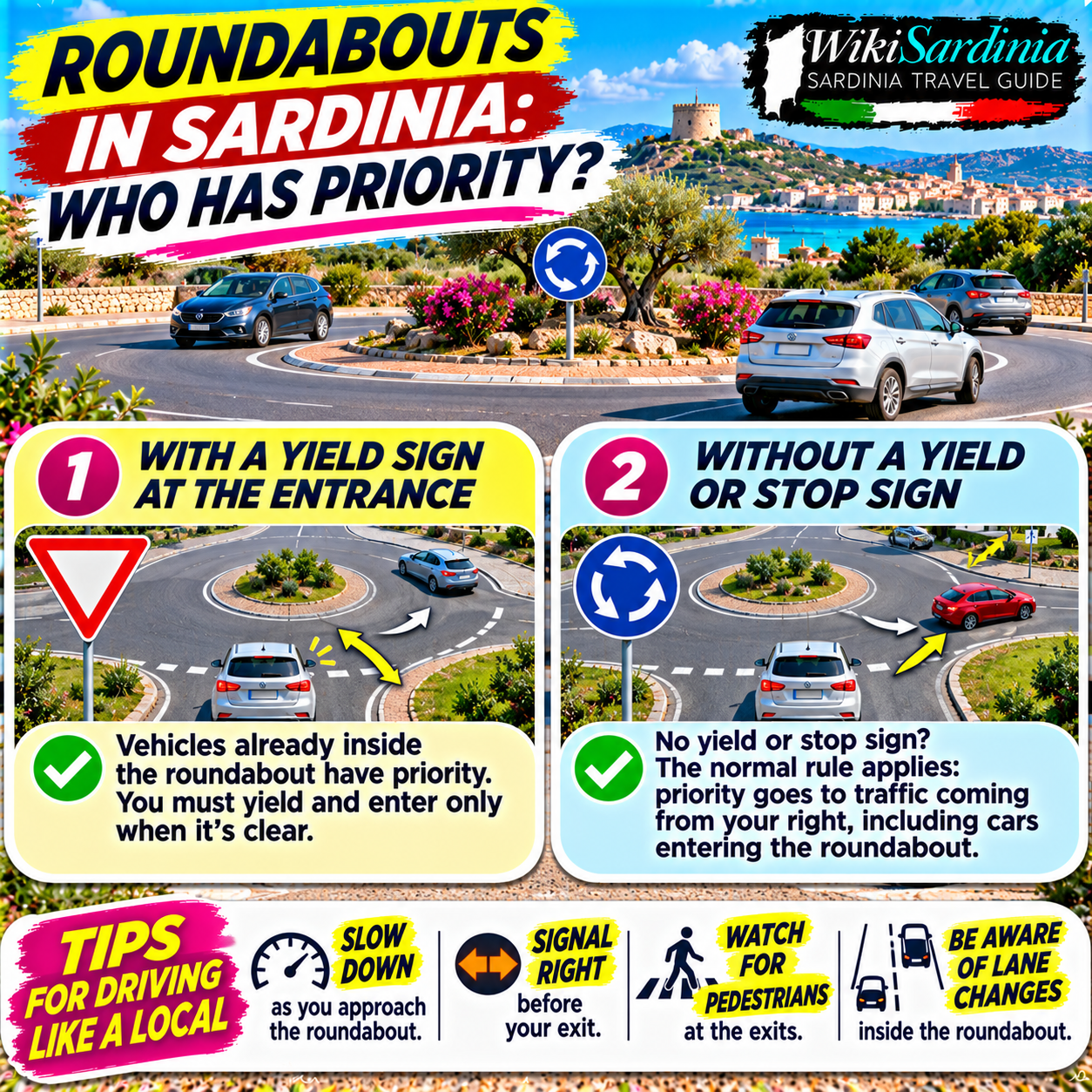
Italian law does not automatically give every vehicle circulating in a roundabout priority. Article 145 of the Highway Code establishes priority for vehicles approaching from the right unless signs provide otherwise. Italy's Automobile Club (ACI) explicitly confirms this distinction in its guidance for foreign visitors.
| Entrance signs | Who has priority? | What to do |
|---|---|---|
| Triangular Dare precedenza (Give Way) sign | Traffic already circulating in the roundabout | Slow down and yield; stop if necessary |
| STOP sign | Traffic on the intersecting road, as indicated | Stop completely and yield before entering |
| No priority signs | Normally traffic approaching from the right, potentially vehicles entering the roundabout | Check carefully rather than assuming circulating traffic always has priority |
The blue circular sign with white arrows indicates mandatory circulation around the central island. By itself, it does not establish that traffic already in the roundabout has priority. The common design with a Give Way sign at the entrance is often called a rotatoria alla francese or European-style roundabout; the less common design applying priority to the right is sometimes called a rotatoria all'italiana.
How do you recognise the signs?
Look for the inverted red-bordered white triangle marked Dare precedenza, sometimes accompanied by a row of white triangles painted on the road. If it is present, let vehicles already in the circular carriageway pass before entering. If there is a STOP sign, stop and then give way as required. If neither sign is present, follow Article 145's right-hand-priority rule while proceeding cautiously.
How to use indicators correctly
Italian Ministry of Transport guidance describes roundabout signalling for driving tests. On a simple single-lane roundabout, when taking the first exit, signal right as you approach or enter. When continuing beyond the first exit, you do not normally need to signal left on entry; signal right in good time after passing the exit before your intended exit. Do not signal right so early that another driver might think you are leaving at the preceding exit. Follow the road layout and signs, especially in multi-lane roundabouts.
Which lane should you use?
For a single-lane roundabout, keep to your lane and maintain a safe speed. In multi-lane roundabouts, observe approach arrows and road markings. Ministry guidance distinguishes cases based on the intended exit and traffic conditions; a right-hand lane is commonly appropriate for the first exit, while other movements can require more careful lane selection. Never cut across another vehicle's path to reach your exit. Signal any lane change, check mirrors and blind spots, and yield where required. If you cannot exit safely, continue around where permitted rather than forcing a manoeuvre.
How do local drivers actually behave?
Driving behaviour varies from person to person. Visitors may encounter quick entries, late indicators, unexpected lane changes or drivers who assume they have priority. These are situations to anticipate, not evidence that Sardinian drivers as a group disregard the rules. Do not imitate an unsafe manoeuvre simply because another driver makes it. Slow down, make your intentions clear and allow enough space for motorcycles, scooters, cyclists and pedestrians.
Pedestrians, cyclists and scooters
Look for pedestrian crossings close to roundabout entrances and exits, where drivers may be concentrating on circulating traffic instead of people crossing. Yield to pedestrians as required by the crossing rules and watch for cyclists or scooters in your blind spots. A vehicle indicating right may still change its mind or signal incorrectly; do not rely on its indicator alone when deciding to enter.
What should you do if you miss your exit?
Do not stop suddenly, reverse or cut across lanes. Continue around the roundabout if the layout permits and take the correct exit on the next circuit when safe. On unusual or spiral layouts, follow the lane markings rather than trying to make a second lap from a lane that does not permit it.
Common mistakes by tourists
- Assuming that every roundabout automatically gives priority to traffic inside.
- Not noticing the triangular Give Way sign or painted yield triangles.
- Using the left indicator throughout a simple single-lane roundabout instead of signalling the exit clearly.
- Crossing from an inner lane directly to an exit without checking the outer lane.
- Entering too quickly because a driver inside appears to be leaving.
- Ignoring pedestrian crossings just beyond an exit.
- Following another driver's behaviour instead of the actual signs and road markings.
Are the rules different in Sardinia?
No. Sardinia follows the Italian Highway Code. The rules are the same as in mainland Italy, though road designs, visibility and traffic volumes vary. Roundabouts can be found in cities, near airports, on approaches to beach towns and at junctions on major roads. Always assess the actual intersection rather than relying on a blanket regional rule.
Useful Italian phrases
- Rotatoria — Roundabout
- Dare precedenza — Give way / yield
- Precedenza a destra — Priority to traffic from the right
- Prima uscita — First exit
- Freccia destra — Right turn indicator
- Attraversamento pedonale — Pedestrian crossing
Frequently asked questions
Does traffic inside a Sardinian roundabout always have priority?
No. It does when the entrance is controlled by a Give Way sign. Without priority signs, the general right-hand-priority rule applies.
What does the blue roundabout sign mean?
It indicates mandatory circulation around the roundabout. It does not, on its own, determine who has priority.
Do I have to stop before every roundabout?
No. At a Give Way entrance, stop only if necessary to yield. At a STOP sign, a complete stop is required.
Should I indicate left when entering?
Not normally for a simple single-lane roundabout. Signal right for the first exit or in good time before your chosen exit; more complex layouts require attention to road markings and lane changes.
Can I change lanes inside a roundabout?
Only when safe and permitted by the markings. Signal, check blind spots and avoid cutting off other road users.
What if I miss my exit?
Continue around where the layout permits and exit safely on the next circuit; never reverse or cut across traffic.
Do locals follow different roundabout rules?
No. The Italian Highway Code applies equally to residents and visitors. Individual driving habits vary.
Can a rental-car driver be fined for failing to yield?
Yes. Violations of Article 145 can lead to administrative penalties, and rental status does not exempt a driver.
The bottom line
In most familiar Give Way-controlled Sardinian roundabouts, let vehicles already inside go first. But read the signs: without a priority instruction, traffic approaching from the right may have priority. Slow down, signal your exit, check pedestrians and other lanes, and never force a last-second turn. These habits are safer than trying to predict how another driver will behave.