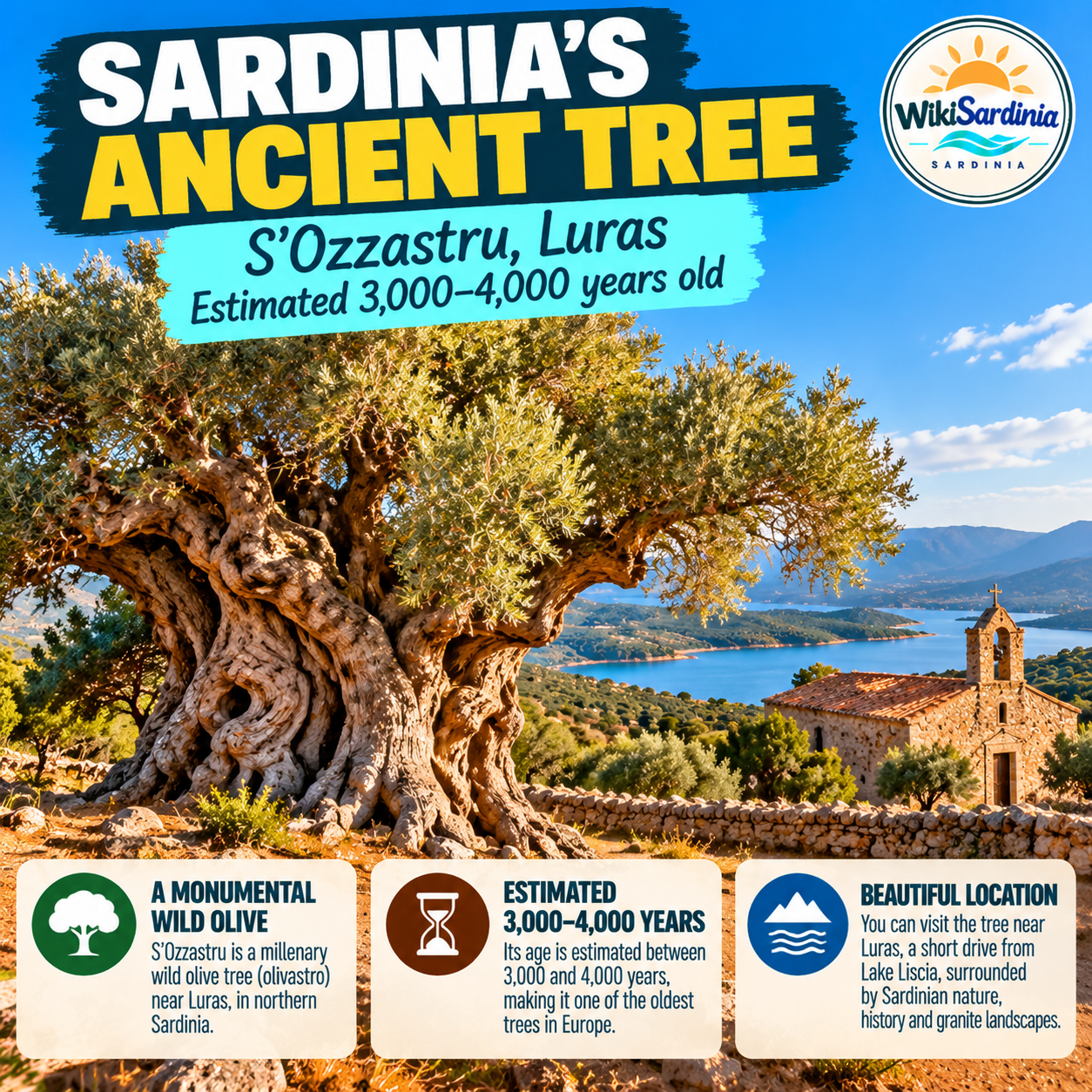
In the Gallura countryside near Luras, northern Sardinia, stands an extraordinary wild olive tree known as S’Ozzastru—a Sardinian name meaning “the wild olive.” Its age is estimated at around 3,000 to 4,000 years, making it one of Italy’s most remarkable ancient trees and a contender among Europe’s oldest living trees.
Is it really Europe’s oldest tree?
The claim needs a little care. The Comune di Luras describes S’Ozzastru as Italy’s oldest tree and one of the two oldest in Europe. However, the ranking is not universally settled: the Llangernyw Yew in Wales is also claimed to be around 4,000–5,000 years old, and that estimate is disputed. Tree ages can be difficult to establish precisely, especially for very old trees with complex, hollow or irregular trunks.
The safest conclusion is that S’Ozzastru is among Europe’s oldest known trees, rather than declaring it the undisputed oldest.
How old is S’Ozzastru?
Official Sardinian sources commonly give an estimated age of 3,000–4,000 years, while some local descriptions state more than 4,000 years. These are estimates rather than an exact birth date. Even at the lower end of that range, the tree was already growing long before the rise of Rome and has witnessed thousands of years of change in Sardinia and the Mediterranean.
A monumental wild olive
S’Ozzastru is an olivastro, the wild form of the olive tree. It stands around 14 metres tall, with an enormous trunk and a canopy covering a broad area. Its twisted wood and sprawling branches make it look less like a conventional orchard tree and more like a living monument shaped by centuries of growth and environmental change.
The tree was recognised as a Natural Monument in 1991 and is included among Italy’s protected monumental trees. It is not only a botanical curiosity but also an important symbol of the local landscape and community.
Where can you find it?
The tree grows at Santu Baltolu di Carana, near the shores of Lake Liscia in the municipality of Luras. The rural setting combines granite landscapes, Mediterranean vegetation and views across the lake. Another ancient olive tree grows nearby, making the area especially interesting for visitors who enjoy natural heritage.
Before travelling, check the current visitor arrangements and any seasonal opening information. The site has offered guided visits and, at certain times, boat excursions on Lake Liscia, but services and schedules can change.
Check the Comune di Luras information about the ancient olive trees and the visitor site for Olivastri Millenari before setting out.
How to visit respectfully
- Follow site rules: respect any barriers, paths and instructions from staff.
- Do not climb the tree: its age and monumental structure make it vulnerable to damage.
- Avoid damaging the bark or branches: do not carve, break or remove any part of the tree.
- Leave the surroundings as you found them: take rubbish away and keep noise low.
- Check access before driving out: the site is in a rural area, so confirm directions and current arrangements in advance.
A living witness to Sardinian history
S’Ozzastru’s exact age may never be known with complete certainty, and its European ranking remains debatable. What is clear is that this ancient wild olive is a remarkable survivor: a living link to a landscape shaped by countless generations. If you visit Luras, take time to appreciate the tree itself and the quiet setting around Lake Liscia—not just the record it might hold.
Official and specialist sources: Comune di Luras — Olivastri Millenari; Regione Autonoma della Sardegna — estimated age and monumental status; CREA — Ancient Italian olive trees and biodiversity.