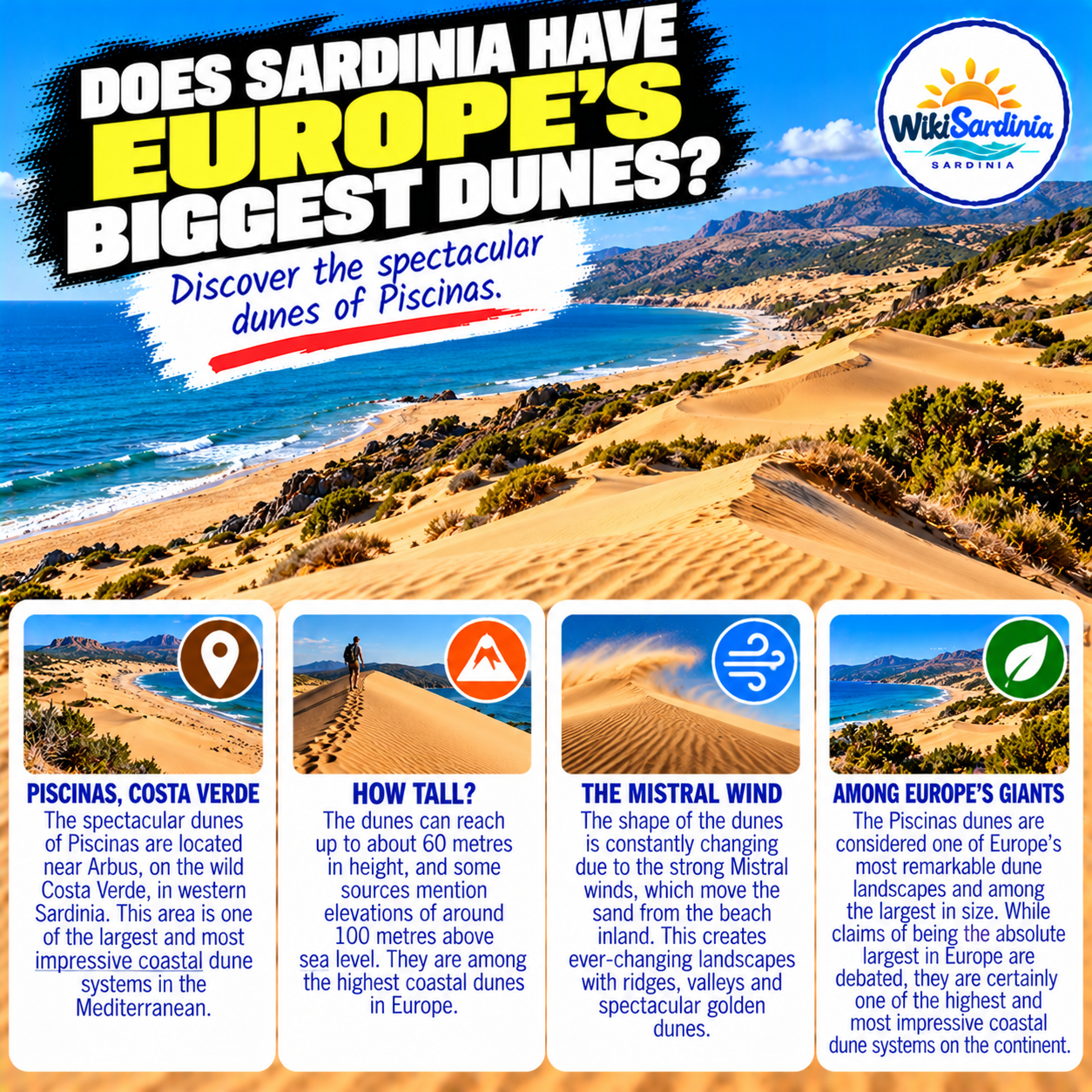
Can Sardinia really claim to have Europe's biggest sand dunes? On the island's wild western coast, the golden dunes of Piscinas rise behind a sweeping Mediterranean beach. Their immense scale has earned them comparisons with the Sahara and a reputation as some of Europe's most spectacular coastal dunes. But the claim that they are the biggest in Europe needs a closer look.
Where are the dunes of Piscinas?
Piscinas lies in the municipality of Arbus, along the remote Costa Verde in southwestern Sardinia. Here, sandy hills extend from the shoreline into an inland landscape of Mediterranean scrub, junipers and former mining territory. The area's isolation makes it feel dramatically different from the island's more developed beach resorts.
Are they really 100 metres high?
Figures for the dunes vary across publications, partly because height above sea level and the vertical height of a dune above its surrounding ground are different measurements. Sardegna Turismo, the official regional tourism portal, describes the dunes as reaching approximately 60 metres in height. A page hosted by Italy's Ministry of Culture describes dune elevations reaching approximately 100 metres above sea level. Those statements are not necessarily contradictory: a dune crest's altitude is not automatically the height of the sand mound itself.
For readers, the safest description is that Piscinas contains very large coastal dunes, with approximately 60 metres cited as their height by the regional tourism authority and higher elevations reported in other sources. A precise European ranking would require consistent measurement methods and a clear definition of the dune system being compared.
Does Sardinia have Europe's biggest dunes?
Piscinas is among Europe's remarkable coastal dune landscapes, but the absolute record is not established by the figures alone. For comparison, France's famous Dune du Pilat on the Atlantic coast is regularly measured at more than 100 metres above sea level, although its height changes over time. Other European dune systems are much larger in area. The word biggest can refer to height, area, volume, length or the extent of an entire dune field—each producing a different comparison.
That does not diminish Piscinas. Its combination of high golden dunes, a long open beach and relatively undeveloped scenery is extraordinary in the Mediterranean.
How were the dunes formed?
Over long periods, waves and coastal processes supplied sand to the beach. Strong prevailing winds, especially the mistral from the northwest, carried dry grains inland. Where wind speed fell or vegetation trapped sand, deposits accumulated and developed into dune ridges and slopes. The dunes continue to change: gusts shift surface grains, build ripples and reshape exposed sections.
Not every part of the landscape moves freely. Vegetation can stabilise some areas by holding sand with its roots, while more exposed surfaces remain mobile.
Why does Piscinas look like a desert?
The ochre-gold sand, broad open spaces and sculpted ridges give Piscinas an almost Saharan appearance. Yet it is a Mediterranean coastal ecosystem, not a true extension of the Sahara. Hardy plants such as juniper, lentisk and other scrub species survive in places where sand, salt spray and drought create difficult growing conditions. The contrast between dunes, greenery and deep blue sea is what makes the setting so striking.
What animals live around Piscinas?
The wider Costa Verde supports important wildlife, including the Sardinian deer, a conservation symbol of the island. Coastal habitats also provide nesting opportunities for protected birds and, under suitable conditions, sea turtles. Wildlife sightings are never guaranteed. Visitors should observe animals from a distance, avoid disturbing vegetation and respect any temporary protections around sensitive habitats.
What does the area's mining history have to do with the dunes?
The hinterland around Ingurtosu and Montevecchio was once an important mining district. Old industrial buildings, tracks and remnants of mining activity still mark the surrounding landscape. Geological research notes that material from former mining areas has affected the colour and composition of sediments near certain watercourses. This adds another layer to the story of Piscinas: its scenery reflects both natural coastal processes and the region's industrial past.
Can you walk on the dunes?
Visitors should follow designated paths and local conservation instructions. Dune vegetation is fragile, and repeated trampling can damage the plants that help stabilise the sand. Avoid climbing sensitive ridges or crossing fenced-off restoration areas. The open beach provides ample opportunities to enjoy the landscape without disturbing protected sections.
When is the best time to visit Piscinas?
Spring and early autumn can offer pleasant conditions for exploring the coastline, although weather and wind vary. Summer brings hotter sand and stronger visitor demand. The west coast is exposed to wind, surf and potentially dangerous currents, so swimming conditions should never be judged by the beauty of the beach alone. Check local weather, access conditions and available services before travelling.
Why Piscinas deserves its reputation
Even without claiming a definitive European record, Piscinas is one of Sardinia's most memorable natural landscapes. The dunes rise from the wild Costa Verde, are constantly reshaped by wind and shelter a fragile coastal ecosystem. Whether you come for the scenery, the geology or the silence, the experience explains why the area is often described as Sardinia's little desert.
The verdict
True in spirit, but not as an uncontested record: Sardinia has one of Europe's most impressive coastal dune systems at Piscinas. Official Sardinian tourism information cites dune heights of up to approximately 60 metres, while other institutional sources refer to elevations around 100 metres above sea level. Saying they are unquestionably Europe's biggest dunes—or that every dune stands 100 metres tall—would overstate the evidence.