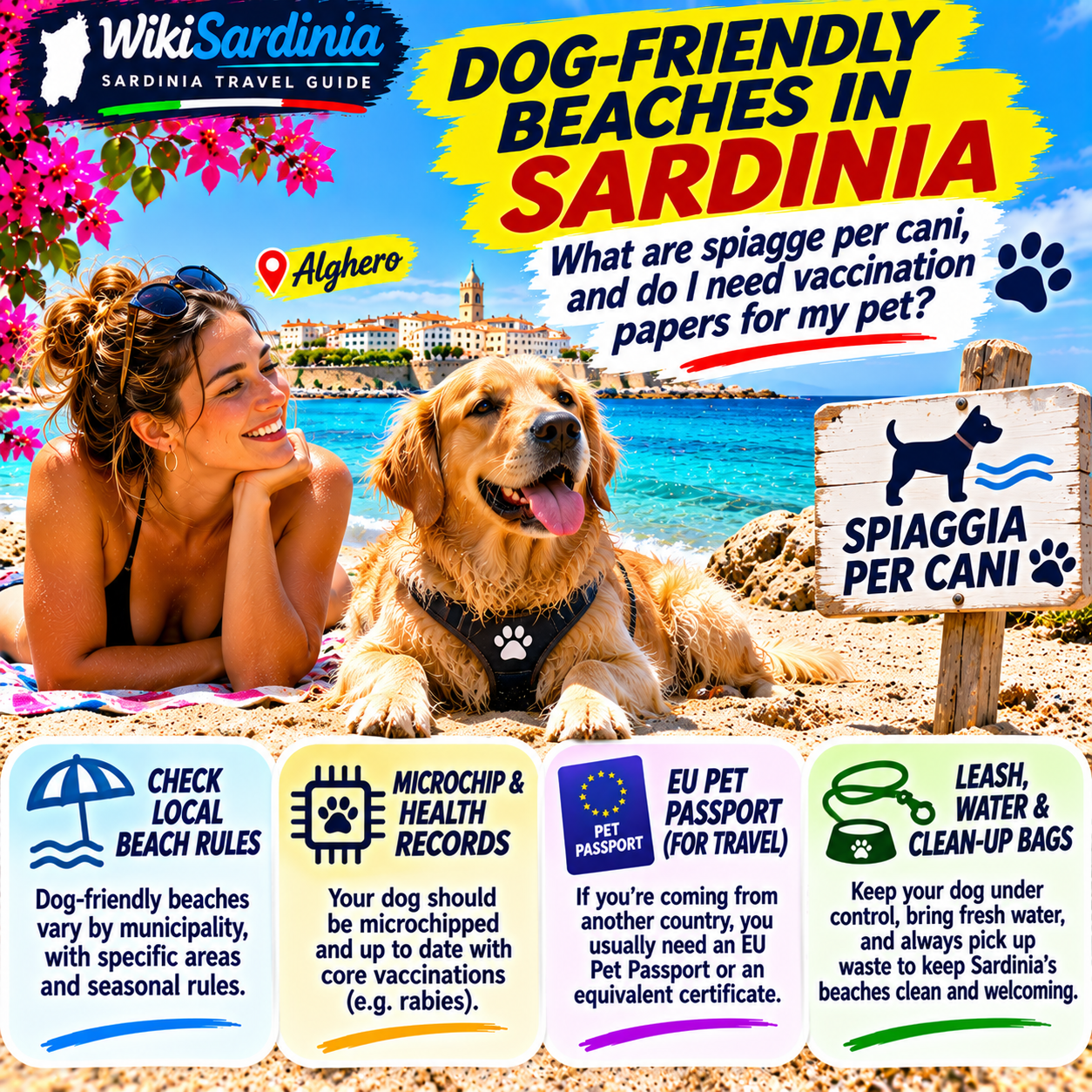
Dreaming of a Sardinian beach holiday with your dog? You're not alone. More visitors are travelling with pets and looking for places where their four-legged companions can enjoy the sea. But before packing the leash and beach towel, there are two separate questions to answer: where is your dog allowed on the beach, and which health documents do you need?
Sardinia has designated spiagge per cani—dog-friendly beach areas—with local rules about access, microchips, vaccinations and responsible behaviour. If you're travelling from another country, additional EU pet-entry requirements may apply. The safest approach is to check both sets of rules before departure.
What does “spiaggia per cani” mean?
Spiaggia per cani literally means “beach for dogs.” It usually refers to a designated section of coastline where dogs may accompany their owners under stated conditions. Some are public areas managed by a municipality; others may be privately managed facilities with their own services and restrictions.
Not every dog-friendly beach is fenced, staffed or equipped with showers and drinking water. Some allow dogs to swim within marked waters, while others impose specific controls. Read the signs at the entrance rather than assuming that a dog-friendly label means unrestricted off-leash access.
Can dogs go on any beach in Sardinia?
No simple island-wide yes-or-no rule covers every location and season. Sardinia's regional animal-welfare legislation recognises access to public places, including beaches, subject to applicable restrictions and responsible handling. At the same time, regional bathing ordinances, municipal measures, protected-area rules and specific beach regulations can limit where and when animals are permitted.
During the summer bathing season, many popular bathing areas have designated dog sections or local access rules. Do not assume you can take your dog onto any crowded beach just because it is public. Check the current municipal ordinance and on-site signs, especially in July and August.
Where is the official dog beach in Alghero?
The Municipality of Alghero's official Dog Beach was established by a municipal resolution in 2015. The city's published rules allow dogs of any size or breed when accompanied by their owners or temporary handlers.
However, access is conditional. Dogs must be identifiable by microchip and registered in the canine registry, with vaccinations and internal and external parasite prevention up to date. The municipality specifically states that the health booklet documenting vaccination prophylaxis must be shown to the authorities when requested.
Dogs must not be left unattended or allowed to wander freely. They must be kept on a leash, and a muzzle may be required in specified circumstances, including when an animal causes disturbance or where the law requires one. Check the official page and current on-site notices for the precise beach location and any seasonal changes.
Is there a dog-friendly beach in Cagliari?
Yes. Cagliari's official tourism portal identifies a dog-friendly area at Poetto beach, near the seventh bus stop opposite Ospedale Marino. The municipality describes an approximately 6,000-square-metre section enclosed by fencing, with a drinking-water fountain along the seafront.
Dogs can swim with their handlers inside the area marked by buoys. Entry is limited to animals with microchips and health documentation confirming their good health, and handlers must carry equipment to collect waste. Follow the posted rules about supervision, leashes and swimming boundaries.
Are there dog-friendly areas near Sassari?
Yes. The Municipality of Sassari's Ordinance No. 56/2026 established designated dog areas at Porto Ferro and Fiume Santo. The municipality provides supporting documents showing the areas and facilities.
These examples are not an exhaustive list of Sardinia's dog-friendly beaches. Rules and designated areas may change each season, so check with the municipality before making a long drive with your pet.
Do I need vaccination papers at the beach?
Yes, bring them. At least some official dog beaches in Sardinia expressly require proof that a dog is properly identified and in good health. Alghero requires vaccinations and antiparasitic treatments to be in order and the health booklet to be available for inspection. Cagliari's Poetto dog beach requires a microchip and health documentation.
The precise list of documents depends on the beach and its local rules. A vaccination booklet or equivalent veterinary record can be useful even if nobody checks it on arrival. Do not confuse this local beach documentation with the documents legally required for international travel.
Is a microchip required?
Dog identification and registration are central to Italian pet regulations. Both Alghero and Cagliari's official dog beaches specifically require a microchip. Carry the dog's identification details and ensure that the registration information is accurate.
If your dog is travelling from abroad, the microchip also plays an essential role in EU pet travel rules: the animal's identity must match its travel documents, and the microchip must generally have been implanted before the rabies vaccination used for travel.
Do I need a pet passport to visit Sardinia?
It depends on where you are travelling from. Sardinia is part of Italy and follows EU rules for non-commercial movements of pet dogs, cats and ferrets.
Travelling from another EU country
For travel between EU member states, your dog generally needs a valid EU pet passport, a compliant microchip or qualifying older tattoo, and a valid rabies vaccination recorded in the passport. The EU passport is an official document issued by an authorised veterinarian.
Travelling from Great Britain or another non-EU country
For most non-EU origins, a dog needs an EU animal health certificate issued or endorsed through the applicable official veterinary process, plus a compliant microchip and valid rabies vaccination. Some countries and territories have special passport arrangements. Depending on the country of departure, an additional rabies antibody test and waiting period may be required.
EU rules generally require the animal health certificate to be issued within ten days before entry into the EU, with specific validity rules for onward movement. Check the European Commission's official pet-travel guidance for your exact country and itinerary before booking flights or ferries.
Travelling within Italy
A trip from mainland Italy to Sardinia is a domestic journey, not an international border crossing. An EU pet passport is not automatically required merely because you take a ferry or plane to Sardinia, but domestic identification rules, transport-operator conditions and the chosen beach's health-document requirements still apply.
Does my dog need a rabies vaccination?
A valid rabies vaccination is a standard requirement for dogs entering Italy from another EU country or many non-EU origins. The vaccination must meet EU timing and identification rules. For a first vaccination, the EU normally requires a waiting period of at least 21 days before travel; young animals are subject to restrictions, and Italy does not accept certain unvaccinated young puppies under the relevant exception scheme.
For dogs travelling only within Italy, the international rabies-entry requirement should not be confused with a blanket rule that every dog on every Sardinian beach must have the same vaccination paperwork. Specific beaches can impose their own health and vaccination requirements. Ask your veterinarian what is needed for your journey.
What about parasite treatments?
Alghero's dog beach rules expressly require internal and external antiparasitic prophylaxis to be in order. Other facilities may have different veterinary-document requirements.
EU rules on mandatory treatment against the tapeworm Echinococcus multilocularis apply to travel to certain listed destinations such as Ireland, Malta, Finland, Norway and Northern Ireland; Italy is not among those destinations for that particular mandatory entry treatment. Routine parasite prevention remains a veterinary health matter and may be required by local beach rules.
Must my dog be on a leash or wear a muzzle?
Follow the posted rules at the specific beach. Alghero's official dog beach requires dogs to be leashed and provides for muzzle use in circumstances specified by law or when needed because the dog is causing a disturbance. Some designated exercise areas may allow different arrangements, but do not assume all dog beaches are off-leash parks.
Bring a suitable leash and a muzzle in case it is needed for transport, public areas or local requirements. Keep your dog under close supervision, especially around children and other animals.
Can dogs swim in the sea?
Sometimes, yes, but only where local rules allow it. At Cagliari's Poetto dog beach, the official tourism portal states that dogs can swim with their handlers within the water area marked by buoys. Other dog beaches may have different boundaries or restrictions.
Never let your dog swim near dangerous currents, heavy surf or crowded bathing lanes. Rinse salt from its coat after swimming, provide fresh water and watch for signs of overheating or exhaustion.
How can I keep my dog comfortable on a hot Sardinian beach?
Summer sand can become extremely hot. Plan visits for cooler hours, provide shade and plenty of fresh drinking water, and check the sand temperature before allowing your dog to walk on it. A towel or cooling mat can help prevent prolonged contact with hot surfaces.
Never leave a dog unattended under an umbrella or inside a parked car. Watch for excessive panting, weakness, vomiting or collapse, which may indicate heat illness. Move the dog to a cool place and seek veterinary assistance promptly if you suspect heatstroke.
What should I pack for a dog-friendly beach?
Bring a leash, muzzle where appropriate, microchip and registration information, vaccination booklet or other health documentation, and the EU pet passport or animal health certificate if travelling internationally. Add fresh water, a bowl, shade, waste bags, towels and any veterinarian-recommended medication.
Collect your dog's waste immediately and dispose of it properly. Respect other beachgoers and wildlife, especially nesting birds and protected dunes.
Frequently asked questions
Can I take my dog to any beach in Sardinia?
No. Access depends on regional, municipal and beach-specific rules. Check designated dog-friendly areas and current signs before entering.
Do dog-friendly beaches in Sardinia require vaccination records?
Some explicitly do. Alghero requires the health booklet showing vaccinations when requested, and Cagliari's Poetto dog beach requires health documentation. Bringing up-to-date records is strongly recommended.
Is a microchip compulsory at Alghero's dog beach?
Yes. The municipality requires microchip identification and registration.
Can my dog swim at Poetto in Cagliari?
Yes, in the designated dog-beach water area marked by buoys, accompanied by the responsible handler and subject to local rules.
Do I need a pet passport if I'm coming from Germany or France?
For travel between EU countries with a dog, an EU pet passport, microchip and valid rabies vaccination are generally required.
Do I need a pet passport if I'm coming from the UK?
Travellers from Great Britain generally need the appropriate EU animal health certificate rather than relying on a GB-issued EU pet passport. Check official guidance for your specific origin and circumstances.
Can my dog be off leash?
Only where the specific beach rules allow it. Do not assume that a dog-friendly beach automatically permits off-leash running.
Are guide dogs subject to the same restrictions?
Assistance and guide dogs may benefit from specific legal access protections. If you are travelling with a trained assistance dog, consult the current applicable rules and the destination's authority rather than assuming that ordinary pet restrictions always apply unchanged.
The bottom line
Sardinia can be a wonderful destination for travellers with dogs, provided you plan ahead. Choose a designated dog-friendly beach, verify its current rules, carry the dog's microchip and health records, and check EU travel requirements if arriving from abroad. A little preparation means more time enjoying the sea—and fewer surprises when you reach the sand.