Sardinia’s wellness map extends far beyond beach resorts and hotel spas. In Fordongianus, a small town in the province of Oristano, naturally hot mineral water still rises beside the Tirso River at roughly 54–56°C, in the same landscape where Romans built one of the island’s most important thermal complexes nearly two thousand years ago. The archaeological baths can be visited today, making Fordongianus an unusual combination of Roman history, geothermal landscape and modern thermal culture in Sardinia’s interior.
There is one important distinction for visitors searching online for “natural Roman baths.” The ancient Forum Traiani baths are an archaeological site, not a historic swimming pool where tourists should simply climb in and soak. Fordongianus also has a modern thermal tradition using the same naturally hot waters. Treat the Roman structures as protected archaeology and use authorized contemporary facilities for a spa experience.
From Aquae Ypsitanae to Forum Traiani
The springs at Fordongianus were valued long before modern wellness tourism. SardegnaTurismo notes that the thermal landscape was known in prehistoric times, with early Sardinian communities regarding the waters as sacred. The surrounding territory preserves prehistoric settlements and domus de janas tombs, evidence that human activity here predates Rome by centuries.
The Romans developed the settlement on the left bank of the Tirso, where the hot springs known as Aquae Ypsitanae emerged. The town became Forum Traiani, an important inland center and a point of contact between Romanized communities around the Gulf of Oristano and populations farther into Sardinia’s interior.
The thermal complex dates principally from the first century AD. Its position was practical as well as symbolic: the Romans could exploit the naturally heated water directly at its source rather than warming every bath artificially.
The ancient site preserves pools, rooms, porticoed spaces and evidence of the sophisticated hydraulic systems that supplied the complex. SardegnaTurismo describes a network of channels, wells and cisterns, while surviving traces include mosaic flooring and architectural elements connected with the bathing spaces.
Water that still emerges at more than 50°C
The most striking thing about Fordongianus is that the thermal phenomenon is not an archaeological memory. The springs are still active.
Official regional tourism sources give the source temperature as approximately 54–56°C, with the water remaining naturally hot throughout the year. Small differences between official pages reflect measurements and descriptions of the spring system rather than a meaningful change for travelers: the key point is that this is genuinely hyperthermal water, far hotter than a comfortable bath when it first emerges.
That temperature is also a reason not to improvise a soak simply because hot water can be seen near the river. Natural thermal environments can involve very hot flows, slippery surfaces, changing river conditions and protected archaeological areas.
For wellness treatments, Sardinia’s official tourism material describes Fordongianus as a modern thermal center using sulphurous, hyperthermal waters and thermal mud. Visitors interested in therapeutic treatment rather than simple relaxation should discuss suitability with the operating spa and, where appropriate, a medical professional rather than treating general tourism claims as personal medical advice.
What can you see at the Roman baths?
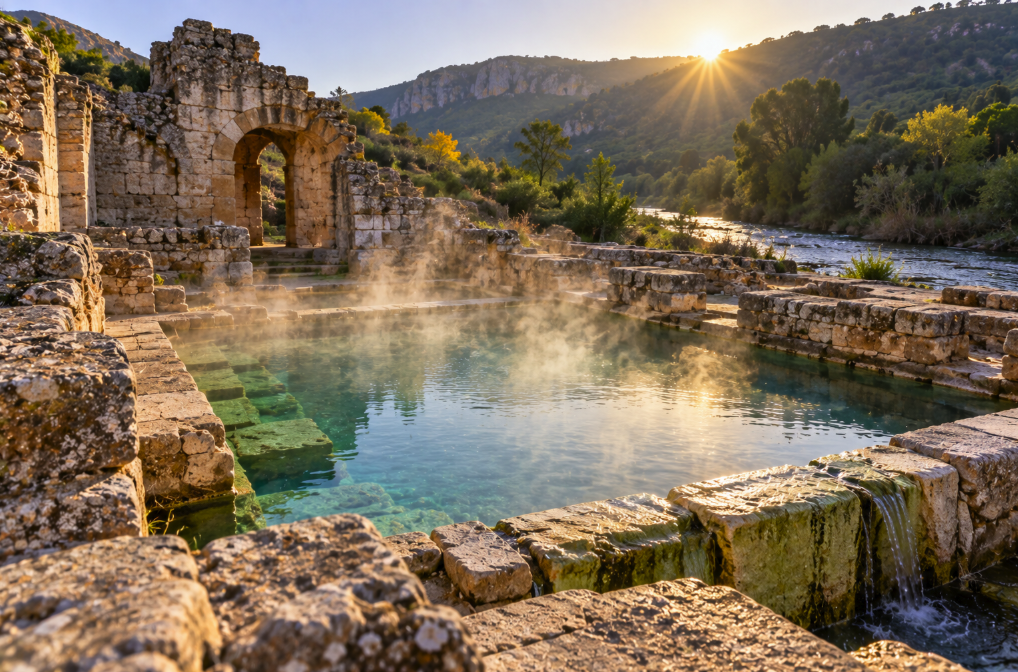
The surviving complex is unusually evocative because water, stone and landscape remain closely connected. One section contains a rectangular pool that was originally covered by a barrel vault and bordered by porticoes. Another includes changing areas and rooms associated with the Roman bathing sequence.
Archaeologists have also found evidence of the religious dimension of thermal culture. Two statues of Bes, a deity associated with health and protection, and a sacred area connected with nymphs show that the springs were not understood merely as plumbing infrastructure. Water, healing and worship overlapped.
The ruins stand at Caddas beside the Tirso. Even the local name points back to heat: SardegnaTurismo explains it as meaning “hot.” The setting helps visitors understand why this site feels different from a Roman bath complex excavated in a modern city. The geothermal source and river landscape are still visible parts of the story.
Can you bathe in the ancient Roman pools?
Visitors should plan on visiting the archaeological complex, not using it as an open-air spa. The surviving Roman structures are cultural heritage and should not be entered as though they were public bathing pools.
This matters because social media can blur the distinction between archaeological water features and legitimate thermal bathing areas. Images of steam rising beside ancient stone can create the impression that Fordongianus is Sardinia’s version of an unrestricted wild hot spring.
The better itinerary separates the two experiences: explore Forum Traiani for its archaeology, then book a modern thermal facility if you want to spend time in controlled thermal water. That protects the site and gives travelers a more predictable wellness experience.
Why Fordongianus fits a slower Sardinia itinerary
Fordongianus sits in the Barigadu area of central-western Sardinia, away from the island’s busiest resort corridors. It works particularly well for travelers already exploring Oristano, the Sinis Peninsula or inland archaeological sites and who want to add something different from another beach day.
The town itself is small, but the Roman baths are not its only cultural interest. Fordongianus is known for local trachyte stone in red, green and grey tones, used in traditional architecture. The 17th-century Aragonese House is another notable historic building.
Nearby, the church of San Lussorio adds a later layer of history. SardegnaTurismo describes a crypt, traces of mosaics and Byzantine frescoes, as well as the traditional connection with the martyr Luxorius. Together, the Roman thermal complex, Christian site and town architecture make Fordongianus more rewarding as a cultural stop than a quick photo beside steaming water.
A different kind of Sardinian wellness
The rise of wellness travel makes Fordongianus particularly relevant because it offers something difficult to manufacture in a luxury resort: continuity. The attraction is not simply that the water is hot. It is that people have attached ritual, healing, bathing and social meaning to these springs across very different periods of Sardinian history.
The Romans turned that resource into monumental architecture. Modern thermal establishments use contemporary facilities. Between them is the same geological fact: naturally heated mineral water rising from beneath the Tirso valley.
Fordongianus also challenges the idea that a Sardinia wellness trip must be coastal. An itinerary can combine archaeological walks, inland villages, thermal treatments and the landscapes around Oristano before returning to the sea.
When to visit
The site has year-round appeal, but autumn, winter and spring are especially interesting for travelers attracted by thermal culture. Cooler air makes the presence of hot water more atmospheric, and an inland archaeological visit can be more comfortable than walking exposed ruins in the hottest part of summer.
Before traveling, check the current archaeological opening hours and any admission arrangements rather than relying on an old travel blog. The same applies to modern spa treatments: opening periods, packages and access conditions can change independently from the archaeological site.
Allow enough time to see the ruins rather than treating them as a backdrop for a wellness photo. The surviving hydraulic engineering, religious evidence and relationship with the river are what turn Fordongianus from a hot spring into one of Sardinia’s most interesting Roman sites.
For travelers looking for a less familiar side of the island, that is the real appeal. Fordongianus offers warm water without the beach, wellness without needing a resort and Roman archaeology whose original natural resource is still flowing beside it today.