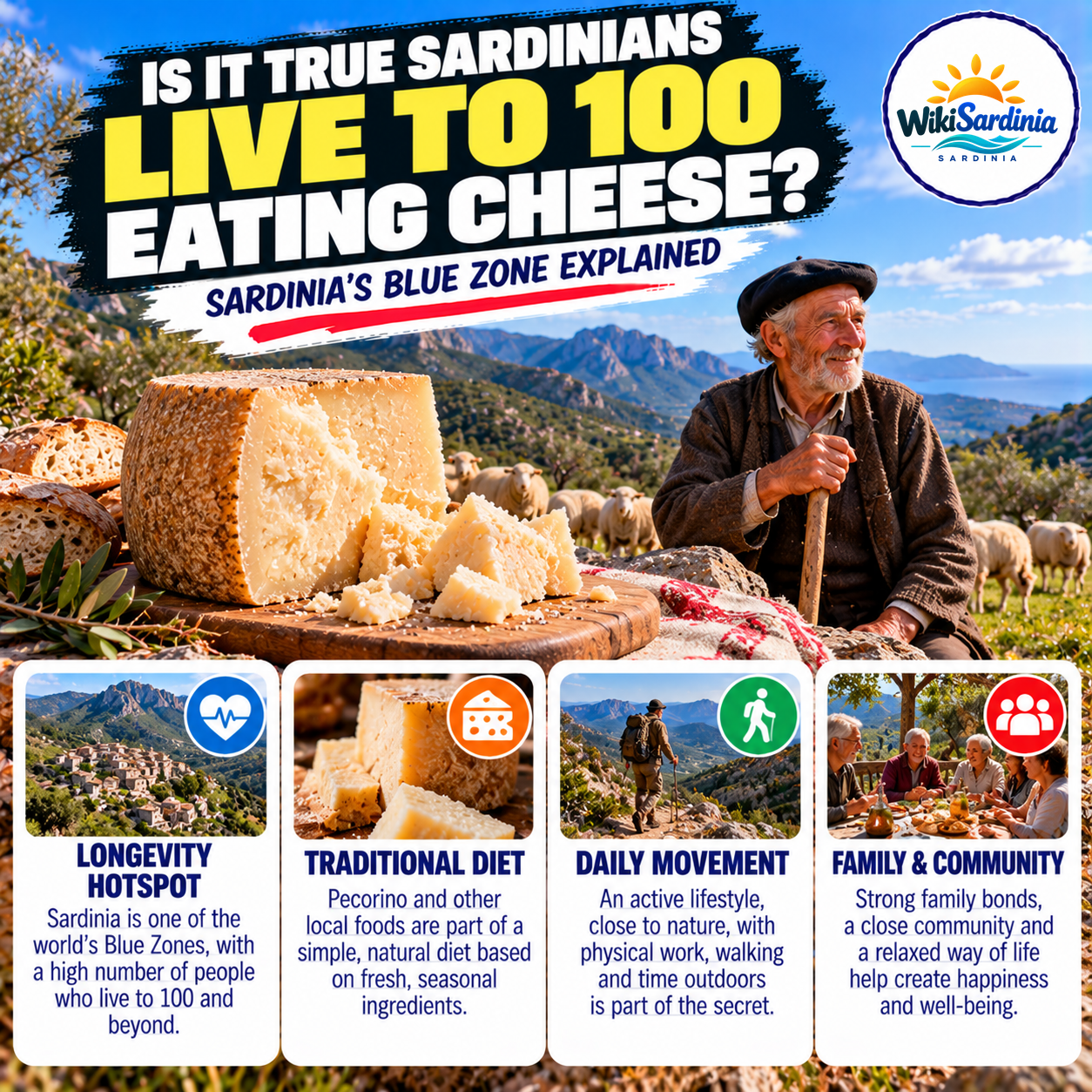
It is a tempting idea: Sardinians eat pecorino cheese and live to 100. Sardinia is indeed famous for an unusually high number of centenarians in parts of the island, and its central-eastern inland communities are widely known as a longevity “Blue Zone.” But the real story is more interesting than a single food being responsible for a long life.
Is Sardinia really a Blue Zone?
Yes—but not every part of Sardinia is equally associated with exceptional longevity. Demographic research identified a cluster of inland communities in central-eastern Sardinia, especially around Ogliastra and neighbouring mountainous areas, where validated centenarians were unusually common in historical birth cohorts. The region is often described as the Sardinian Blue Zone.
It is a specific area rather than the whole island, and researchers continue to investigate why longevity has been so pronounced there. The pattern cannot be explained by one habit alone.
Do Sardinians really eat pecorino?
Sheep’s-milk cheese is an important part of Sardinia’s pastoral food culture. Pecorino Sardo and other local cheeses reflect a long tradition of sheep farming, while some inland communities also have traditional fresh or fermented dairy products. But traditional meals vary by household, season and generation; there is no single “centenarian menu” that every Sardinian follows.
Traditional inland diets have often included vegetables, beans and other pulses, bread, seasonal foods and modest amounts of meat, alongside dairy products. Walking, physical work and close social relationships have also been discussed as possible parts of the wider Blue Zone picture.
What does the research say about cheese and longevity?
A 2026 observational study followed 200 residents of the Sardinian Blue Zone who were aged 90 to 106 at recruitment. Researchers found that more frequent consumption of milk and cheese was associated with lower mortality during the follow-up period. This is an interesting finding, but it needs careful interpretation.
The participants were already at least 90 years old when their diet was assessed. The study therefore does not show that eating cheese throughout life makes someone reach 100. Nor does it prove that pecorino specifically was responsible: the questionnaire recorded cheese consumption as a broad category and could not isolate one variety as the cause of longer survival.
Observational studies can identify associations, but they cannot fully separate the influence of diet from appetite, health, income, family support, activity, genetics and other factors. The researchers themselves caution against extrapolating these late-life findings to the causes of exceptional longevity across an entire lifetime.
So what might explain the Sardinian Blue Zone?
Researchers generally consider longevity a combination of influences rather than the result of one superfood. Possible contributors include:
- Everyday movement: walking, gardening, shepherding and other regular activity built into daily life.
- Traditional food patterns: seasonal vegetables, pulses, grains and locally produced foods, including dairy.
- Family and community: strong social ties and regular contact across generations.
- Local history and genetics: population history and inherited factors may contribute, although they do not determine an individual’s lifespan.
- Healthcare and living conditions: access to care and changes in living standards also influence survival and must be considered.
The relative importance of these factors is still being studied. It would be misleading to claim that all centenarians share the same habits or that one item on their plate explains their age.
Should you eat more pecorino to live longer?
Pecorino can be enjoyed as part of a balanced diet, but it is not a proven longevity treatment. It contains protein and calcium, while also being relatively rich in salt and saturated fat, so portion size and a person’s overall dietary needs matter. The evidence does not support eating extra cheese specifically to try to reach 100.
A more useful lesson is to look at the whole pattern: varied foods, regular movement suited to your abilities, meaningful social connections and appropriate healthcare. If you enjoy Sardinian food, savour the cheese as one part of a rich regional tradition—not as a guarantee of a longer life.
The short answer
Yes, Sardinia has a recognised Blue Zone with a notable history of exceptional longevity, and cheese is part of the traditional diet in some communities. Recent research has found an association between cheese consumption and survival among people who had already reached 90 or older, but it does not prove that pecorino causes longevity. The secret, if there is one, is likely to be a complex combination of lifestyle, community, environment, history and biology.
For more information, read the original demographic research on the identification of Sardinia’s longevity area, the 2026 study on diet and subsequent survival among Sardinian Blue Zone residents aged 90 and older, and the Ogliastra Blue Zone overview.