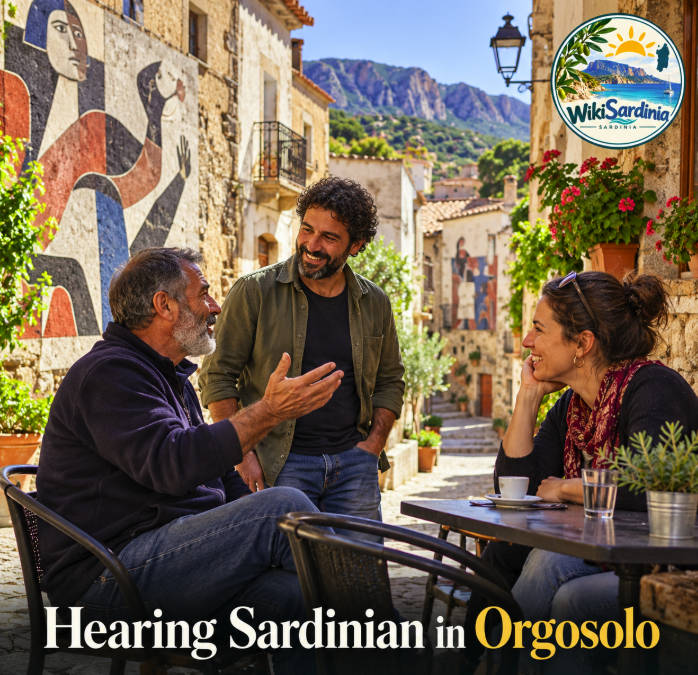
Orgosolo is a rewarding starting point for travellers interested in hearing Sardinian and understanding its place in local culture. The village’s oral traditions and canto a tenore are documented by Sardinia’s regional cultural and tourism portals. Come with curiosity about a living community, rather than expecting everyone to speak on request or a performance to begin when you arrive.
No source establishes Orgosolo as the single “best” place to hear Sardinian, and we cannot guarantee which language you will hear during a particular visit. A more useful plan is to ask a local guide or cultural host for an introduction to the local variety, then allow time for conversation and listening.
A language with local varieties
The regional SardegnaCultura overview of Sardinian describes broad central-northern and southern linguistic areas, commonly associated with Logudorese and Campidanese, with further local distinctions. It also explains that Sardinia’s linguistic landscape includes other languages and varieties, such as Algherese Catalan and Tabarchino.
That context helps avoid treating everything spoken on the island as one interchangeable “strong dialect”. Ask how a speaker describes the language used locally and which words or sounds differ from neighbouring places. Local variation is part of the interest, not a measure of how authentic a town or person is.
If someone addresses you in Italian, it does not tell you whether they also speak Sardinian. They may simply be choosing a language they expect you to understand. You can explain that you are interested in learning, while leaving them free to continue in whichever language suits the conversation.
Make Orgosolo a listening visit
SardegnaTurismo’s Orgosolo guide highlights the village’s murals, its Barbagia traditions and its relationship with canto a tenore. These offer subjects for a guided walk or a discussion with a willing host. A guide who can explain both the place and local speech may give you more context than trying to decipher fragments overheard in passing.
When arranging a visit, ask specifically whether language can be part of the experience. For example: “Mi interessa la lingua sarda: può spiegarmi qualche parola usata a Orgosolo?”—“I’m interested in Sardinian: could you explain a few words used in Orgosolo?” This is a request for an introduction, not an assumption that a standard tour includes a lesson.
Let the speaker choose a few everyday words and explain their meaning. Hearing the same expression repeated slowly, then within a sentence, can be more useful than collecting a long list you cannot pronounce. Ask before making an audio recording, and accept a refusal without turning it into a negotiation.
Do not treat private conversations as visitor attractions. Cafés and shops are places where people work and spend their day. An exchange that develops naturally can be valuable, but residents do not owe visitors a demonstration of their language.
Canto a tenore opens another door
The regional account of Orgosolo’s tenore tradition discusses a repertoire that includes poetry and political texts, linking singing with the community’s history. It is a useful route into language through performance, although sung poetry and everyday conversation are different listening experiences.
If hearing a live group is important, arrange around a confirmed event or an explicitly booked performance. Ask an organiser about the date, venue and programme. A general description of a strong singing tradition is not a calendar, and we have not verified a performance available tonight.
For a first listen, ask for the meaning or a translation of a short passage. Understanding the subject helps you follow the relationship between words and voices without pretending that you will understand the whole song immediately.
Give Orgosolo enough time for a walk, a cultural introduction and unhurried conversation where it is welcomed. The most memorable encounter may be a short explanation from a willing speaker rather than a staged display. You will leave with a clearer sense of Sardinian as a language people use and interpret in their own community.