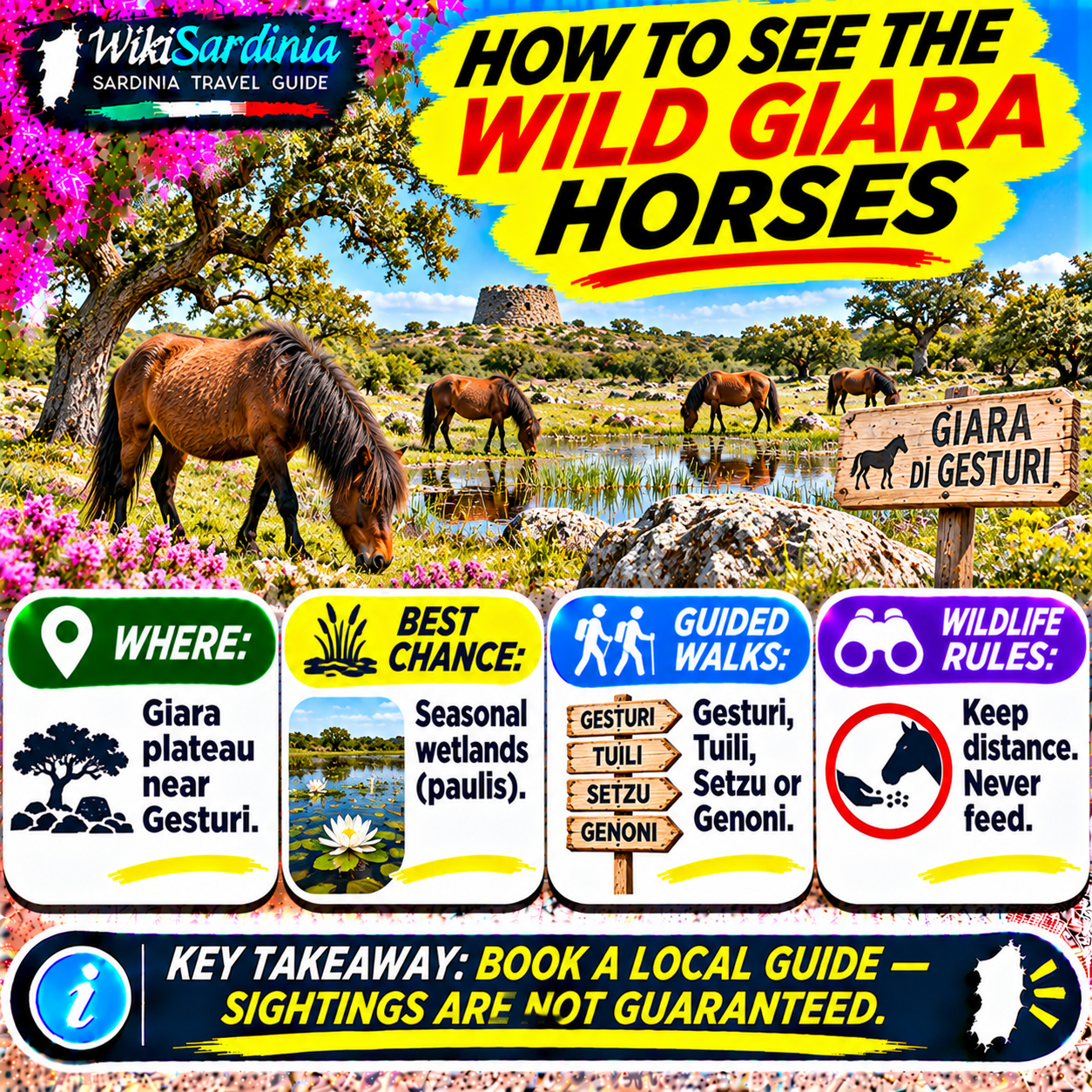
The best way to see Sardinia's famous wild Giara horses is to visit the Giara di Gesturi plateau, ideally on a guided walk toward its seasonal wetlands, known locally as paulis. The small, free-roaming horses—cavallini della Giara or is quadeddus—are one of the island's most distinctive wildlife encounters. They are not kept in a zoo or a paddock for visitors, so sightings depend on where the animals are moving and the conditions on the day.
Where is the Giara di Gesturi?
The Giara, also called Sa Jara Manna, is a basalt plateau in south-central Sardinia, between the Marmilla and Sarcidano areas. It rises to roughly 550 metres and covers about 45 square kilometres, extending across the territories of Gesturi, Genoni, Tuili and Setzu. Its volcanic terrain supports oak woods, Mediterranean scrub, seasonal pools, rare flowers and the Giara horses. Official regional tourism describes it as a remarkable natural landscape around 60 kilometres from Cagliari as the crow flies; driving routes are longer. SardegnaTurismo — Giara di Gesturi.
Are the cavallini really miniature horses?
They are small, hardy horses, often called ponies in English because of their size, rather than miniature versions of an ordinary riding horse. Their compact build, long mane and distinctive appearance are adaptations associated with a long-established free-ranging population. Popular tourism descriptions call them Europe's last wild horses, but the exact meaning of “wild” can be debated: they are a distinctive local population living freely on the plateau, not a guarantee that their ancestry is completely untouched by human management. The important thing for visitors is to observe them as free-ranging animals, not as tame attractions.
Where are you most likely to spot the horses?
Look toward the paulis, the shallow seasonal wetlands that form on the plateau after rainfall. The horses may graze or come to drink near these pools. The Fondazione Altopiano della Giara's official excursions describe sightings around Pauli Majori de Susu from the Genoni side, Pauli Nuracciassu from Setzu and other areas on the Gesturi and Tuili approaches. These are places where sightings are possible, not guaranteed feeding stations or fixed animal enclosures. Never leave permitted paths or enter sensitive wetland habitat merely to get closer to a horse.
Which entrance should you use?
There are several approaches to the plateau, including Gesturi, Tuili, Setzu and Genoni. Gesturi is a familiar starting point for first-time visitors and has the Museo della Giara in the village. Tuili offers routes through woodland and the Morisia Botanical Garden. Setzu itineraries can include pastoral structures, a prehistoric rock-cut tomb and seasonal pools, while Genoni approaches include the Zeppara Manna volcanic viewpoint. The best entrance depends on the specific guided itinerary, parking arrangements and your mobility. Book or confirm the route before driving to an entrance, because the four starting points are not interchangeable once you arrive.
How do you book a guided walk?
The Fondazione Altopiano della Giara offers guided walks from the Gesturi, Tuili, Setzu and Genoni sides, with programs that combine horse-watching opportunities, ecology and archaeology. Contact the foundation through its official excursions page, by email at info@fondazionegiara.org or by phone at +39 370 157 1599. Tell the staff your date, number of people, children's ages if applicable, preferred language and walking ability. Ask for the current meeting point, duration, price and whether an English-speaking guide is available. Do not assume every departure runs daily or that a guide can promise an encounter.
Can you explore without a guide?
Some official visitor information describes the plateau as accessible for independent walking on permitted routes, with maps available from local museums or visitor points. Other excursion providers promote reserved guided itineraries. This means you should not assume that every path or special site is freely accessible without conditions. Check current entry rules at your chosen access point. If this is your first visit, a local guide is strongly recommended: trails can branch, signage can be limited, and a guide can explain the ecosystem while helping you look for horses without disturbing them.
What is the best season to see them?
Spring is especially rewarding for the overall landscape: the seasonal pools can hold water, wildflowers bloom and the weather is often more comfortable for walking. The Museo della Giara describes white asphodel and water-crowfoot flowers around the paulis in spring, while summer can be dry and exposed. The horses live on the plateau throughout the year, however, so spring is not the only time to look for them. Their precise location changes with water availability, grazing and weather. A cooler morning is often a more comfortable choice for visitors than the hottest part of a summer day, but no particular hour guarantees sightings.
What should you wear and bring?
Wear closed walking shoes with good grip, not flip-flops. Bring drinking water, sun protection, a hat and layers suited to the forecast. Basalt stones, muddy patches near seasonal pools and uneven paths can make the terrain slippery or tiring. Take a fully charged phone, but do not rely on continuous reception. Download a map before you arrive if walking independently. Binoculars or a camera zoom are more useful than trying to approach the animals closely. Take all litter home and follow posted restrictions, especially during hot or high-fire-risk weather.
Are the Giara horses dangerous?
They are not animals to fear from a respectful distance, but they are not tame ponies for children to pet. Horses can kick, bite or move suddenly, especially around foals or when crowded. Do not feed, touch, chase, surround or block their route. Keep children close and avoid stepping between a mare and foal. If a horse approaches, remain calm and give it room to move away. A guide can help you judge an appropriate viewing distance for the situation.
Can children visit the plateau?
Yes. The foundation advertises family-oriented guided itineraries and educational activities for children, including map-based learning. Choose a short walk suited to the youngest participant rather than committing to a long route. Ask whether a stroller is practical; natural trails and uneven basalt surfaces may make it unsuitable even if a museum is accessible. Carry water and snacks, protect children from the sun and explain in advance that the horses cannot be fed or petted. A child who enjoys wildlife watching may find the outing memorable even without a close encounter.
Can you ride the wild horses?
No. The Giara horses are free-ranging wildlife, not a riding attraction. Some local equestrian operators offer horseback excursions in the surrounding area, but these use their own riding horses and are a different activity from watching the cavallini. If considering a guided riding experience, verify the operator, route permissions, safety requirements and suitability for your experience level. Do not confuse an equestrian tour with permission to handle the Giara horses.
How much time should you allow?
Allow at least a half day for travel to the plateau, a manageable nature walk and some time to watch quietly for horses. A guided excursion may take a couple of hours, but duration varies by route and operator. If you also want to see the Museo della Giara in Gesturi or nearby archaeological sites, a fuller day is more comfortable. Do not plan a tightly timed wildlife visit between two fixed appointments: animals do not follow a tourist schedule.
Can you combine the Giara with Su Nuraxi in Barumini?
Yes. Su Nuraxi di Barumini, the UNESCO-listed Nuragic complex, is nearby and makes a logical cultural companion to the Giara. Book any required archaeological tour separately and account for driving, meals and the time needed on the plateau. For families, one nature walk plus one cultural site is often more enjoyable than trying to fit in several villages and museums. Confirm the actual visiting hours and tour availability before departure.
Is the Museo della Giara worth visiting?
Yes, particularly for first-time visitors. The Museo della Giara in Gesturi explains the plateau's geology, archaeology, plants and horses. Its official address is Via Cavour 4, 09020 Gesturi. The museum publishes contact telephone +39 070 936 9052 and email museodellagiara@gmail.com. Its website lists Tuesday–Sunday opening periods, but schedules, tickets and educational programs may change; confirm before visiting. The museum is an introduction to the ecosystem, not a substitute for seeing the horses in their natural setting. Museo della Giara — official information.
Do you need to pay to enter the Giara?
Do not confuse the cost of a guided excursion with a universal entry fee for the entire plateau. Published visitor arrangements differ by route, museum and operator, and some areas are described as independently visitable. Contact the foundation or the staff at your chosen entrance for current access conditions, any parking or entry charges, and the price of a guide. There is no single verified ticket price that applies to every way of visiting the Giara.
Can you photograph the horses?
Yes, from a respectful distance on permitted routes. Use a zoom lens if you want close-up images and avoid flash or noisy behavior that could disturb the animals. Never lure them with food, crowd foals or walk into wetland habitat for a better angle. Be patient: a natural photograph of the horses grazing or drinking is more meaningful than a forced selfie.
What if you don't see any horses?
It can happen. These animals roam freely and may be hidden by vegetation or grazing in another part of the plateau. A guided walk still offers basalt landscapes, oak woods, seasonal wetlands, rare plants and traces of Sardinia's prehistoric and pastoral history. Ask the guide about recent sightings, but remember that even local knowledge cannot guarantee wildlife. Do not extend your walk beyond safe limits or miss your return arrangements in an attempt to find a herd.
How to plan your visit in five steps
- Choose your approach: Gesturi, Tuili, Setzu or Genoni, depending on the itinerary you want.
- Contact the foundation: confirm current access conditions and book a guide if desired.
- Ask about horse-viewing areas: seasonal pools are promising, but sightings are never guaranteed.
- Prepare for a real nature walk: bring sturdy shoes, water, sun protection and a map.
- Keep wildlife wild: watch from a distance, never feed or touch the horses, and stay on permitted paths.
Useful Italian phrases
“Dove si possono vedere i cavallini della Giara?” — Where can we see the Giara horses? “Vorrei prenotare una visita guidata.” — I'd like to book a guided visit. “Qual è l'ingresso migliore?” — Which entrance is best? “Ci sono stati avvistamenti oggi?” — Have there been sightings today? “Il percorso è adatto ai bambini?” — Is the route suitable for children? “La guida parla inglese?” — Does the guide speak English?
Official sources and contacts
Fondazione Altopiano della Giara — guided excursions and booking; Museo della Giara — the plateau and wildlife; SardegnaTurismo — official Giara destination guide; SardegnaCultura — Museo della Giara contacts and visitor information; Museo del Cavallino della Giara — park and self-guided access information. Guided-visit enquiries: info@fondazionegiara.org, +39 370 157 1599. Confirm route access, prices and availability for your specific date.
The WikiSardinia takeaway
To see the cavallini della Giara, go to the basalt plateau above Gesturi and look for them on a respectful nature walk near the seasonal paulis. A local guide can help you choose the best route from Gesturi, Tuili, Setzu or Genoni and explain the animals' habitat. Spring is especially beautiful, but the horses live there year-round. Bring walking shoes and water, keep your distance, and remember that a genuine wildlife encounter can never be guaranteed.