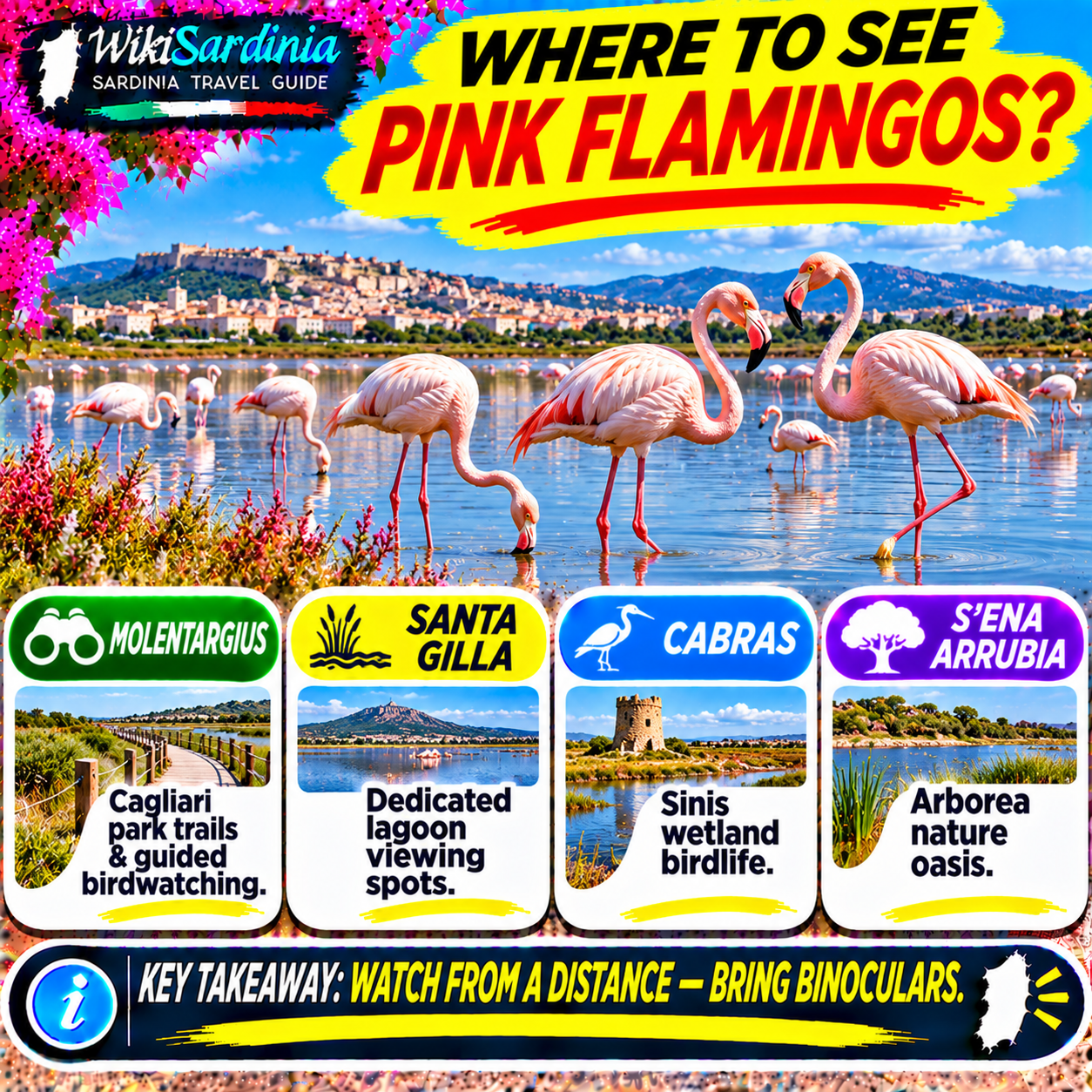
You can see pink flamingos in the wild near both Cagliari and Oristano, often without traveling far from town. For a first visit, the easiest choice is Molentargius-Saline Park beside Cagliari, where marked trails and guided birdwatching excursions help you find appropriate observation areas. Near Oristano, try the Cabras lagoon or the protected S'Ena Arrubia wetland near Arborea. These are free-living birds, not zoo animals: “up close” means a good view from a safe, permitted distance, ideally with binoculars or a zoom lens—not walking toward a flock.
Where are the best places to see flamingos?
The four most practical areas for travelers are Molentargius-Saline and Santa Gilla around Cagliari, plus Stagno di Cabras and S'Ena Arrubia in the Oristano region. All are documented flamingo habitats by SardegnaTurismo, the Sardinian regional tourism authority. Which produces the closest view on a particular day depends on water levels, feeding behavior, nesting restrictions and where the birds happen to be. Never promise a guaranteed encounter or a particular distance.
1. Molentargius-Saline Park: best first stop in Cagliari
Parco Naturale Regionale Molentargius-Saline lies between Cagliari and Quartu Sant'Elena, close to Poetto beach. Its former saltworks and freshwater basins are important feeding and nesting habitat for flamingos and many other waterbirds. The regional tourism authority describes free walking and cycling routes as well as organized visits by foot, bicycle, electric vehicle and, where operated, boat. Guided excursions may include observation hides facing the Bellarosa Maggiore area, where flamingos nest. SardegnaTurismo — Molentargius-Saline Park.
How do you visit Molentargius?
Begin at an official park entrance or visitor information point and ask which paths are currently open and where birds have recently been seen. The Città del Sale visitor area near Via La Palma, Cagliari is a useful starting point for information about guided experiences. Walking on designated public routes can be free, but a guided activity or bike rental may have a separate fee. Do not assume all nesting basins are publicly accessible. For current visits and rules, consult the Molentargius Park website before leaving.
2. Santa Gilla lagoon: flamingos on Cagliari's western side
The Stagno di Cagliari, often called the Laguna di Santa Gilla, is a broad wetland complex west of the city that includes the Capoterra lagoon and nearby salt pans. SardegnaTurismo identifies designated birdwatching observation positions along the road bordering the Capoterra lagoon, including the SS195 corridor. This can be a rewarding place to watch flamingos feeding, wading or flying over the water. SardegnaTurismo — Pond of Cagliari.
Can you stop beside the road to photograph flamingos at Santa Gilla?
Only at a lawful, safe parking or designated viewing area. Do not stop on a busy highway shoulder, cross barriers or walk onto working salt-pan embankments for a photograph. The lagoon is extensive, and a viewpoint that looks close on a map may be separated from the birds by water, channels or restricted industrial land. If you want an interpreted experience, check whether an authorized nature or saltworks tour is operating for your date. The best viewpoint is the one you can reach legally and without disturbing wildlife.
3. Stagno di Cabras: the classic Oristano-area wetland
Northwest of Oristano, the Stagno di Cabras is one of the Sinis Peninsula's defining wetlands. Regional tourism identifies it as habitat for nesting flamingos as well as ducks, marsh harriers, swamphens and other waterbirds. Visitors can observe from permitted public edges and appropriate birdwatching points, but this is a working and protected lagoon landscape rather than a single managed flamingo enclosure. Start in Cabras, ask locally for the currently accessible observation points and respect fishing facilities and protected shorelines. SardegnaTurismo — Stagno di Cabras.
Can you arrange a birdwatching guide near Cabras?
Yes. Local nature-tour operators in the Sinis area offer guided walks and other low-impact outings. For example, Alea Ricerca & Ambiente, based in Cabras, offers nature-focused activities in the area. Ask specifically for a flamingo and lagoon birdwatching outing, rather than assuming a generic coastal excursion will visit the best wetland viewpoints. Confirm the meeting point, duration, languages, cost and whether binoculars or a spotting scope are provided. Sightings still cannot be guaranteed.
4. S'Ena Arrubia: a quieter wetland near Arborea
Stagno di S'Ena Arrubia, south of Oristano near Arborea, is a protected coastal wetland surrounded by a pine forest and close to the beach. SardegnaTurismo specifically identifies pink flamingos among the migratory birds using this Ramsar-listed site and describes it as a birdwatching destination. The regional guide lists free admission to the wetland area, but this does not authorize entry into every reed bed or sensitive habitat. Follow existing public access routes and any local restrictions. SardegnaTurismo — S'Ena Arrubia.
Which place is best for seeing flamingos close enough to photograph?
Molentargius is the best all-round starting point for travelers staying in Cagliari because it combines an established park, visitor information and organized birdwatching. Santa Gilla is useful for a quieter, viewpoint-based stop if you know where it is safe to park. Cabras offers a rich lagoon landscape and access to local guides, while S'Ena Arrubia suits visitors exploring the Arborea coast. None can promise birds a few metres away. A spotting scope often gives a better experience than trying to move closer.
When is the best time of year?
Flamingos can be present in Sardinian wetlands across the year, particularly around Cagliari, where nesting colonies are established. Spring and early summer can be especially interesting for observing breeding-season activity, but some nesting areas may be closed or require greater distances to protect the birds. Autumn and winter can also reward birdwatchers, with changing water levels and bird movements. At S'Ena Arrubia, regional tourism particularly describes flamingos stopping during migration. Seasonal presence varies by wetland, so there is no universal “flamingo season” that guarantees a sighting.
What time of day is best?
Early morning and late afternoon are sensible choices for softer photography light, more comfortable temperatures and often quieter paths. However, feeding patterns depend on water conditions and other factors; no exact hour guarantees birds close to the bank. In summer, avoid long exposed walks at midday without water and sun protection. Check the park's current access hours rather than assuming a wetland is open around the clock because the birds live there.
Why are some flamingos pinker than others?
Flamingos obtain the pigments behind their pink coloration from carotenoids in their diet, including small aquatic organisms. Young birds are generally greyer, and the intensity of adults' pink coloration can vary. A pale flamingo is not necessarily sick, and a very pink bird is not evidence that it belongs to a different species. The species commonly seen in Sardinia is the greater flamingo (Phoenicopterus roseus).
Can you see baby flamingos?
Breeding occurs in protected colonies, notably around Cagliari. Chicks are not bright pink like adults, and nesting sites may be deliberately kept distant from public trails. Never approach a nest, cross a closure or fly a drone over a breeding colony to get a better photograph. If seeing nesting activity is important, choose an authorized guided excursion with suitable optics and ask whether the season and access rules permit viewing from an approved hide.
Are flamingos dangerous?
They are generally not a danger to visitors observing from a respectful distance. The greater concern is disturbing the birds, particularly when they are feeding or breeding. Do not chase them, try to feed them or enter shallow water to approach a flock. Keep dogs under control where permitted, and follow site-specific pet restrictions. If the birds stop feeding, move away or take flight because of your presence, you are too close.
Can you photograph flamingos with a phone?
Yes, especially if a flock is relatively near a permitted observation point, but phone cameras may make distant birds appear tiny. Binoculars help you enjoy the experience, while a camera with a telephoto lens gives better close-up photographs without disturbing wildlife. A lightweight tripod or monopod may help if allowed. Avoid loud behavior and flash, and never trespass for a better composition. Sometimes a wide landscape photograph showing the lagoon and birds is more evocative than a close-up.
Is flamingo watching suitable for children?
Yes. It can be an easy and memorable wildlife activity if you choose a manageable public path or an organized family-friendly tour. Molentargius is especially convenient because of its visitor infrastructure. Bring water, hats and sun protection, and explain that the flamingos are wild birds that must not be approached. Wetland paths may have uneven ground, open water or limited shade. Ask the park or guide about stroller and wheelchair access on the specific route rather than assuming the whole reserve is step-free.
Do you need a ticket or guide?
Not always. SardegnaTurismo describes free public routes at Molentargius, and the S'Ena Arrubia destination page lists free admission. The Santa Gilla and Cabras wetlands also have publicly accessible observation opportunities, subject to local access rules. Guided tours, rentals and specialist birdwatching experiences may cost extra. Prices, operating days and access restrictions change, so consult the managing authority or provider for the date you intend to visit.
Can you visit Cagliari and Oristano lagoons in one day?
It is technically possible to travel between the regions by car, but they are far enough apart that combining all four wetlands in one day would turn a relaxing wildlife experience into a driving itinerary. If you are based in Cagliari, prioritize Molentargius and perhaps Santa Gilla. If you are based in Oristano, choose Cabras and S'Ena Arrubia. Wildlife watching benefits from patience; two well-chosen stops usually beat rushing through four.
What should you bring?
- Binoculars or a camera zoom: the best way to see details without approaching birds.
- Comfortable closed shoes: paths may be dusty, muddy or uneven.
- Water, hat and sun protection: lagoon paths often have limited shade.
- A map of permitted access points: not every shore or salt-pan track is public.
- Patience: birds move freely, and a particular viewpoint may be quiet when you arrive.
Useful Italian phrases
“Dove si possono vedere i fenicotteri rosa?” — Where can we see pink flamingos? “C'è un punto di osservazione?” — Is there a viewing point? “Ci sono visite guidate per il birdwatching?” — Are there guided birdwatching tours? “È possibile noleggiare un binocolo?” — Can we rent binoculars? “Quali sentieri sono aperti?” — Which paths are open? “Ci sono fenicotteri oggi?” — Are there flamingos here today?
Official sources and further reading
SardegnaTurismo — Birdwatching in the Kingdom of the Pink Flamingos; SardegnaTurismo — Molentargius-Saline; SardegnaTurismo — Santa Gilla and Cagliari lagoon; SardegnaTurismo — Cabras lagoon; SardegnaTurismo — S'Ena Arrubia; Molentargius Park — visitor information. These sources confirm the wetlands as flamingo habitats, but they do not provide live sightings or guarantee proximity on any particular date.
The WikiSardinia takeaway
For the easiest flamingo-watching experience in Cagliari, start at Molentargius. Near Oristano, begin with Cabras or S'Ena Arrubia. Santa Gilla is another excellent Cagliari-area option if you use designated observation points. Go in the cooler hours, bring binoculars and stay on authorized paths. Sardinia's flamingos are most impressive when you let them behave naturally—not when you try to get physically close.